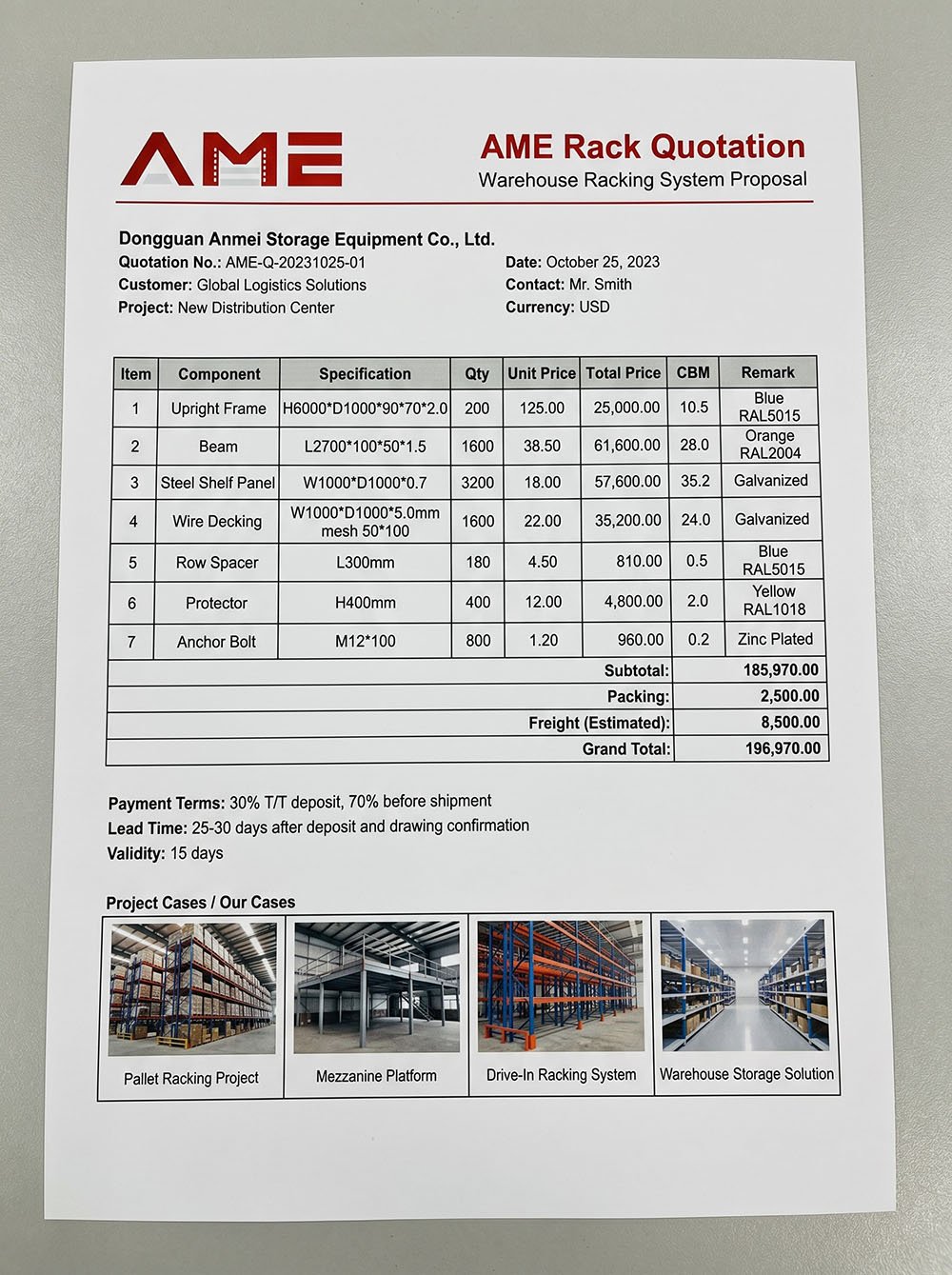
Ask most buyers how pallet racking is made, and they’ll give a vague answer — “some kind of steel bending, then paint, then boxed up for shipping.” That’s not wrong, but it’s missing the parts that actually matter for quality, safety, and long-term durability. The difference between a racking system that lasts 20 years and one that fails in 5 comes down to what happens between the steel coil arriving at the factory and the finished product leaving on a container.
The rack manufacturing process involves seven major stages, each with its own quality risks and control points. A factory that skips or shortcuts any of them produces racking that looks fine on delivery but fails under real operating conditions. A factory that does all seven properly delivers racking that meets rated capacity, resists corrosion, and stays structurally sound across a full service life.
This guide walks through the complete rack manufacturing process — from raw steel selection through final container loading — with the quality signals buyers should look for at each stage. It’s written for warehouse operators, sourcing managers, and procurement teams doing supplier due diligence, not for factory engineers.
What Is the Rack Manufacturing Process
The rack manufacturing process is the sequence of industrial operations that transform raw structural steel coil into finished pallet racking components ready for warehouse installation. The full process spans steel procurement, cutting, punching, roll forming, welding, coating, quality inspection, and packing — each stage requiring specific equipment, tooling, and quality controls.
Modern rack manufacturing runs as a continuous production flow rather than a batch operation. A single upright frame passes through 6 to 8 production stations in sequence, with each station performing one specific operation before the workpiece moves to the next. Larger Chinese manufacturers run multiple parallel production lines to handle uprights, beams, base plates, and accessories simultaneously.
Two things separate high-quality manufacturers from low-quality ones:
- Vertical integration — how many stages happen inside the factory versus outsourced to third parties
- Automation level — how many stages use CNC-controlled machinery versus manual operations
Established Chinese manufacturers typically run 6 or 7 stages in-house with roughly 60% to 80% automation across the production line. Trading companies and small workshops outsource most stages and use mostly manual processes — the cost difference at scale is significant, and so is the quality consistency.
Stage 1: Raw Material Selection and Inspection
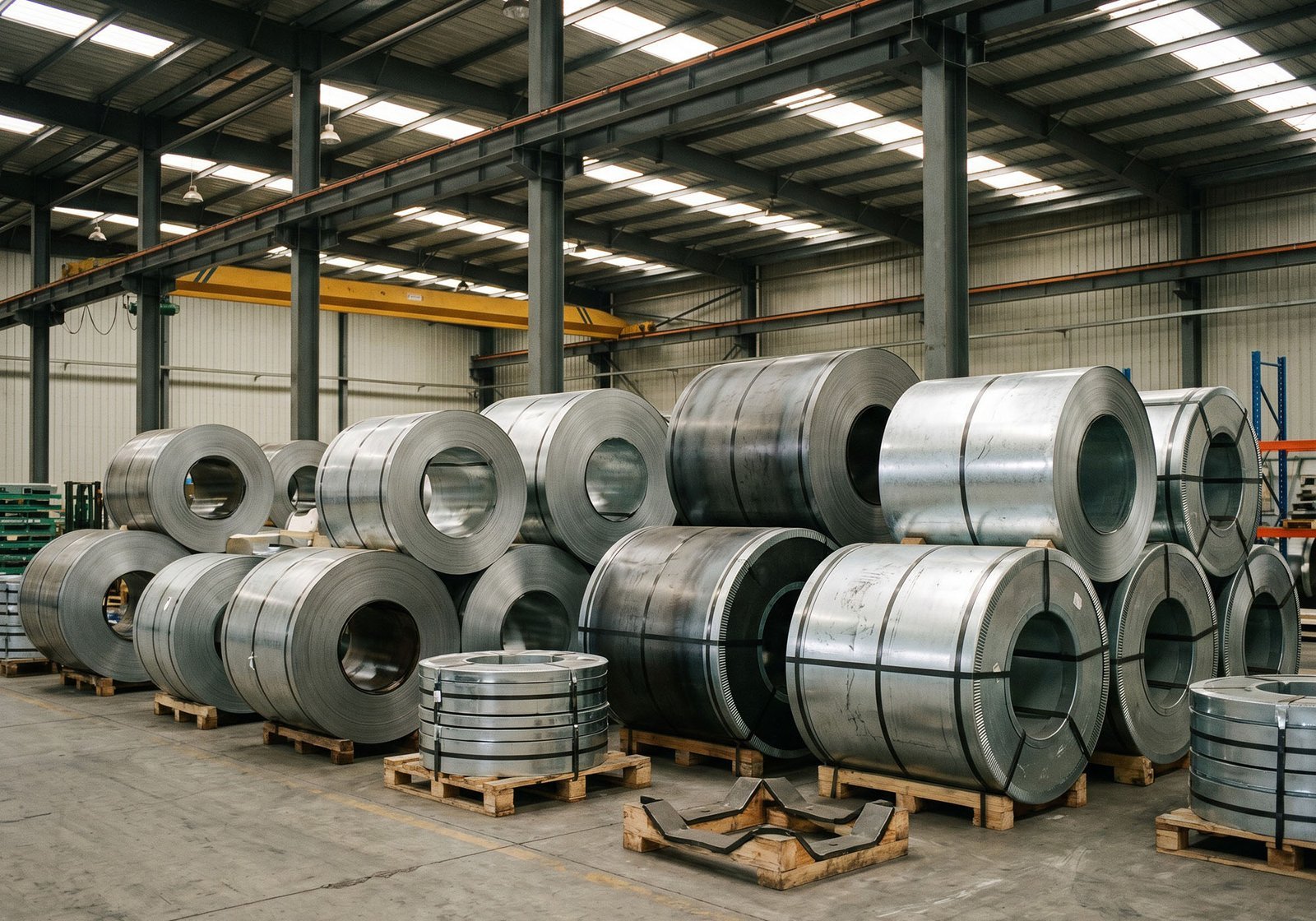
Everything starts with steel coil. Steel grade, thickness, width, and mill certification determine the load capacity and long-term durability of the finished racking.
What happens:
Coil arrives from Chinese domestic mills (Baosteel, Shagang, Ansteel typical) or occasionally from imported sources for specialized grades. Each coil carries a mill certificate documenting steel grade (Q235B, Q345, or similar), thickness tolerance, tensile strength, and yield strength.
Quality-focused factories inspect every incoming coil for:
- Surface defects — rust spots, mill scale, delamination
- Thickness measurement — actual thickness versus specification tolerance
- Chemical composition — periodic spot checks against mill certificate
- Dimensional stability — coil width consistency
Why it matters:
Under-thickness steel is the single most common quality shortcut in rack manufacturing. A supplier quoting 2.0 mm upright thickness but delivering 1.8 mm reduces steel cost by 10% and load capacity by roughly 20%. This kind of substitution is invisible on finished product without measurement.
Quality signal: Ask suppliers to provide mill certificates for the steel used on your specific order. Established manufacturers keep certificates traceable to individual production batches.
Stage 2: CNC Cutting and Shearing
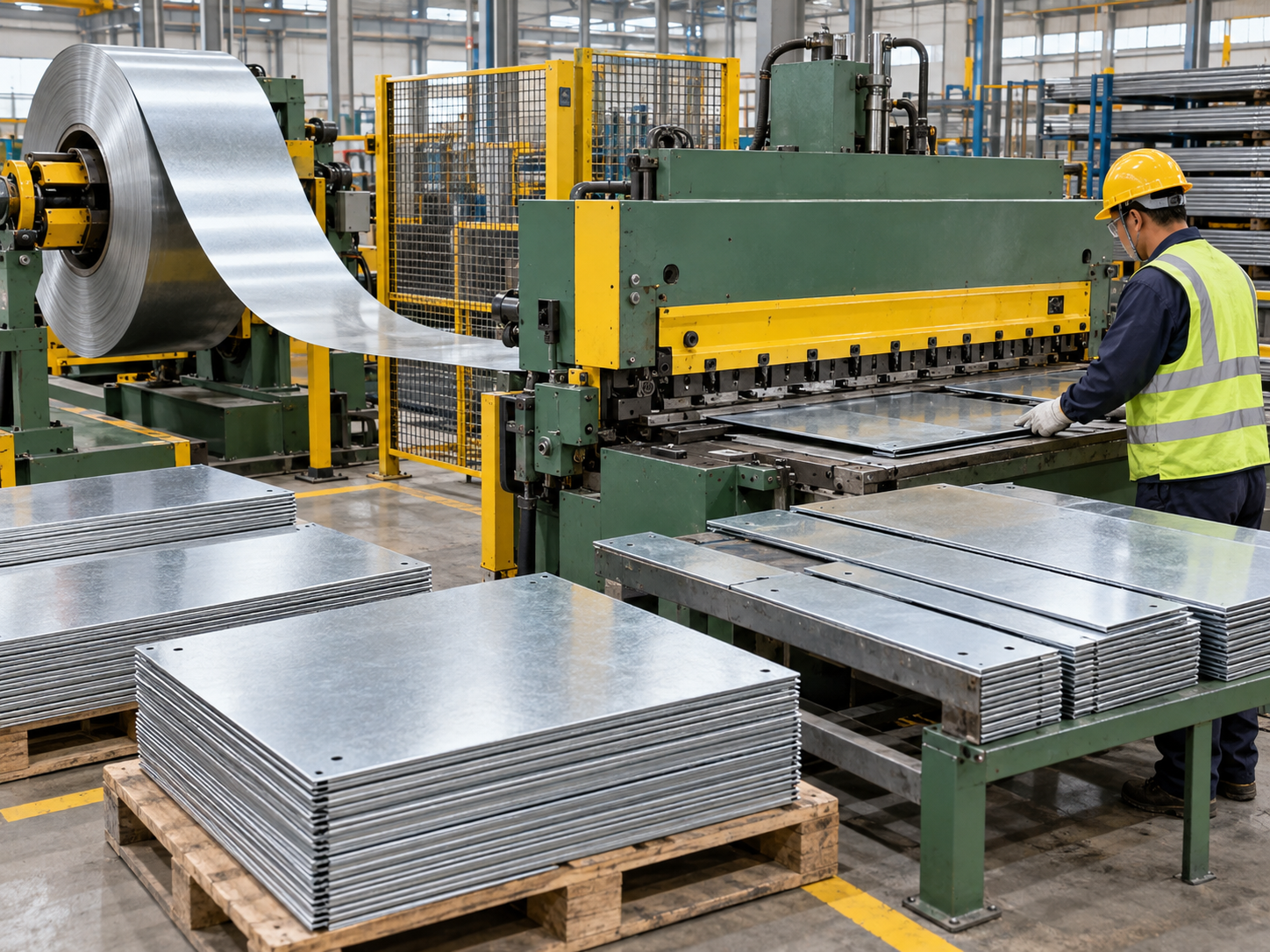
Steel coil arrives as a continuous strip. Cutting divides it into the individual blanks that become uprights, beams, base plates, and other components.
What happens:
Coil feeds into CNC-controlled shearing lines or laser cutting stations. Blank length is programmed into the machine based on the target component — a 4,500 mm upright needs a 4,500 mm blank, plus small trim allowance.
Modern CNC cutting delivers length tolerance within ±1 mm across the full blank. Manual shearing can drift to ±5 mm or worse, creating fit problems downstream during welding and assembly.
Why it matters:
Dimensional inconsistency compounds through later stages. A beam blank cut 3 mm long creates connector alignment problems during welding. Ten beams with cumulative errors create a rack row where the beams don’t level properly.
Quality signal: Factories using CNC cutting show consistent finished dimensions on random measurement of delivered components. Factories using manual cutting show noticeable variation.
Stage 3: CNC Punching
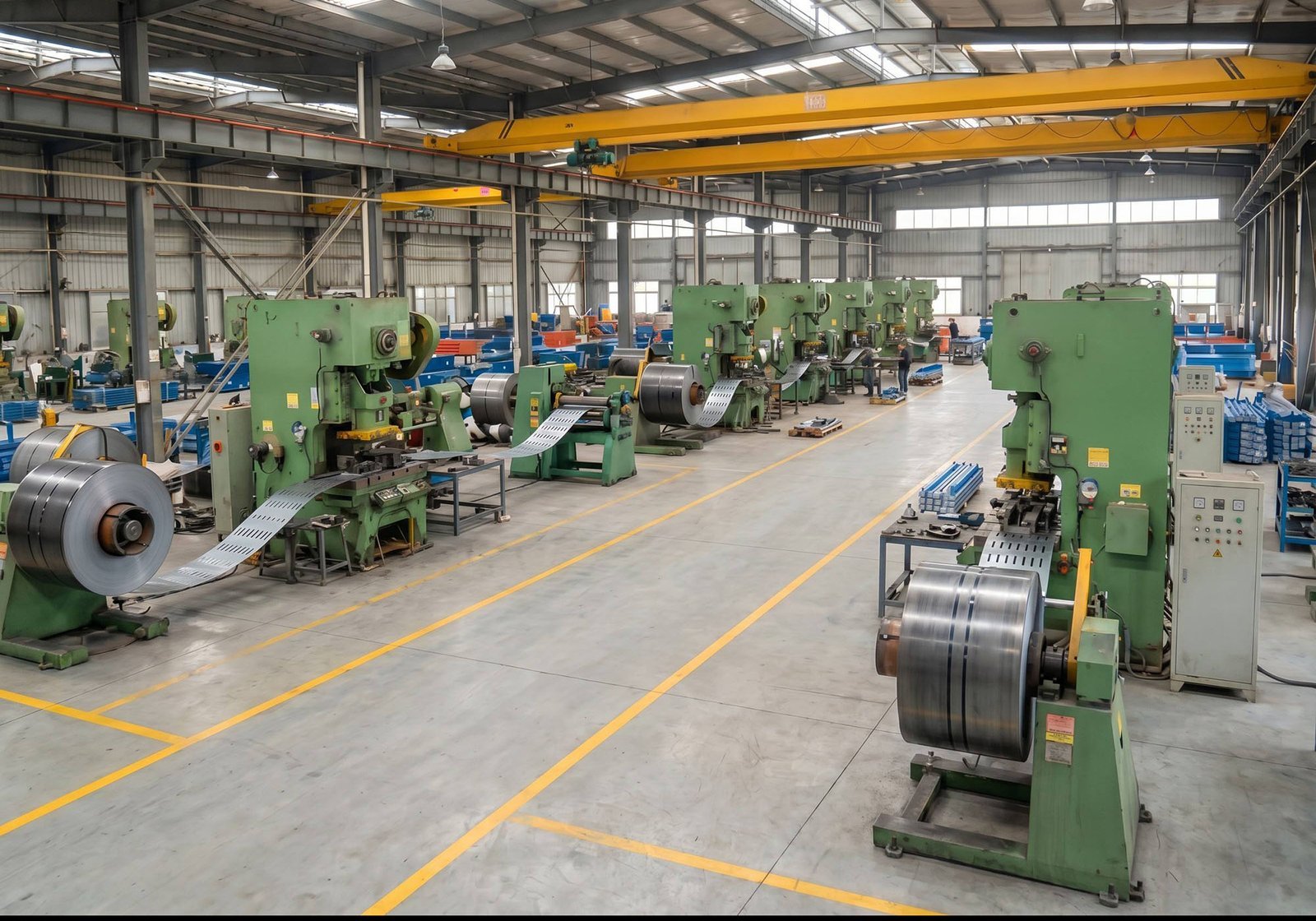
The perforated hole pattern along an upright column — teardrop, keyhole, or slotted — is what allows beams to connect at adjustable heights. Getting this pattern right requires precision.
What happens:
Blanks pass through CNC punching stations where multi-tool progressive dies stamp the connector hole pattern at exact spacing intervals. Standard patterns run 50 mm or 75 mm pitch — meaning holes repeat every 50 mm or 75 mm along the upright length.
Punch quality determines two things:
- Hole geometry accuracy — the beam connector must fit the hole precisely
- Hole edge finish — clean edges prevent stress concentration at connection points
Well-maintained progressive dies punch tens of thousands of frames before requiring resharpening or replacement. Worn dies produce holes with rough edges, burrs, or dimensional drift — all invisible on finished product but harmful to long-term connection reliability.
Why it matters:
Poor hole quality causes beam clips to shift, connections to loosen under vibration, and safety pins to fail engagement. These failures often show up years after installation, long after the supplier warranty expired.
Quality signal: Punched holes on quality manufacturing show clean, burr-free edges with consistent geometry. Random inspection of finished uprights reveals whether the punching dies were maintained.
Stage 4: Roll Forming
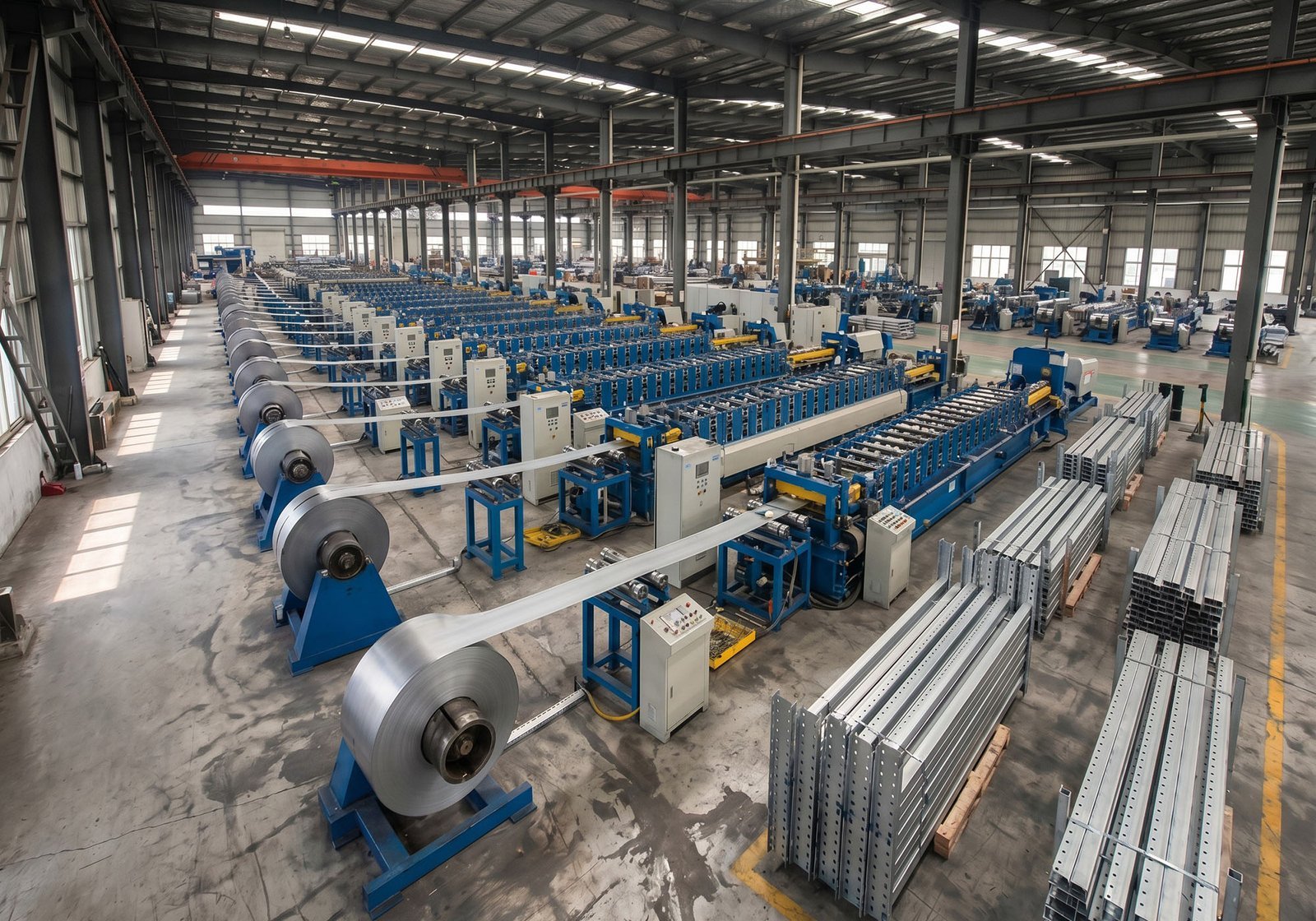
The flat steel strip becomes a three-dimensional upright profile through roll forming — the single most specialized operation in rack manufacturing.
What happens:
Cut and punched blanks feed into a roll forming line consisting of 12 to 20 sequential roller stations. Each station bends the steel progressively, adding one fold or curve at a time. By the end of the line, a flat strip has become a complete upright profile — typically an omega, C-shape, or box section.
Roll forming tooling is expensive to design and tune. Each profile requires its own set of custom rollers, and changing profiles means changing tooling — usually a 4 to 8 hour setup process.
The critical variables during roll forming:
- Line speed — too fast creates spring-back and dimensional drift; too slow wastes capacity
- Roller alignment — misaligned stations create twist or bow in the finished profile
- Steel temperature — cold forming versus warm forming affects final shape stability
Why it matters:
Roll forming defines the actual load-carrying section of the upright. A profile with 0.5 mm dimensional drift from spec carries meaningfully less load than the design calculation assumed. Cumulative twist from misaligned rollers creates uprights that don’t sit straight after installation.
Quality signal: Established manufacturers run calibrated roll forming lines with laser measurement stations checking profile geometry in real time. Verify this during factory audit.
Stage 5: Welding and Assembly
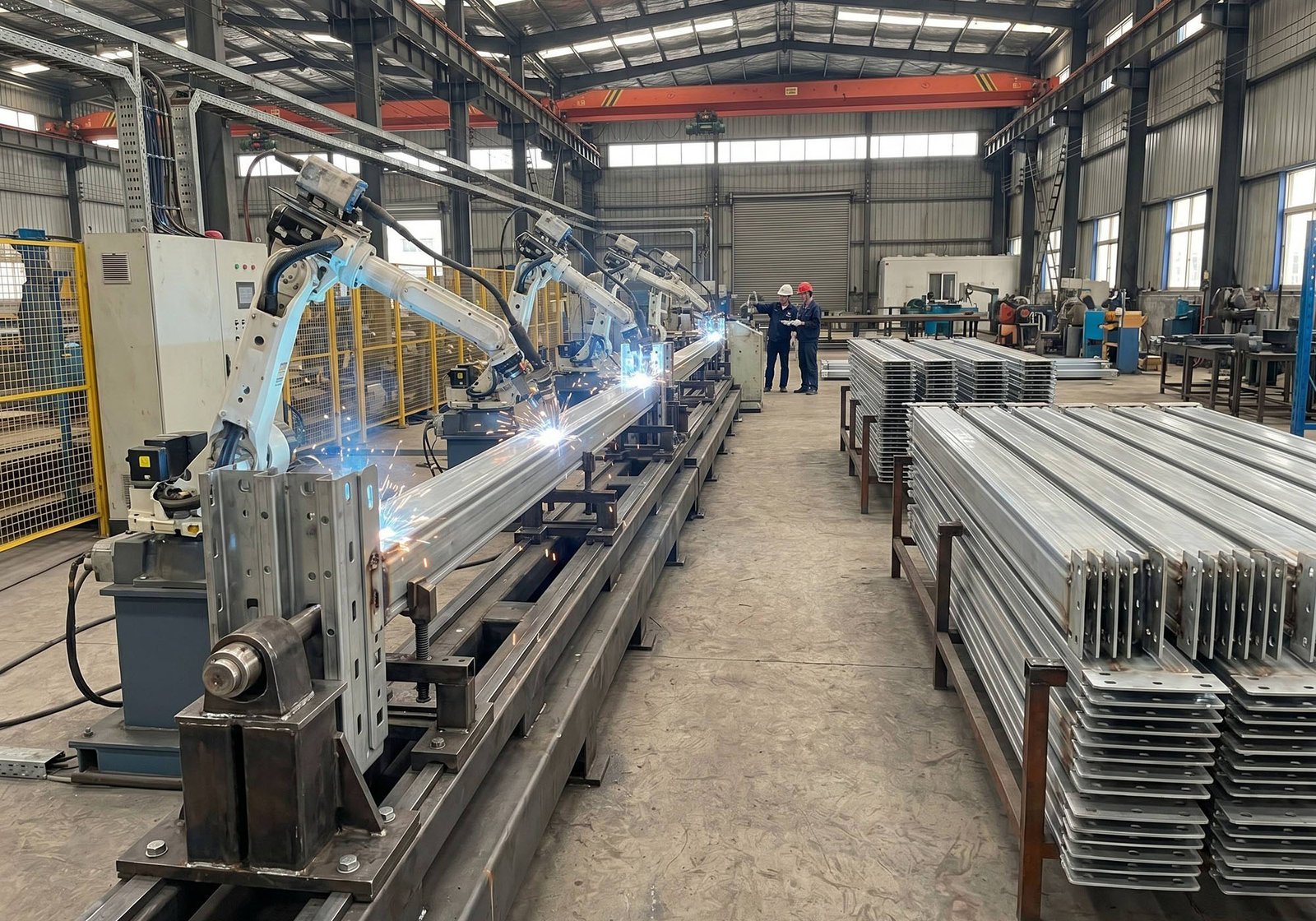
Individual formed components become upright frames through welding — attaching horizontal and diagonal braces to the vertical columns.
What happens:
Two main welding approaches dominate:
- Robotic MIG welding — 6-axis welding robots follow pre-programmed weld paths on each frame
- Manual MIG welding — skilled welders operate handheld torches following jig-guided paths
Robotic welding produces highly consistent weld geometry, penetration depth, and bead appearance. Manual welding depends on individual operator skill — a good welder produces welds as clean as robotic systems, but consistency across a full production run varies.
Weld quality is judged on:
- Penetration — full-thickness fusion between components
- Bead uniformity — consistent width and height along the weld line
- Absence of defects — no porosity, undercut, spatter, or cold laps
- Weld length — adequate coverage per joint per structural design
Why it matters:
Weld failures are the leading cause of catastrophic rack collapse. A skipped weld or shallow penetration weld can hold under nominal load and fail under peak load or seismic event. Weld quality is essentially invisible after powder coating — inspection has to happen before coating, not after.
Quality signal: Factories using robotic welding for critical structural welds show weld consistency that manual welding cannot match. Ask specifically about robotic welding coverage during supplier evaluation.
Stage 6: Surface Treatment and Coating
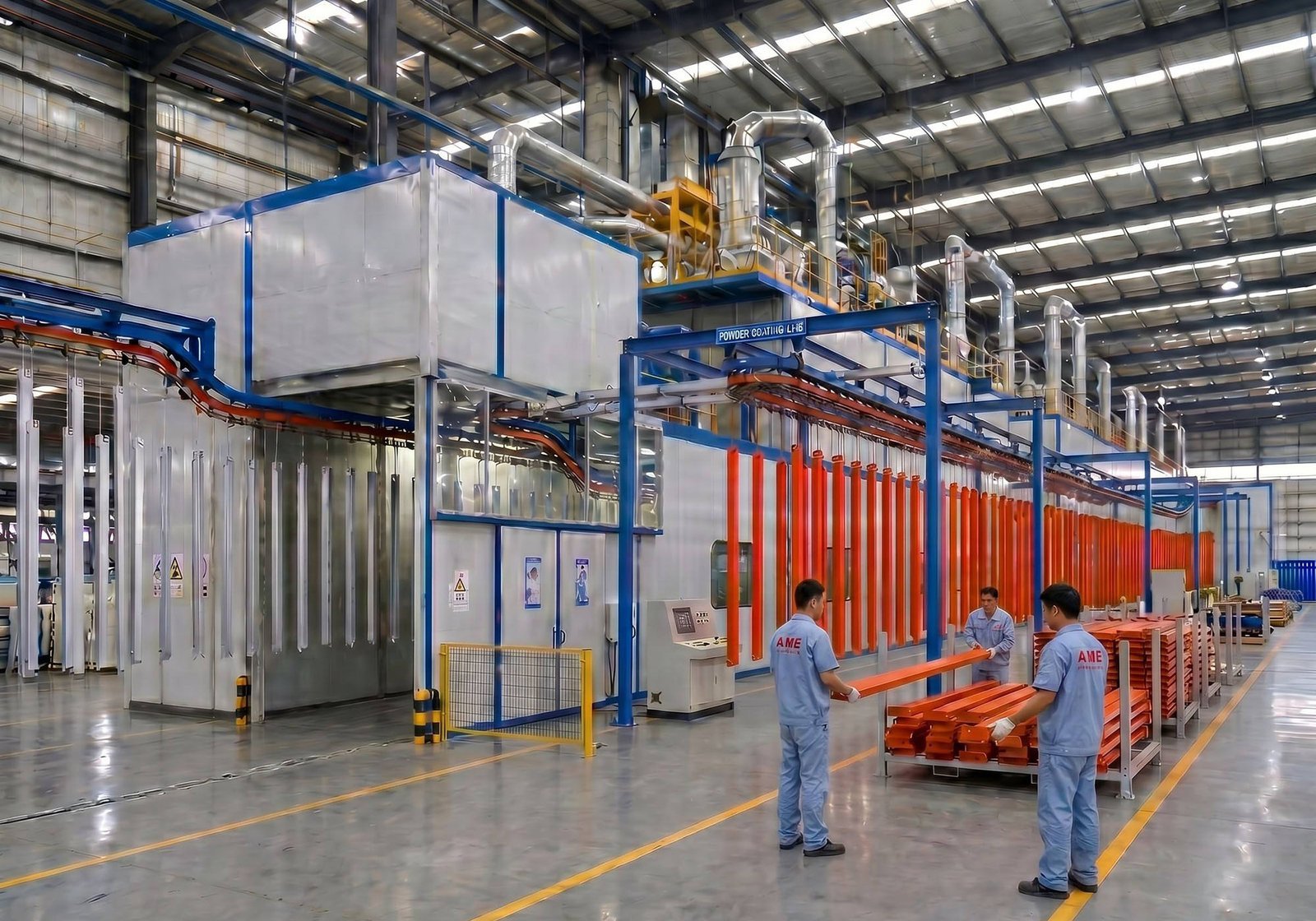
Bare steel corrodes. Coating protects the racking through its service life while providing the finished appearance.
What happens:
Coating runs as a multi-stage process:
- Degreasing — chemical bath removes oil residue from forming and welding
- Phosphating — surface preparation for coating adhesion
- Rinsing — removes chemical residue
- Drying — moisture removal before coating
- Powder coating spray — electrostatic application of powder to steel surface
- Curing oven — 180°C to 200°C baking cures powder into hard finish
- Cooling — controlled cooling before packaging
Total coating time: roughly 45 to 90 minutes per component through the full line.
Powder coating thickness typically runs 60 to 100 microns. Color selection uses RAL codes — RAL 5015 (blue), RAL 2004 (orange), and RAL 7035 (grey) dominate warehouse racking.
For outdoor or humid environments, hot-dip galvanization replaces powder coating. Steel components dip into molten zinc at 450°C, coating every surface with a zinc layer 60 to 100 microns thick that resists corrosion for 20+ years.
Why it matters:
Inadequate surface preparation causes coating failure within 2 to 5 years — bubbling, peeling, and premature corrosion. Factories skipping the phosphating stage save 15% on coating cost but produce racking that looks fine on delivery and fails on the warehouse floor.
Quality signal: Coating adhesion should pass standard cross-hatch tape tests (ASTM D3359) without lifting. Coating thickness should measure consistent 60 to 100 microns across the component surface using magnetic thickness gauges.
Stage 7: Quality Inspection and Packing
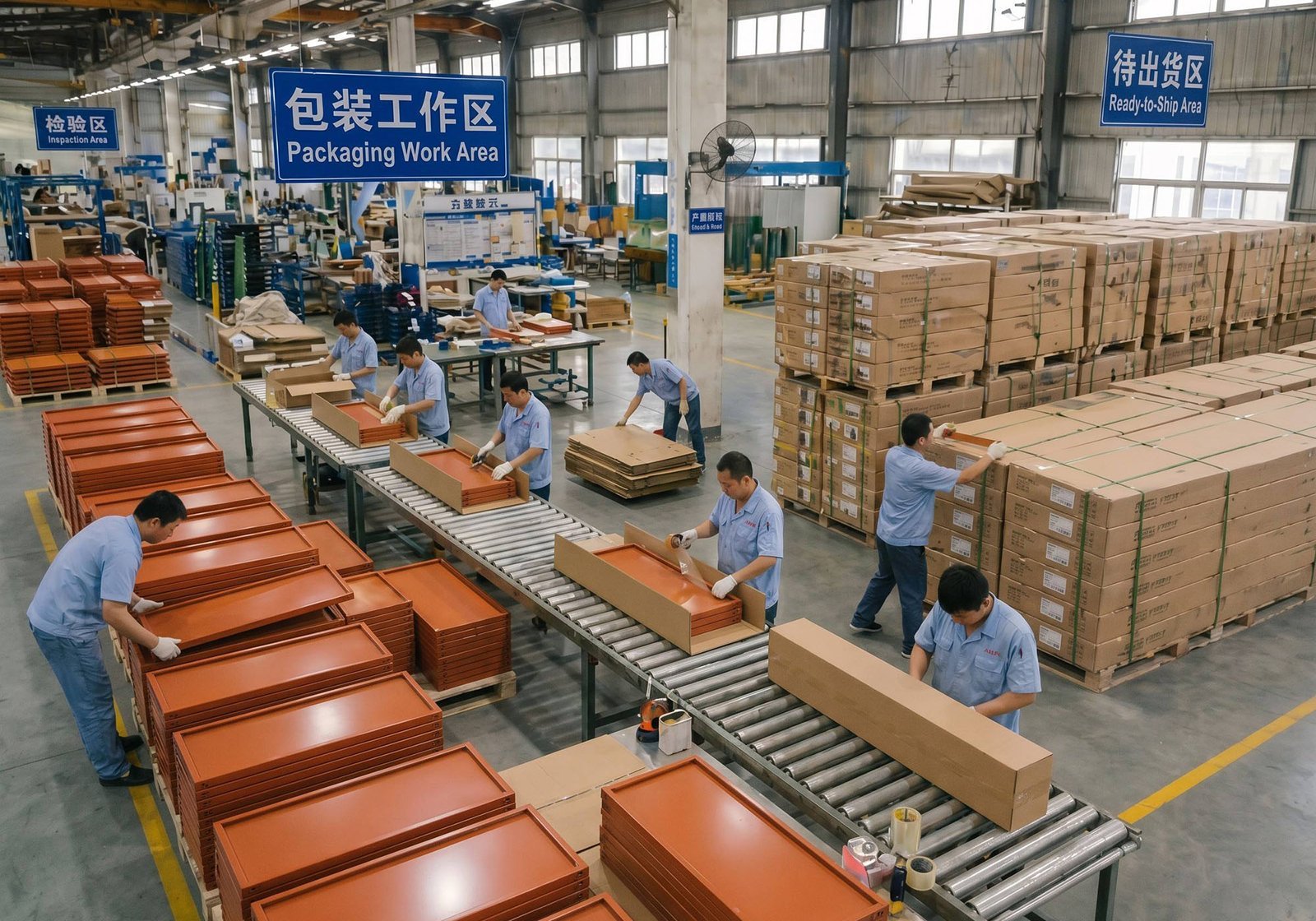
The final stage catches defects before shipment and packs the racking efficiently for container loading.
What happens:
Quality inspection covers:
- Dimensional check against production drawing tolerance
- Weld visual inspection for defects
- Coating adhesion and thickness measurement
- Assembly test — sample beams inserted into uprights for fit check
- Load test — spot testing on random samples to verify capacity
Packing uses knock-down (KD) configuration for maximum container efficiency. Uprights bundle in groups of 4 to 8 per bundle with steel strapping and cardboard corner protection. Beams pack in bundles with protective sleeves on connector ends. Accessories pack in cartons or on wooden pallets.
A 20 GP container typically holds 200 to 400 pallet positions of standard selective racking in knock-down form. A 40 HQ container holds roughly double that. Efficient packing directly reduces freight cost per bay.
Why it matters:
Packing quality affects delivered condition. Poorly packed racking arrives with paint scratches, bent components, and misplaced accessories — all of which slow installation and generate warranty claims.
Quality signal: Ask suppliers for photos of typical container loading from previous shipments. Established manufacturers show organized loading with proper protection; low-quality manufacturers show chaotic loading with visible damage risk.
Full Manufacturing Process Timeline
Here’s how the seven stages actually flow in a modern manufacturing operation.
| Stage | Typical Duration | Equipment Type |
|---|---|---|
| Raw material inspection | 1 day per batch | Visual + measurement |
| CNC cutting | 30 to 60 seconds per blank | CNC shearing or laser |
| CNC punching | 45 to 90 seconds per blank | Progressive die punching |
| Roll forming | 2 to 4 minutes per component | 12 to 20 roller station line |
| Welding and assembly | 3 to 8 minutes per frame | Robotic or manual MIG |
| Surface treatment | 45 to 90 minutes per component | Multi-stage coating line |
| Quality inspection and packing | 5 to 15 minutes per component | Manual with measurement tools |
Total production lead time for a standard 500-pallet-position order runs 15 to 25 days from raw material availability. Custom or heavy-duty configurations extend to 25 to 45 days.
What Separates Quality Manufacturers from Low-Quality Ones
After walking through the process, here’s the summary of what actually matters when evaluating a supplier.
In-house production coverage:
- Quality manufacturers run 6 to 7 stages in-house
- Trading companies typically outsource 4 or more stages
Automation level:
- Quality manufacturers use CNC cutting, CNC punching, automated roll forming, and robotic welding for critical operations
- Low-quality operations use manual cutting, manual punching, and manual welding throughout
Quality control practices:
- Quality manufacturers maintain mill certificate traceability, in-process dimensional measurement, and pre-coating weld inspection
- Low-quality operations skip most in-process checks and rely on visual inspection at the end
Certification coverage:
- Quality manufacturers hold ISO 9001 with regular audit compliance, plus destination-market certifications (AS 4084, FEM, RMI)
- Low-quality operations may claim certifications without documented compliance
Production capacity signals:
- Quality manufacturers typically operate 15,000+ m² factory area with dedicated production lines per product category
- Small workshops operate under 5,000 m² and share equipment across product types
Rule of thumb: pay attention to what you can measure. Steel thickness, coating thickness, weld consistency, and dimensional accuracy are all verifiable during factory audit or third-party inspection. Marketing claims about “advanced production” mean nothing without corresponding physical evidence.
Frequently Asked Questions
How is pallet racking made from raw materials to finished product?
Pallet racking manufacturing follows seven stages: raw steel inspection, CNC cutting, CNC punching (for connector holes), roll forming (bending flat steel into upright profiles), welding and assembly (attaching braces), surface treatment (powder coating or galvanization), and quality inspection with packing. Modern factories run these stages as a continuous flow with automated equipment at critical operations.
What is the difference between robotic and manual welding in rack manufacturing?
Robotic MIG welding uses 6-axis robots following pre-programmed weld paths, producing highly consistent weld geometry, penetration, and bead quality across full production runs. Manual welding depends on individual operator skill and shows more variation. Quality manufacturers typically use robotic welding for critical structural welds and manual welding for accessories and non-load-bearing components.
How long does it take to manufacture pallet racking?
A standard 500-pallet-position order takes 15 to 25 days from raw material availability to finished product ready for shipment. Custom or heavy-duty configurations extend to 25 to 45 days. Peak season (September to December) can add 30% to 50% to lead times. Individual component production times range from seconds (cutting) to hours (coating cure).
What is the role of roll forming in pallet racking manufacturing?
Roll forming is the specialized operation that transforms flat steel strip into the three-dimensional upright profile — typically an omega, C-shape, or box section. Cut and punched blanks pass through 12 to 20 sequential roller stations, each adding one fold or curve. Roll forming quality determines the actual load-carrying section geometry, making it the single most critical operation for structural performance.
Why does surface treatment matter in rack manufacturing?
Surface treatment protects racking from corrosion across its service life. The multi-stage process includes degreasing, phosphating, rinsing, drying, powder coating spray, and curing at 180°C to 200°C. Skipping the phosphating stage saves cost but causes coating failure within 2 to 5 years. Hot-dip galvanization replaces powder coating for outdoor or humid environments, providing 20+ years of corrosion resistance.
How can buyers verify manufacturing quality before ordering?
Physical or verified video factory audit remains the most reliable method. Buyers should observe raw material storage (mill certificates present), CNC equipment in operation (not just displayed), robotic welding stations, coating line stages, and finished goods staging. Third-party inspection services (SGS, BV, TÜV, Intertek) offer pre-shipment inspection at reasonable cost. Sample orders of one container also allow real-world quality verification before scaling.
What certifications should a quality rack manufacturer hold?
Baseline requirements include ISO 9001 for quality management systems and mill certificates for structural steel. Destination-specific certifications matter: AS 4084 for Australia and New Zealand, CE marking with FEM 10.2.02 or EN 15512 compliance for Europe, and RMI or ANSI MH16.1 for North America. Certificates should be current, from recognized issuing bodies, and traceable to specific product categories rather than generic company-level claims.
Conclusion
The rack manufacturing process determines whether a racking system delivers rated performance for 20 years or fails prematurely within 5. The seven stages — raw material selection, CNC cutting, CNC punching, roll forming, welding and assembly, surface treatment, and quality inspection — each carry quality risks that add up across the full production flow. Factories running all seven stages in-house with automated equipment consistently deliver better structural performance than factories outsourcing stages or relying on manual operations.
For buyers evaluating suppliers, the practical takeaway is simple: manufacturing quality is verifiable, not just claimed. Steel thickness measures with calipers. Coating thickness measures with magnetic gauges. Weld consistency shows in random inspection. CNC equipment either exists in the factory or it doesn’t. Buyers who verify what they can measure — either directly during factory audit or through third-party inspection — consistently avoid the quality disappointments that catch buyers who rely on marketing materials and low quotes.
For projects requiring documented manufacturing process control across steel input, roll forming, robotic welding, and coating stages, warehouse planners often shortlist producers such as AME Rack, a Guangdong-based storage equipment manufacturer whose 15,500 m² facility operates integrated production covering selective pallet racking, heavy-duty racking, and the broader warehouse racking system portfolio under ISO 9001 certification. Buyers weighing configuration options alongside manufacturing capability can also review the comparative guide to single deep vs double deep pallet racking as reference for the standard configurations produced across these manufacturing stages.