Most people know what pallet racking looks like — the tall metal frames and the long horizontal beams. That’s the visible part. But what actually makes a racking system work, last, and stay safe over 15 years of operation? All the smaller pieces bolted, clipped, welded, or dropped onto that frame.
Pallet rack accessories and components are where good warehouses get separated from struggling ones. A rack with the wrong beam type sags. A rack without column protectors gets destroyed by forklifts in a year. A rack missing wire decking either loses pallets through the gaps or fails fire code inspection. The main frame gets the credit, but the accessories do a lot of the heavy lifting.
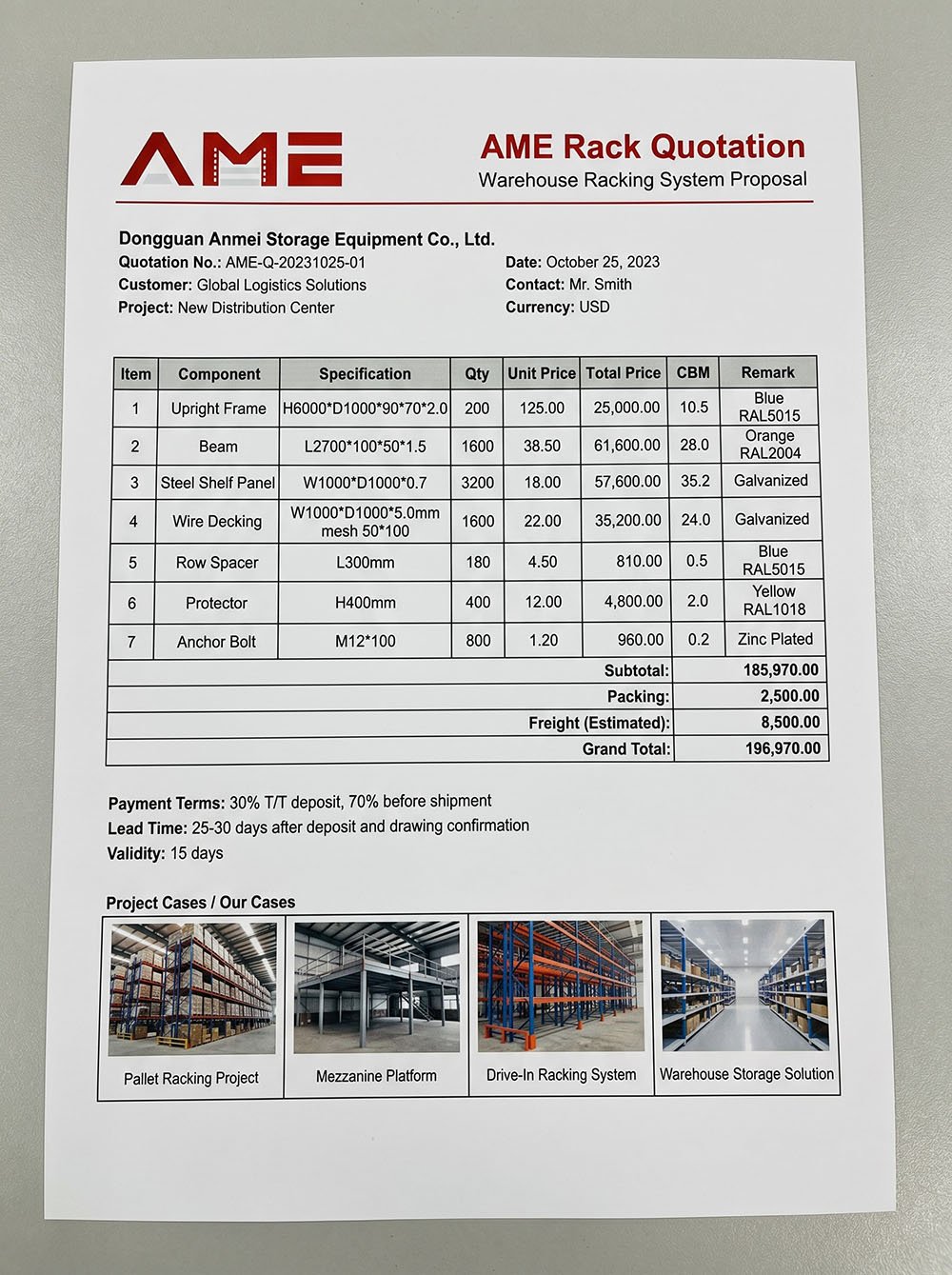
This guide walks through every major pallet rack component and accessory — what each one does, when it’s necessary, and how to know if a supplier’s quotation includes it or hides it as an added-cost extra. By the end, warehouse teams should be able to read any pallet racking quotation and spot exactly what’s included, what’s missing, and what’s worth paying for.
What Are Pallet Rack Accessories and Components
Pallet rack accessories and components are the structural, safety, and functional parts that make a complete pallet racking system — everything from the main upright frames and load beams that carry the load, to the protectors, decking, gates, and hardware that keep the system safe and functional in daily use.
The distinction matters because “racking” often gets quoted as just the frames and beams. The reality is that a working racking installation needs 15 to 25 different components and accessories. Some are structural (the system won’t hold up without them), some are safety-required (building code demands them), and some are optional but strongly worth having.
Here’s the mental model that helps: think of pallet racking components in four groups.
- Structural core — the parts that carry the load
- Deck and support surfaces — what the pallets actually rest on
- Safety and protection — parts that prevent damage and injuries
- Access and workflow — parts that support material handling
Everything else on any quotation fits into one of these four buckets. When comparing two quotes, checking that every bucket is fully covered — and priced consistently — is how buyers avoid nasty surprises after delivery.
Structural Core Components
These are the parts that hold up the weight. If any of them is undersized or missing, the whole system fails.
Upright Frames
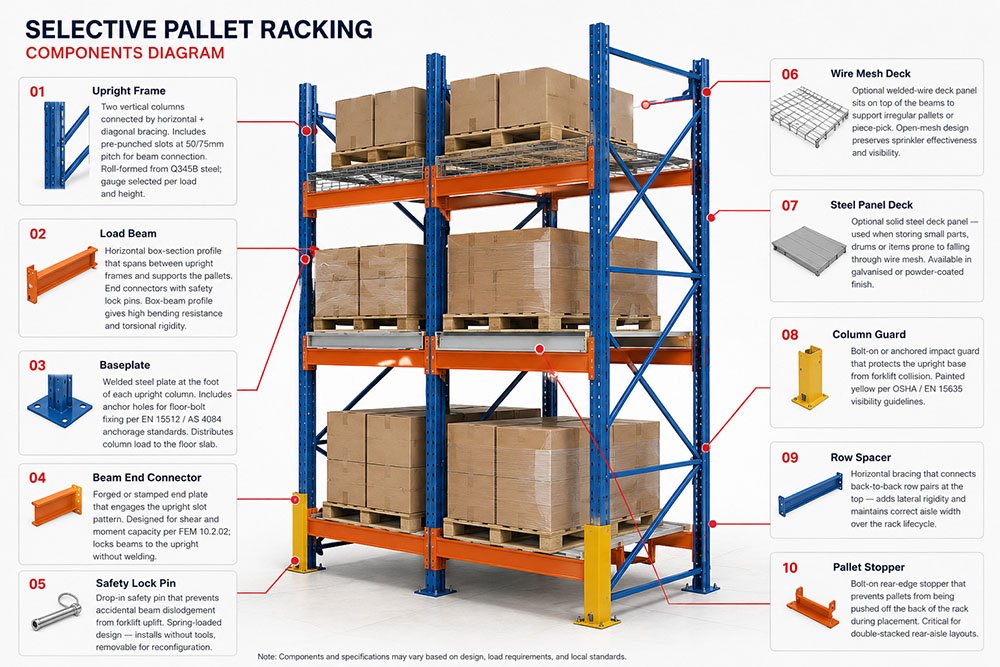
The vertical columns that carry all the load down to the floor. An upright frame is actually a pre-assembled unit — two vertical columns connected by horizontal and diagonal bracing, welded or bolted together.
Common upright profiles range from 76 × 55 mm (light-duty) to 120 × 95 mm (heavy-duty), with steel thickness from 1.5 mm to 2.5 mm. Section size and thickness determine load capacity per bay.
Key specifications to check: profile dimensions, steel grade (Q235B or Q345), thickness, hole pattern (teardrop, keyhole, or slotted), and welded versus bolted bracing.
Load Beams
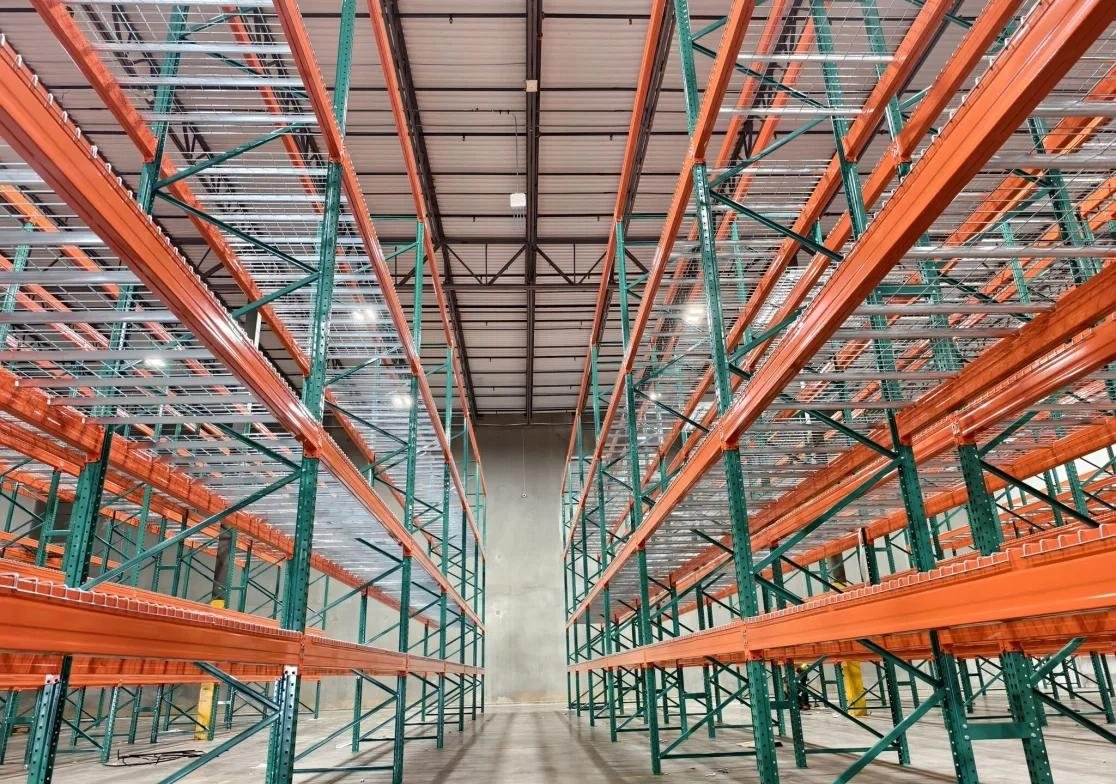
The horizontal beams that connect between two upright frames and actually hold the pallets. Three main profiles dominate:
- Box beam — rectangular hollow section, high torsional strength, most common
- Step beam — designed to accept wire decking cleanly, common in North America
- Structural C-beam — for very heavy loads, uses hot-rolled C-section
Beam length runs from 1,500 mm to 3,900 mm, and beam depth from 90 mm to 200 mm. Longer beams need deeper profiles to maintain load capacity and limit deflection.
Safety Pins and Beam Clips
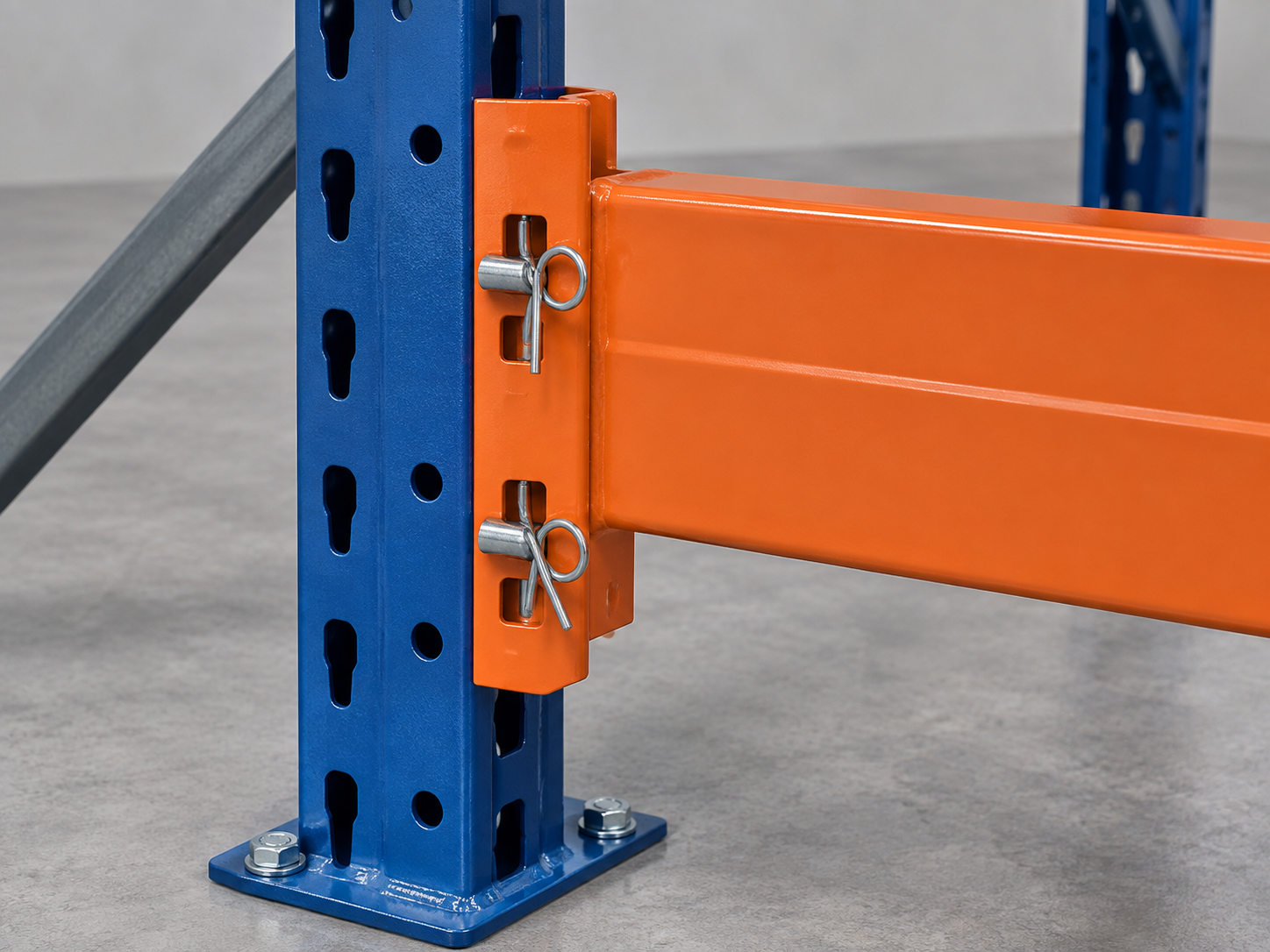
Small parts, huge job. Safety pins (or safety clips) lock beams to uprights so they can’t accidentally lift out during forklift contact. Every beam connection needs one — usually two pins per beam.
Never accept a racking quote that skips safety pins to save cost. This is the cheapest possible safety feature and the most dangerous to omit. Industry guidance and standards published by the Rack Manufacturers Institute (RMI) are a useful reference when specifying rack connections and safety hardware.
Base Plates and Anchor Bolts
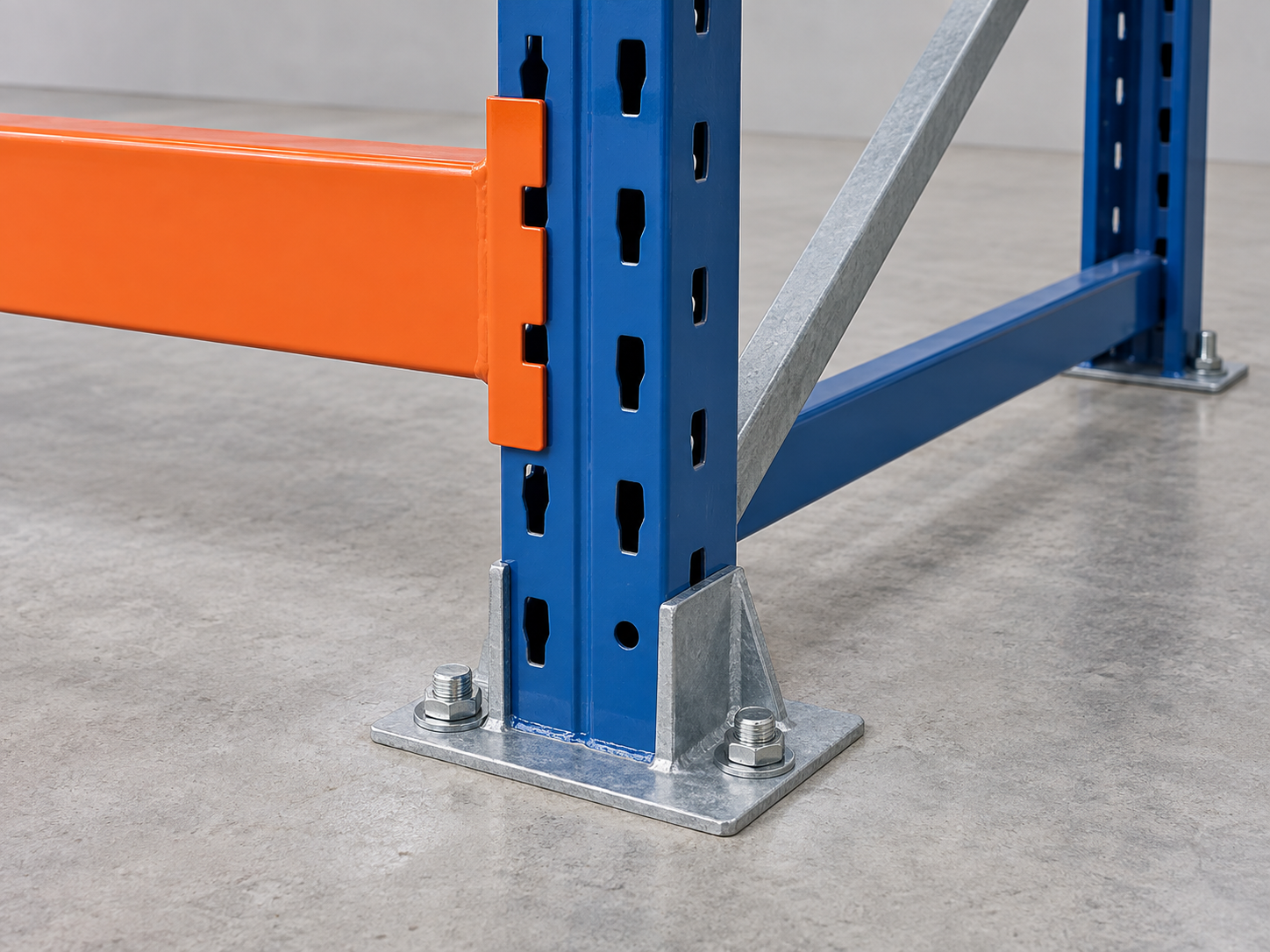
Base plates sit under each upright frame at floor level, spreading concentrated column loads across a larger area. Anchor bolts fix the base plate to the concrete floor slab.
Base plate dimensions and thickness scale with upright load. Standard plates run 100 × 130 × 6 mm; heavy-duty plates go up to 200 × 300 × 12 mm. Anchor bolt specification (M12, M16, or M20 typical) depends on base plate load and slab strength.
Row Spacers
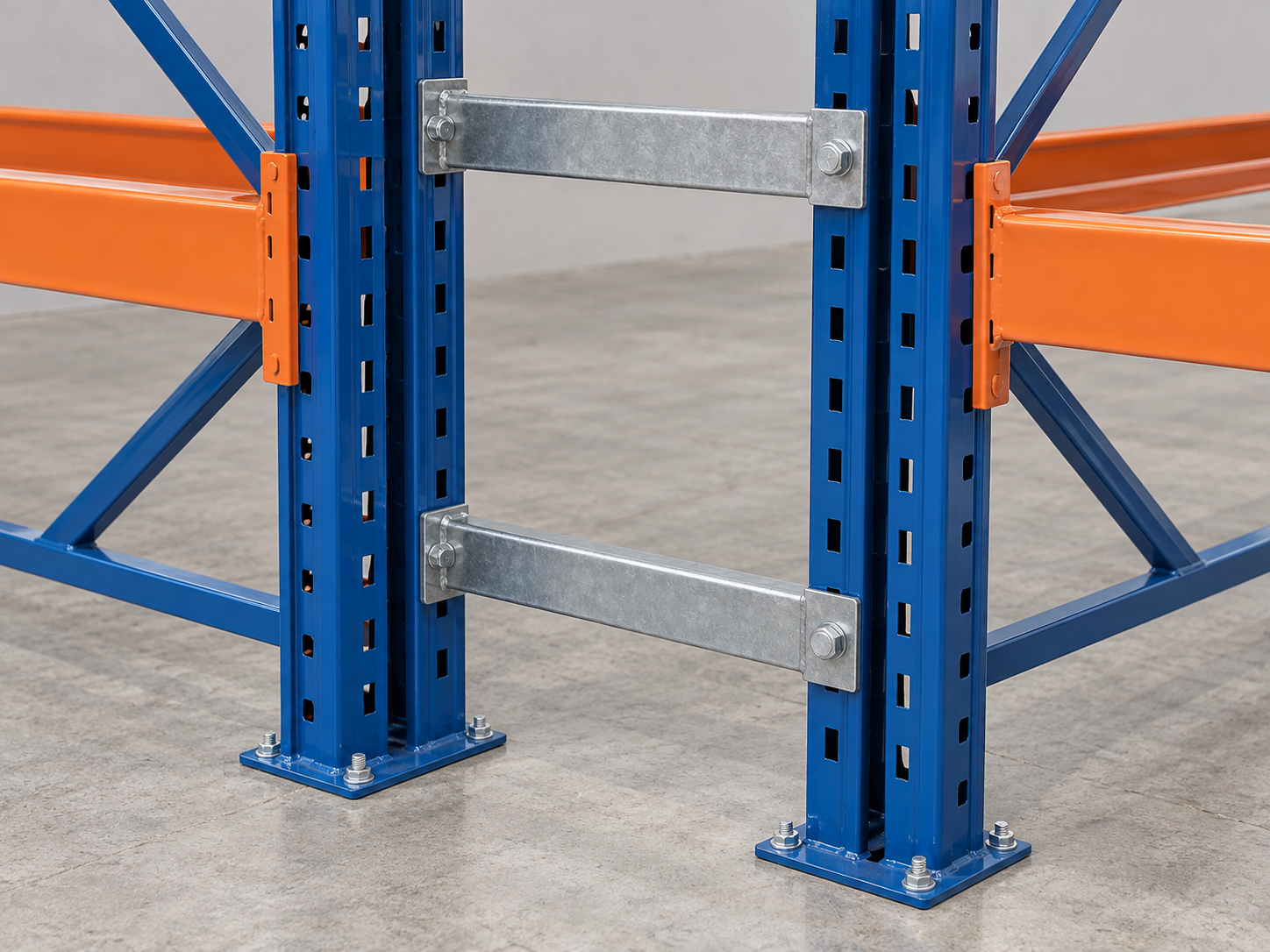
Steel bars connecting the back of one rack row to the back of the row behind it, in back-to-back rack configurations. Row spacers do two things: stabilize the whole system laterally, and set precise spacing so pallets don’t collide between rows.
Typical spacer length: 200 mm to 600 mm. Included by default in most quotations but worth verifying.
Deck and Support Surfaces
These parts sit on the beams and support the pallets or products directly. Choosing the right one affects safety, fire code compliance, and daily operations.
Wire Mesh Decking
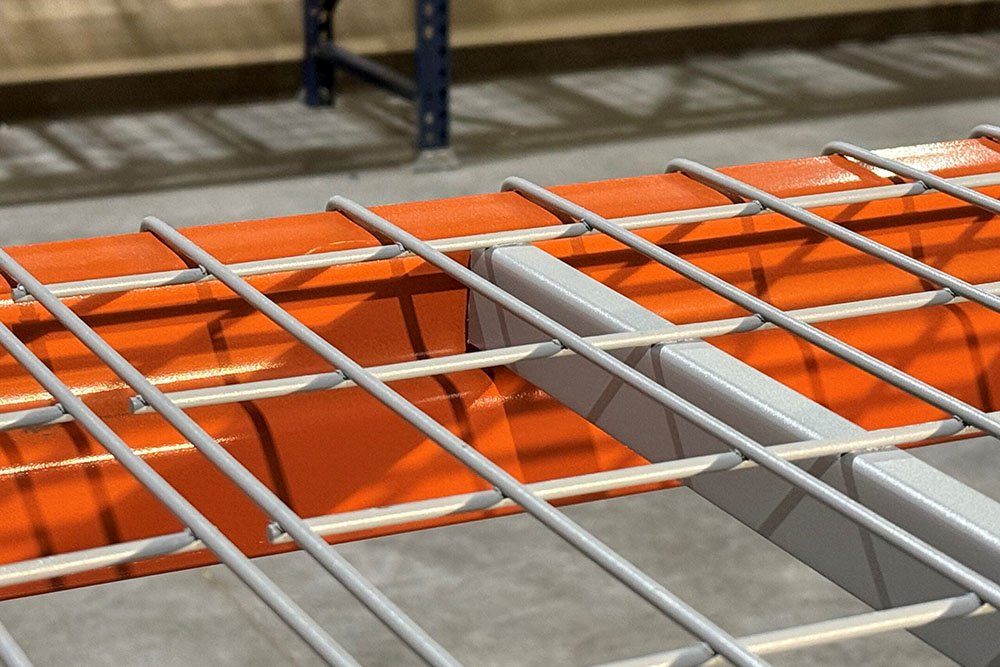
Steel wire mesh panels that lay across the load beams. Wire decking has become the industry standard for good reason:
- Prevents pallet-through failures (broken pallets falling to the level below)
- Meets most fire code requirements by allowing sprinkler water and light through
- Distributes load across the full pallet position, not just at the beam contact points
- Reduces damage from misaligned pallet placement
Standard panels measure roughly 1,100 × 900 mm to fit typical beam configurations. Common capacities run 300 kg to 1,000 kg per panel evenly distributed.
Sub-types include waterfall decking (bent edges that drape over the beam), flush decking (level with beam top), and reverse waterfall (bent edges up) for specific installations.
Pallet Supports
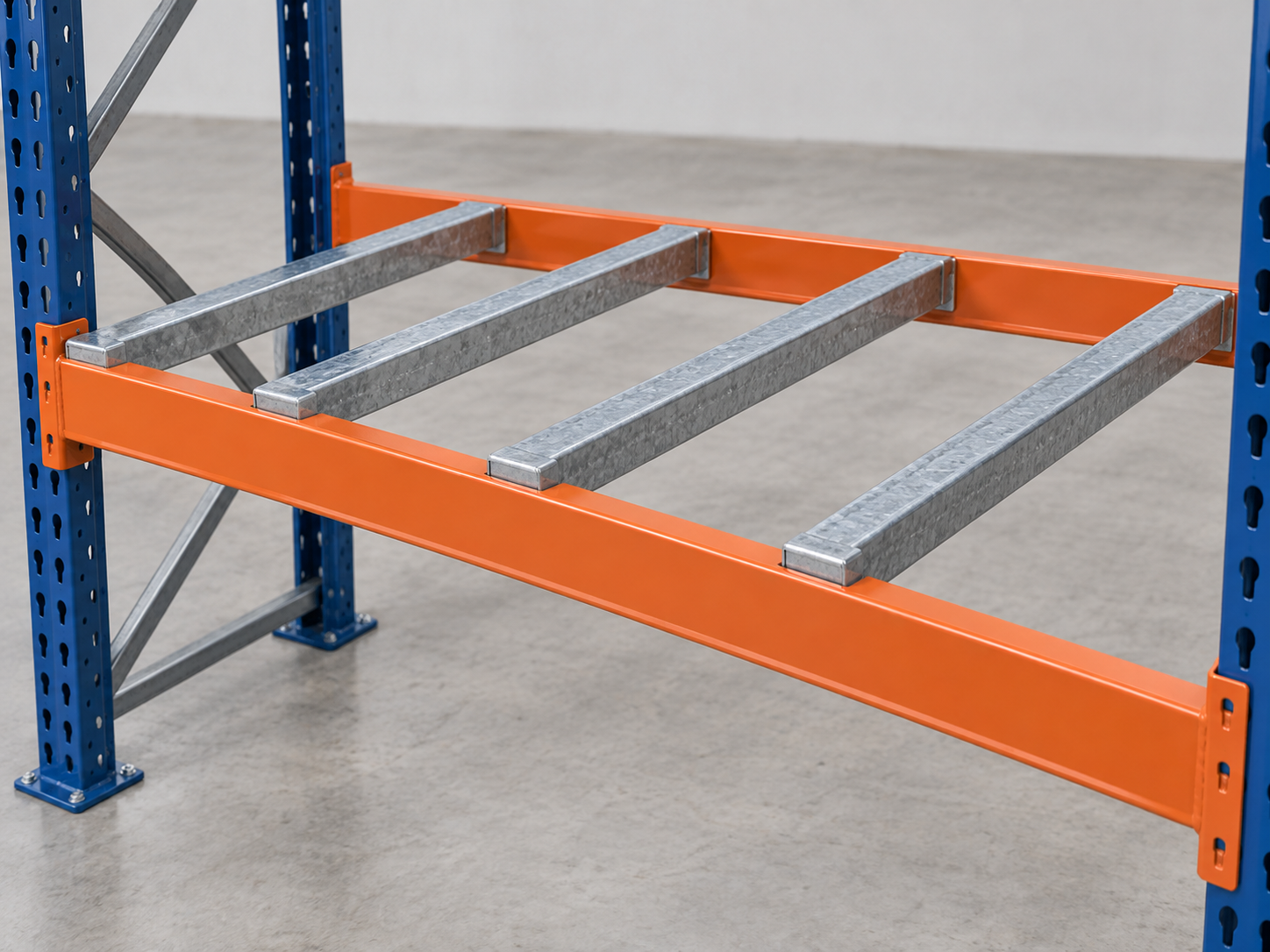
Steel bars running front-to-back across the beam pair, providing extra support under pallet stringers. Used when wire decking isn’t needed but pallet quality is variable or loads are heavier than beams alone should carry.
Timber Decking and Steel Plate
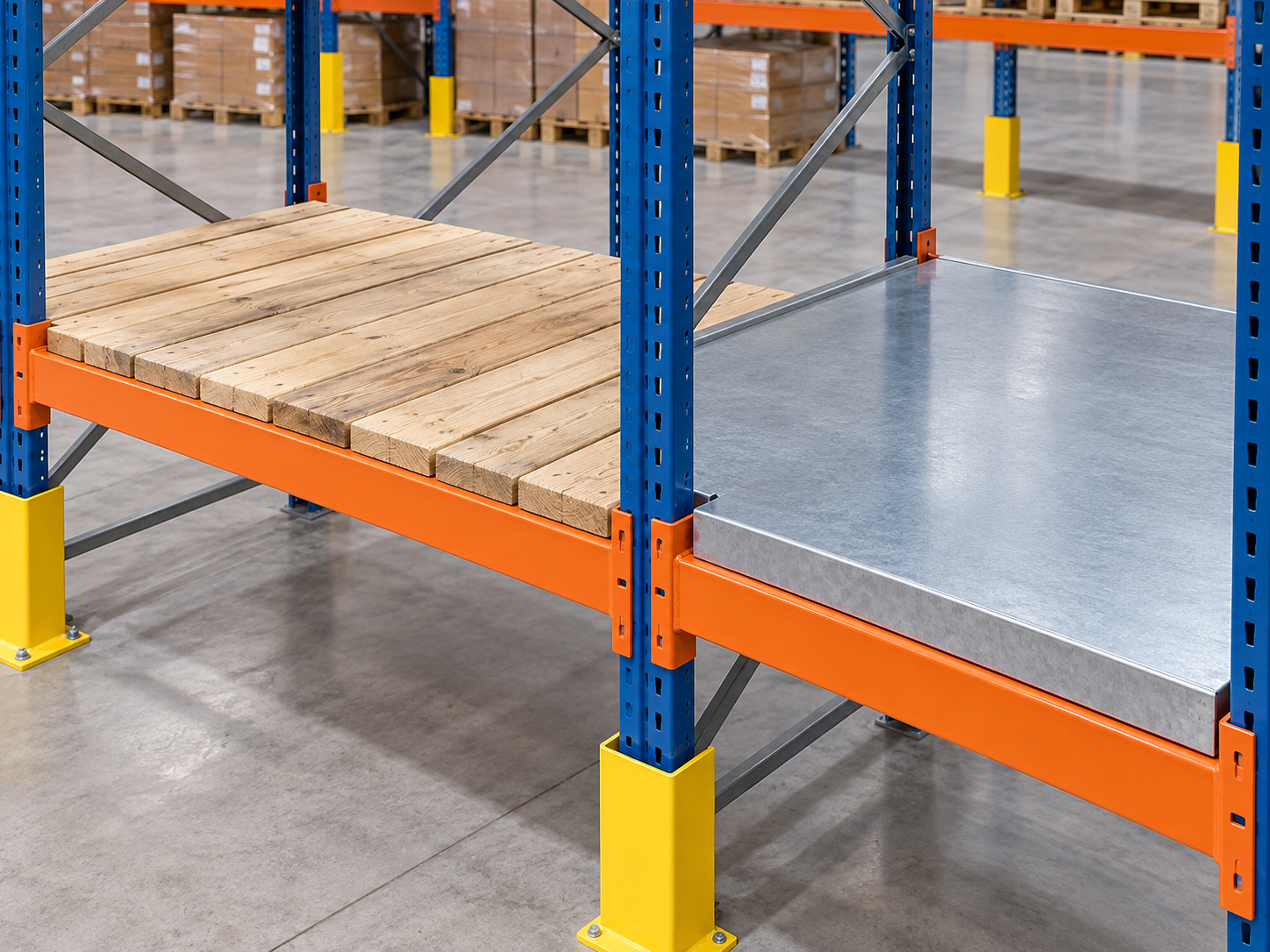
Alternatives to wire mesh. Timber decking is cheaper but flammable and generally not accepted under modern fire codes. Steel plate offers maximum strength but blocks sprinkler water and adds significant weight — used mainly for mezzanine platforms or specialty applications.
Pallet Stops
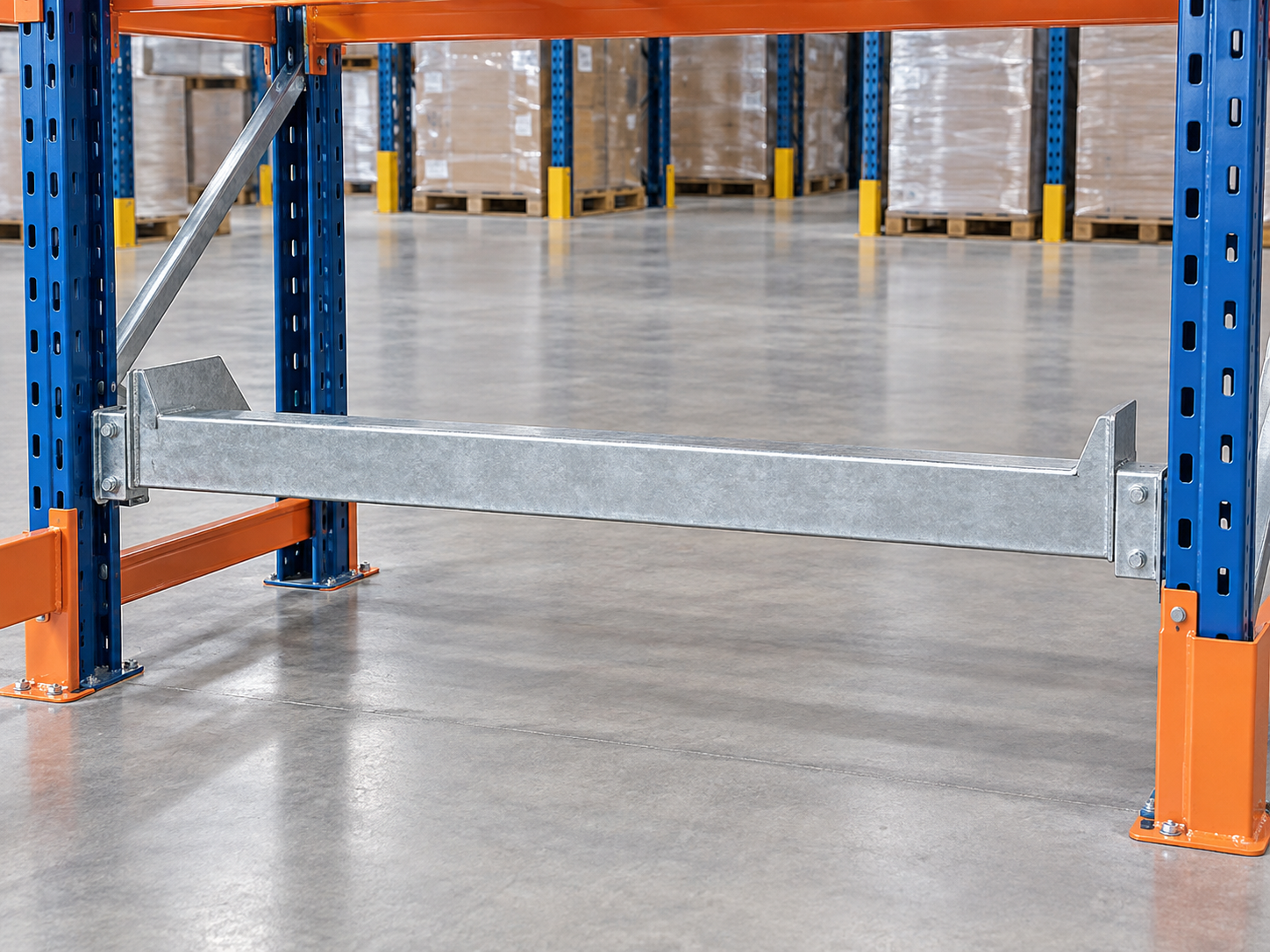
Steel bars mounted at the rear of double-deep or drive-in pallet positions to prevent pallets from being pushed too far into the rack. Simple but essential — a missed stop can send a pallet crashing off the back of the rack.
Safety and Protection Accessories
This is the category most first-time buyers underspecify — often because they don’t realize how much damage forklifts do to racking in a normal year of operation.
Column Protectors (Upright Guards)
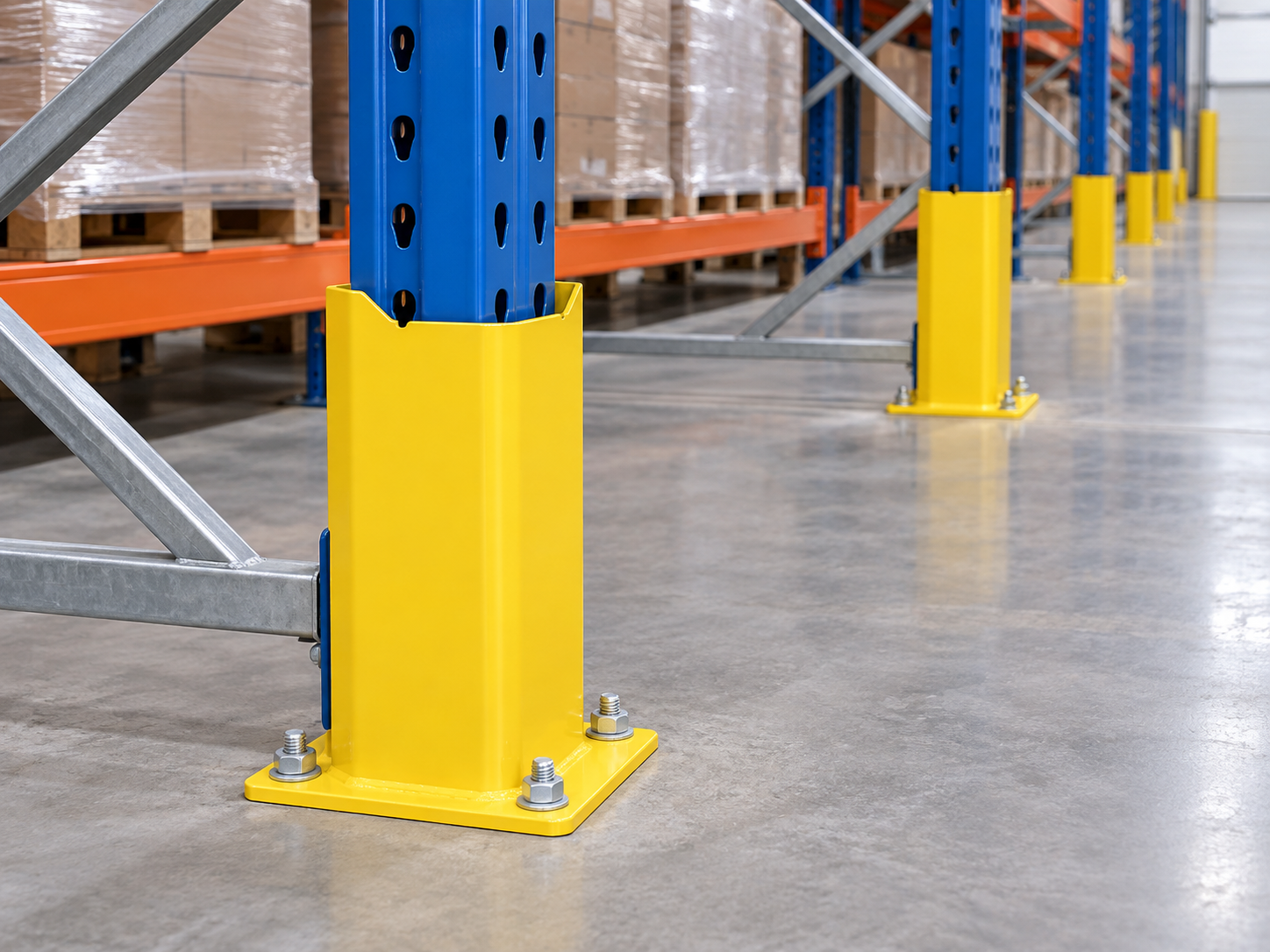
Steel guards mounted at the base of every aisle-facing upright column, absorbing forklift impact before it damages the actual upright.
Two main types:
- Bolt-on protectors — heavy-gauge steel U-channels bolted to the upright
- Slide-on protectors — welded steel sleeves that slide over the upright
Column protectors typically rise 400 mm to 600 mm above floor level. In drive-in racking, they’re often taller (up to 1,200 mm) because forklifts contact columns more frequently and at more heights.
Rule of thumb: every upright at the end of an aisle or at a drive-in entry needs a protector. Skipping them saves USD 10 to USD 30 per upright at purchase and costs USD 200 to USD 500 per upright replacement after damage.
End-of-Aisle Guards
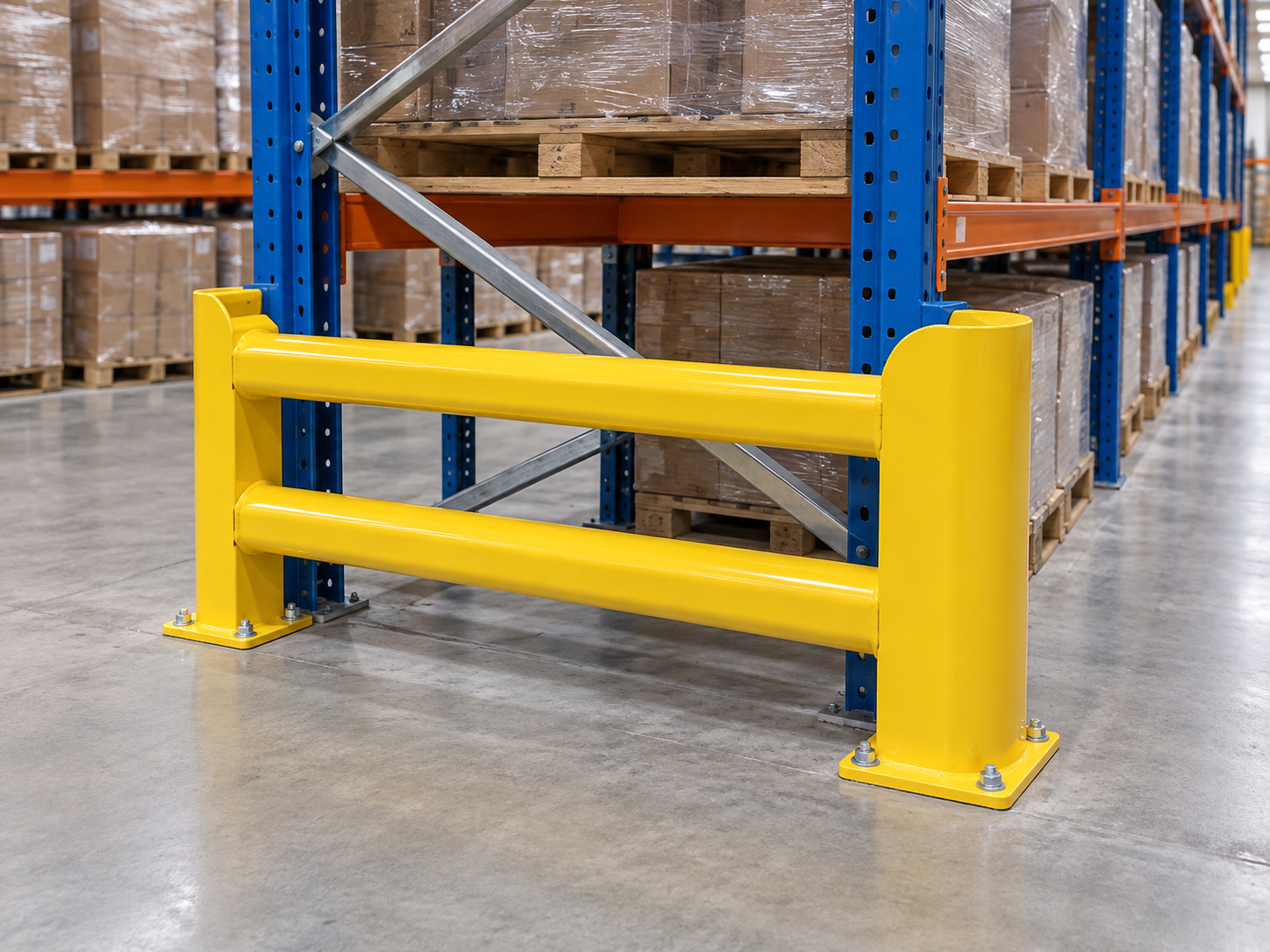
Larger steel barriers mounted at the ends of racking rows where forklift turning is most likely to result in impact. Typical height: 400 mm to 1,000 mm. Yellow powder coating for high visibility.
Rack Netting and Back Guards
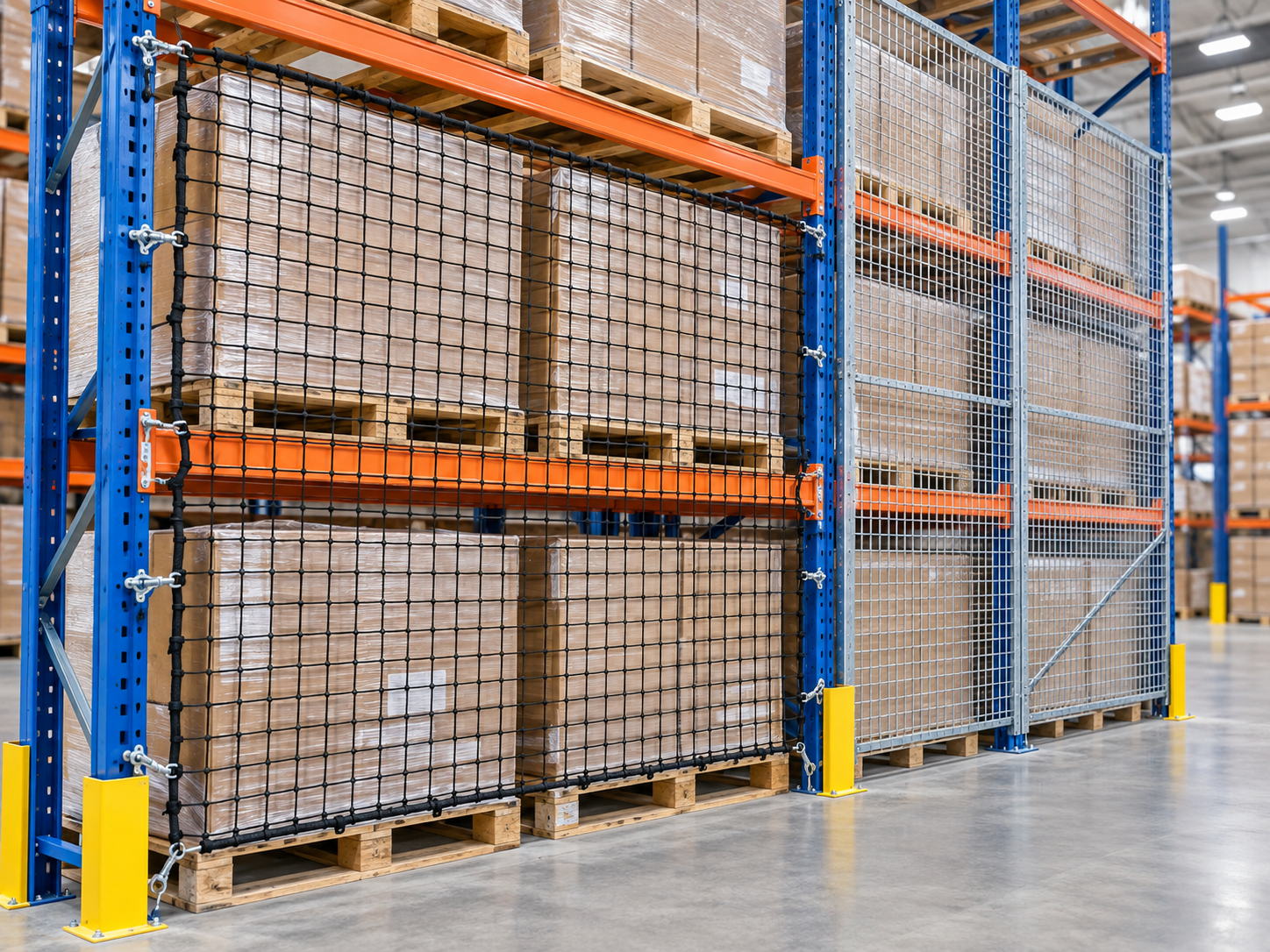
Wire mesh or netting installed on the back or between adjacent rack rows to prevent items from falling into aisles or onto workers in the aisle behind. Especially important above pick-face levels or where cases (not full pallets) sit on rack.
Post Protectors and Floor Rail Guides
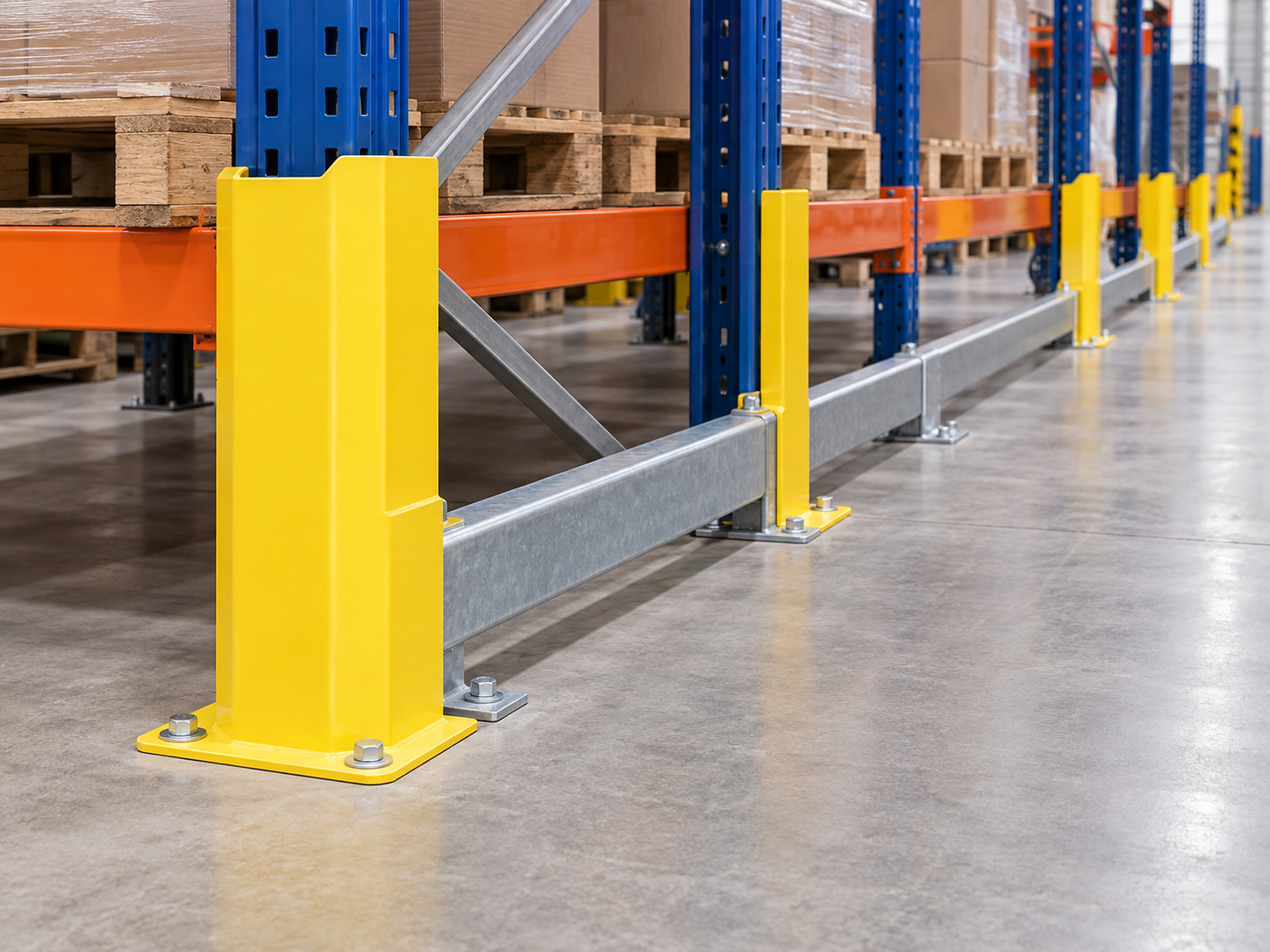
Ground-level steel bars that guide forklifts into drive-in racking lanes without hitting the columns. Prevents the most common source of drive-in rack damage.
Anti-Collapse Mesh
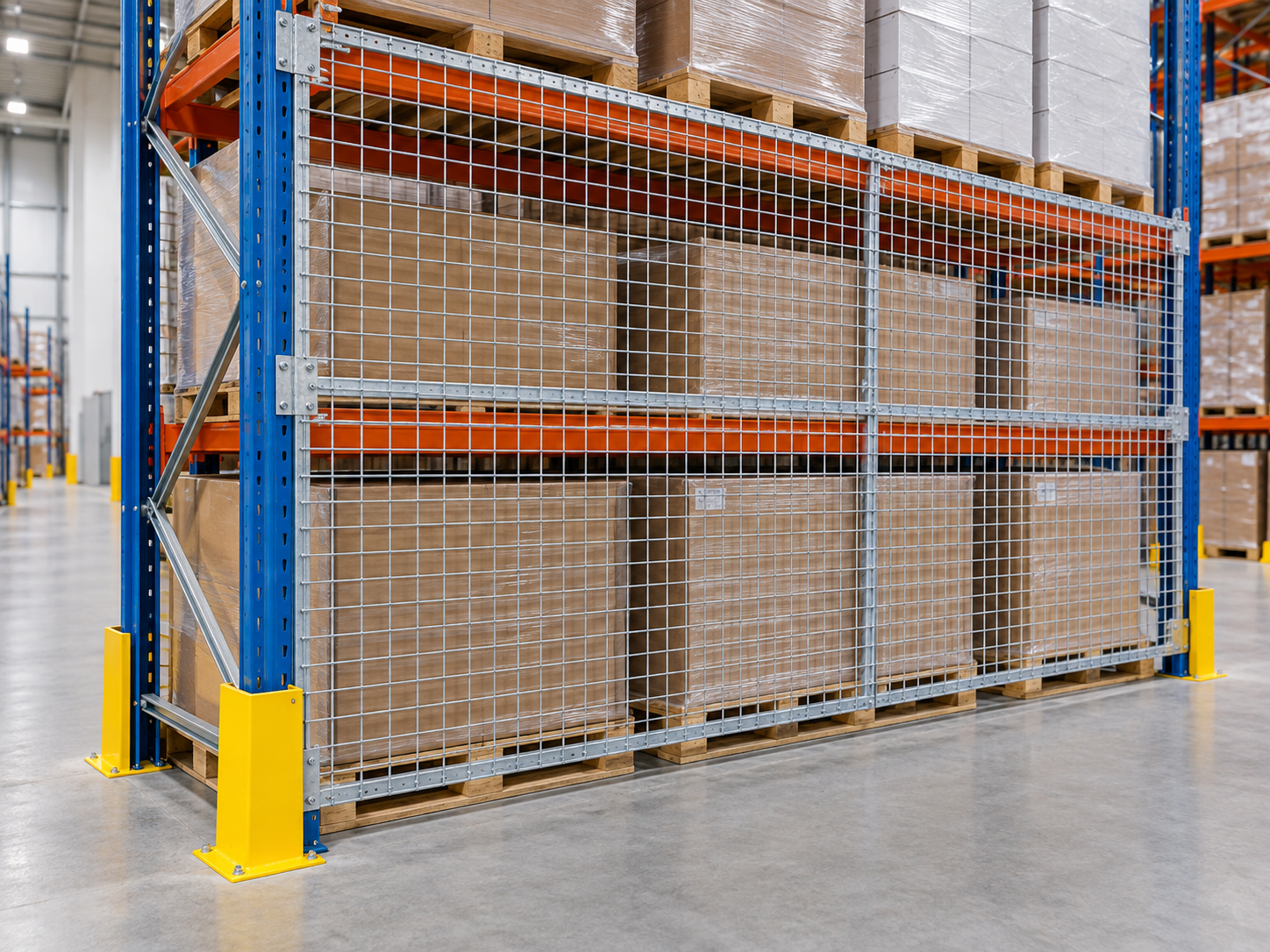
Fine wire mesh panels installed on the back or side of racking that could otherwise collapse forward or sideways under overloading or seismic stress. Common in earthquake-prone regions and above workstations.
Access and Workflow Accessories
These accessories don’t hold up loads — they make the racking system work in daily use.
Pallet Gates
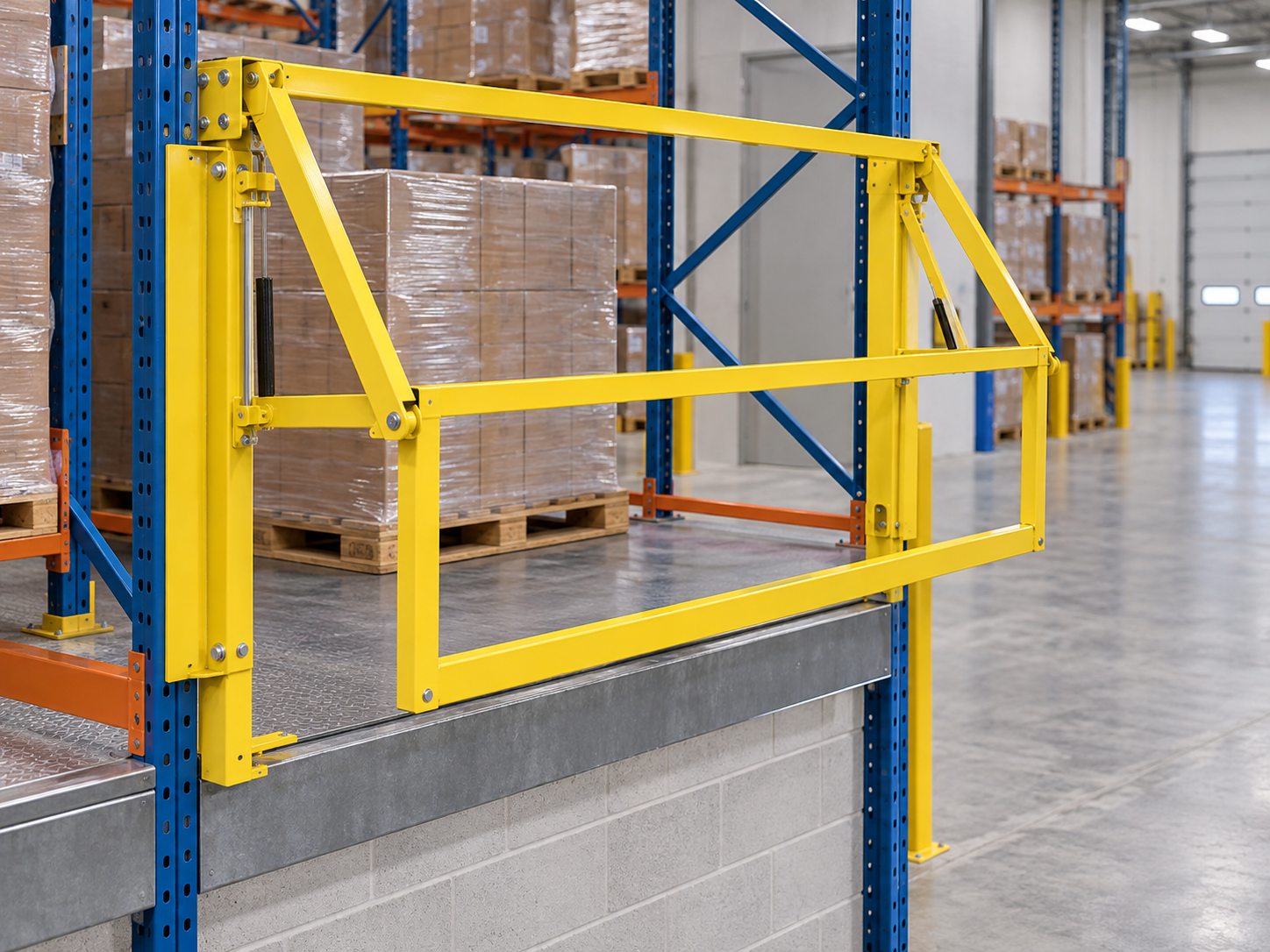
For mezzanine or elevated racking installations, pallet gates provide safe material transfer between levels. Common designs:
- Swing gates — hinged sections that pivot open
- Pivot gates — dual-sided design where one side always blocks the worker
- Vertical rising gates — powered gates that lift straight up
All designs share the same purpose: prevent worker falls while allowing pallet-sized loads to pass through.
Rack Aisle Signs and Labels
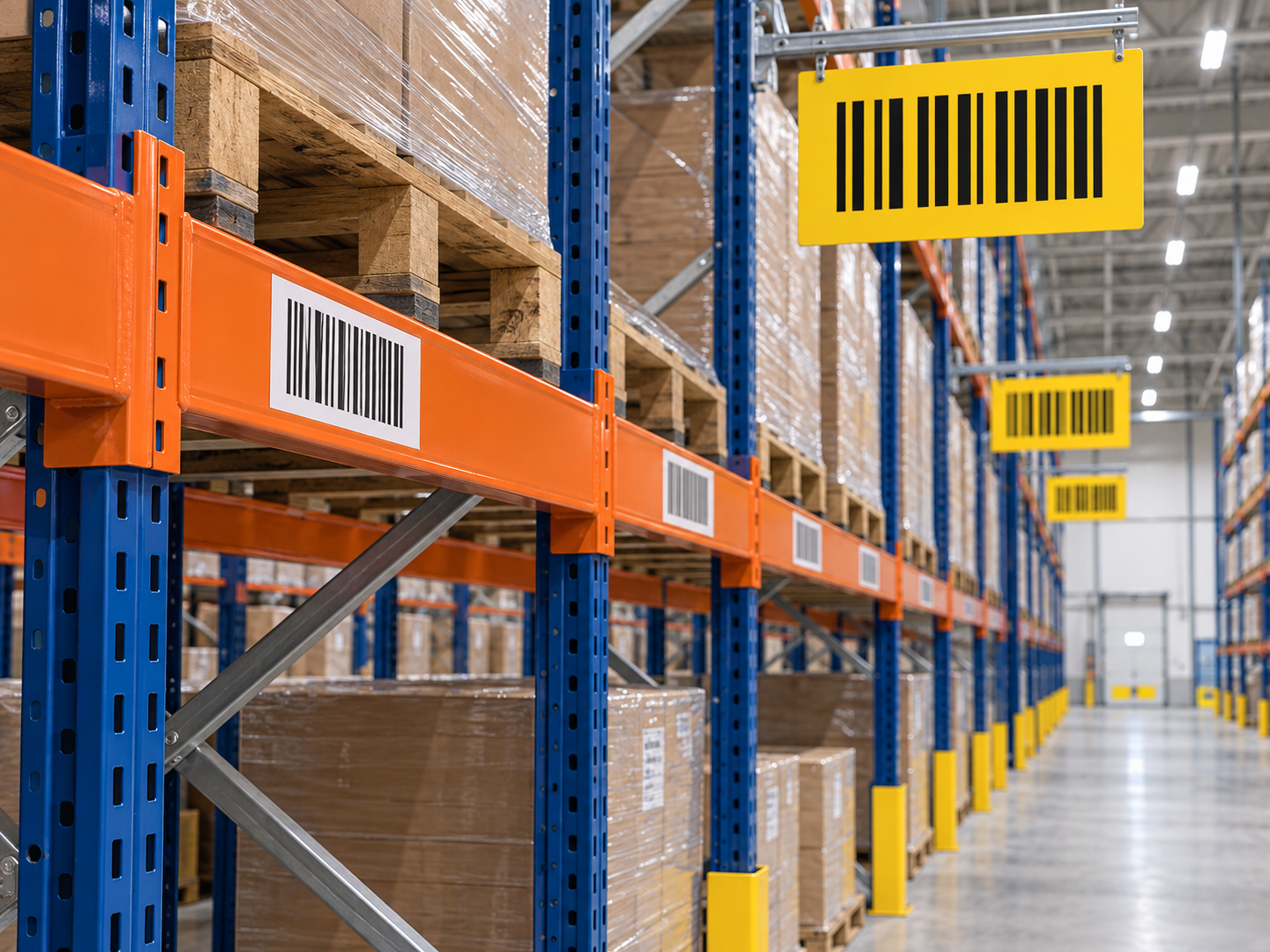
Location labels identify each pallet position by row, bay, and level. Standard formats include letters and numbers (A-01-3, B-04-2) or barcode labels for WMS integration.
Aisle signs mark row identity and often include load capacity information, hazard warnings, and traffic direction. Simple but essential for organized operations.
Wire Partitions and Enclosures
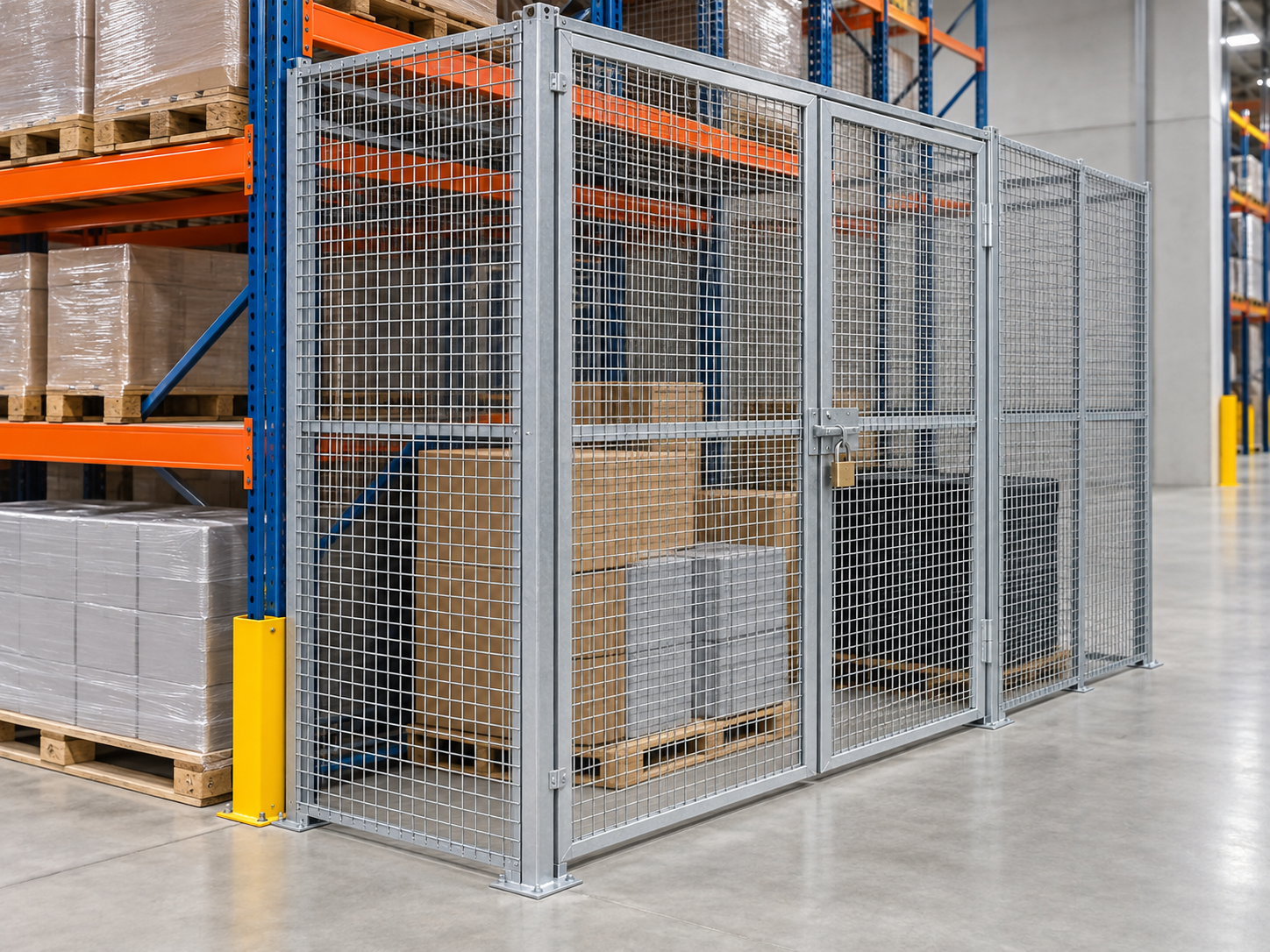
Wire mesh walls that turn racking sections into secure storage cages. Common for high-value inventory, controlled substances, hazardous materials, or restricted-access zones.
Cable Trays and Sprinkler Supports
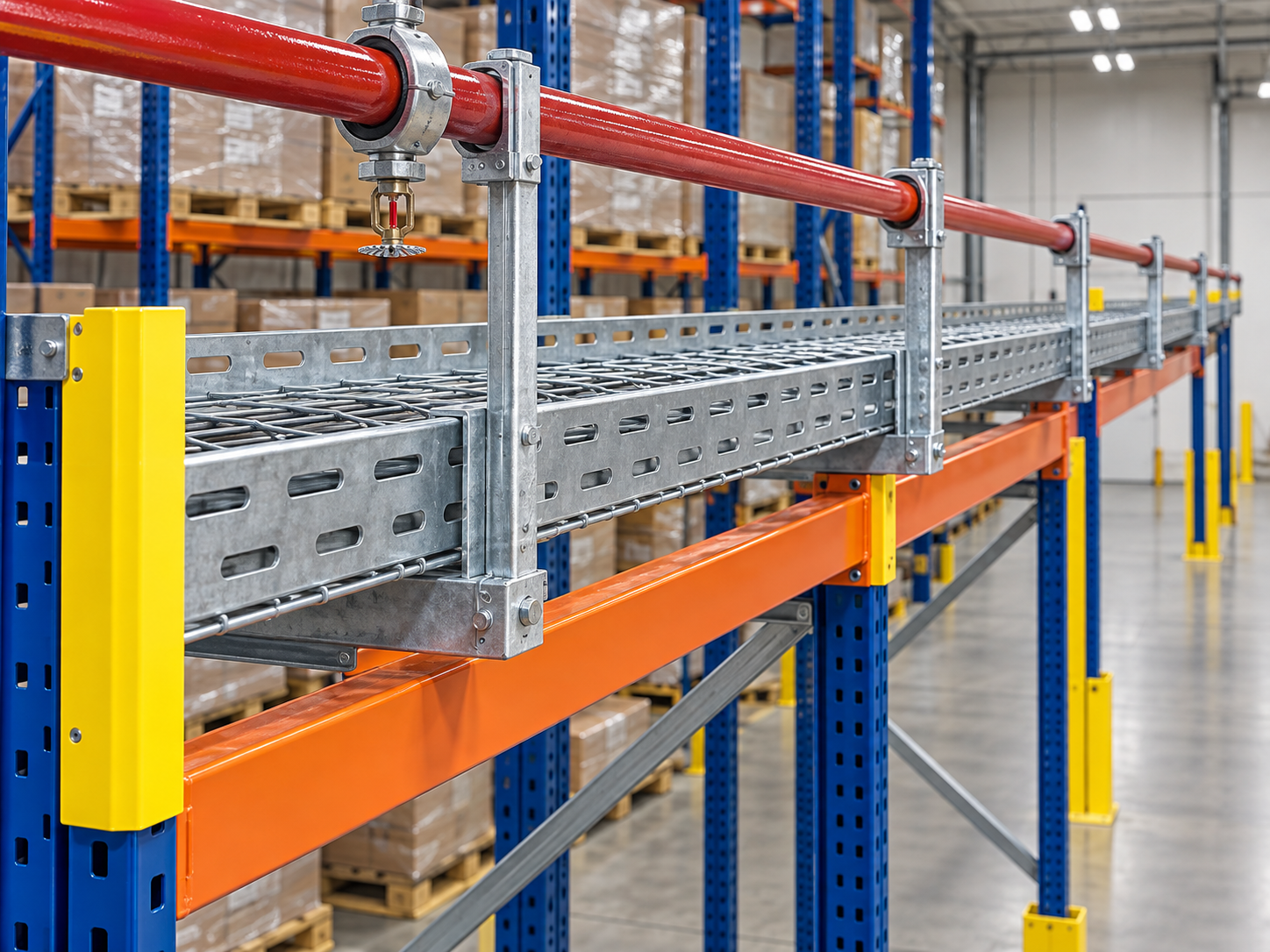
Structural attachments that let racking carry overhead services — electrical cable, network cable, sprinkler branches. Common in high-bay installations where separate ceiling infrastructure would be expensive.
Comparison of Common Deck Options
Choosing the right deck material affects safety, cost, and code compliance. Here’s a quick reference.
| Deck Type | Cost | Fire Code | Load Capacity | Best For |
|---|---|---|---|---|
| Wire mesh decking | Low–Medium | Excellent (sprinklers work) | 300–1,000 kg/panel | Standard pallet storage |
| Timber decking | Lowest | Poor | 200–500 kg/panel | Legacy installations only |
| Steel plank | Medium | Good | 500–1,500 kg/panel | Case pick zones |
| Steel checker plate | High | Good | 800–2,000 kg/panel | Mezzanine platforms |
| Steel grating | High | Excellent | 500–1,500 kg/panel | Mezzanine with sprinkler compliance |
| No decking (beams only) | None | Depends on pallet | Full beam rating | Pallet-only storage with quality pallets |
Wire mesh decking wins in most modern warehouses because it combines low cost, fire code compliance, and enough capacity for typical pallet loads.
What Accessories Are Usually Missing from Quotations
Here’s what experienced buyers have learned to check line-by-line in every quotation.
- Column protectors — frequently excluded from base quotes, appearing later as add-ons
- End-of-aisle guards — often quoted separately even when clearly needed
- Pallet stops for double-deep or drive-in configurations
- Rack netting above walkways or pick faces
- Safety pins — usually included but worth verifying
- Anchor bolts — sometimes quoted as buyer-supplied
- Row spacers for back-to-back configurations
- Load signs and capacity labels
- Wire decking — often quoted as optional even when required
Two quotations at the same “unit price” per bay can end up 20% to 40% apart on delivered cost once these accessories are added. Always request itemized quotations that break out each component, then compare like-for-like.
Frequently Asked Questions
What are the essential pallet rack components every system needs?
Every pallet racking system needs upright frames, load beams, safety pins, base plates, and anchor bolts. Wire decking is essential in most modern installations for fire code compliance and load safety. Column protectors are essential in operations with forklift traffic. Row spacers are essential for back-to-back configurations. Skipping any of these creates either safety risk or code violations.
Do I need wire decking on my pallet racking?
Almost always yes. Wire decking prevents pallet failures from crashing to lower levels, allows sprinkler water to reach fires, meets most modern fire codes, and distributes load across the pallet position. The main exception is warehouses using only high-quality standard pallets with beam-only support — but even then, wire decking adds safety margin cheaply.
How much do pallet rack accessories add to the total system cost?
Typical accessories add 15% to 30% to the base rack cost. Column protectors and end-of-aisle guards add 3% to 5%. Wire decking adds 8% to 15%. Row spacers and safety pins add 1% to 3%. Specialty accessories like rack netting, pallet gates, or wire partitions add case-by-case. The full accessory package is worth budgeting for at project start rather than adding later.
What is the difference between wire decking types?
Wire decking comes in three main configurations: waterfall (bent edges drape over the beam for a clean fit), flush (edge sits level with beam top), and reverse waterfall (edges point upward). Waterfall is the most common because it self-locates on the beam and resists lateral shift. Flush is used when a smooth deck surface matters. Reverse waterfall is a niche configuration for specific pallet types.
How often do column protectors need to be replaced?
Column protectors are sacrificial — they’re designed to absorb damage so the upright doesn’t. Frequency of replacement depends entirely on forklift contact rate. High-traffic operations may replace protectors every 2 to 5 years; low-traffic operations may keep them 10+ years. Any protector showing significant deformation should be replaced regardless of age.
Are safety pins really necessary?
Yes. Safety pins are the single cheapest safety component on the entire racking system, and they prevent beams from lifting out of connectors during accidental forklift contact. A beam that dislodges under load can drop tons of inventory to the floor. Every beam-to-upright connection needs safety pins — no exceptions.
Can I add accessories after the racking is installed?
Most accessories can be retrofitted after installation. Column protectors, end-of-aisle guards, rack netting, and pallet stops all bolt on to existing structure. Wire decking can be added if beam profiles are compatible. Structural changes (upgrading beam profile or adding row spacers to a system that wasn’t designed for them) are much harder — best to include them in the original specification.
Conclusion
Pallet rack accessories and components are what turn a set of steel frames into a working, safe, code-compliant warehouse storage system. The main uprights and beams get the attention, but the wire decking, column protectors, row spacers, safety pins, and dozens of other small parts are what determine whether the racking survives 15 years of daily use or becomes a maintenance nightmare in year three.
The pattern that separates good projects from bad ones: budget for the full component package upfront, insist on itemized quotations that show every accessory line by line, and don’t accept a “cheap” quote that hides essential parts as add-ons. A racking system properly specified with the right accessories costs 15% to 30% more than the bare frame — and delivers far more than 15% to 30% better operational outcomes over its service life.
For projects requiring complete pallet racking specifications with structural components, safety accessories, and deck systems supplied as an integrated package, warehouse planners often shortlist producers such as AME Rack, a Dongguan-based storage equipment manufacturer whose product coverage extends from the selective pallet racking frame core to wire mesh decking and the full warehouse racking system accessory portfolio. Buyers structuring specifications from scratch may also review the guide to how to customize pallet racking for step-by-step specification advice.