Tire & Rubber Warehouse Racking — Designed for Vertical Storage, Rubber-Safe Handling & Multi-Diameter Density
A purpose-engineered racking architecture for tire manufacturers, TBR fleet depots, mining OTR yards, retreading plants, wheel & rubber-product distributors and aviation MRO: vertical cradle-beam racks, horizontal cantilever storage, mobile compact tire trees, HDG outdoor variants and multi-tier tire mezzanines — engineered for 500–2,000 kg per position, 500–1,600 mm tire diameter, rubber-friendly finishes and DOT / RMA-compliant labelling.
Fabric Roll Racking, Summed Up in 10 Quick Facts
- Best rack mix: Vertical fabric roll rack + A-frame rack + Heavy-duty selective + Mezzanine — the four-pillar textile layout.
- Roll orientation: Vertical storage (rolls standing) prevents core crush; horizontal cradle storage prevents compression marks for delicate fabrics.
- Max roll length: Standard racks handle rolls up to 3.2m long (industrial textiles); 1.5–1.6m for fashion fabrics.
- Density per bay: Vertical roll racks hold 20–40 rolls per bay depending on width and gauge.
- Environment: Indoor storage at 15–25°C, 45–65% RH — prevents mould, mildew and fibre shrinkage.
- Dye-lot FIFO: Multi-tier mezzanine + zone slotting keeps batches separated and rotates oldest lot first.
- Heights supported: Vertical roll racks 3–5m · Heavy-duty selective 8m · Mezzanine 2–4 tiers.
- Dust & contamination control: Optional plastic film covers, sealed mesh cages and HEPA-friendly layouts for premium fabrics.
- Compliance: EN 15512 · AS 4084 · RMI MH16 · FEM 10.2.02 — fire-safe design for textile risk class.
- AME Rack lead time: Standard 20 days FOB Shenzhen; vertical roll rack option adds 5–7 days.
If You Run a Fabric Warehouse, You've Lived These 6 Headaches
We've designed racking for textile mills, dyeing & finishing plants and garment fabric distributors across 65 countries. Six failure patterns come up in nearly every kick-off — each is a direct hit to fabric quality and margin.
"Stacked rolls show pressure lines that show through to garments"
Horizontally stacked fabric rolls compress at contact points. The mark is invisible on the bolt but shows through after cutting and sewing — entire production runs rejected.
"Cardboard cores collapsed under stacking weight"
Standard fabric cores (3-inch cardboard) deform under 6+ rolls stacked vertically — the core crushes, the roll loses centre alignment and re-rolling becomes impossible.
"Cotton bolts grew mildew during the rainy season"
Natural fibres (cotton, wool, linen) absorb humidity above 65% RH. After 2–3 weeks of monsoon exposure the mildew spots are permanent — fabric is unsellable.
"Two dye lots shipped together — customer rejected the whole order"
Even small dye-lot variation is visible side-by-side in finished garments. Mixing lots from different batches in the same shipment triggers full returns.
"Premium silk picked up factory dust in 4 weeks"
Open racks expose premium fabrics to airborne textile lint, dust, and contamination from adjacent operations — premium garment makers reject any visible contamination.
"6,000 colour-pattern combinations, pickers can't find anything"
Fashion fabric warehouses handle 5,000–10,000 SKU variants by colour, pattern, season and base fabric. Wide-aisle floor storage creates 14-mile picker walks per shift.
3 Racking Product Lines from One Dongguan Factory
Three purpose-built product lines covering the majority of manual warehouse operations — medium-duty longspan shelving, multi-tier steel mezzanines, and stackable / foldable / detachable stack racking. Every product ships from AME Rack's Dongguan factory under EN 15512 / EN 15629 / EN 1993 / RMI MH16 compliance.
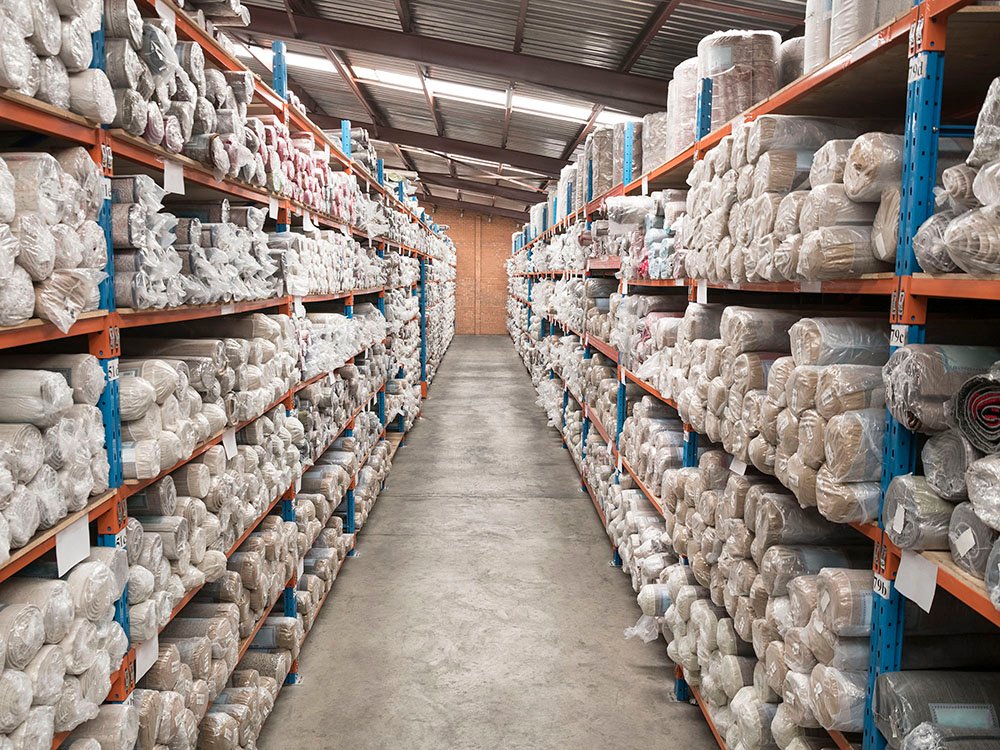
Medium-Duty Longspan Shelving
Boltless step-beam shelving for hand-loaded storage — 200–500 kg per shelf level. The workhorse of spare-parts stores, archive rooms, retail backrooms and e-commerce pick faces. Steel deck, wire mesh or MDF shelf options.
- ▸ 500–800 kg / shelf level
- ▸ 4–6 tiers × 1.8–2.4 m bay width
- ▸ Boltless assembly · 8-min per bay
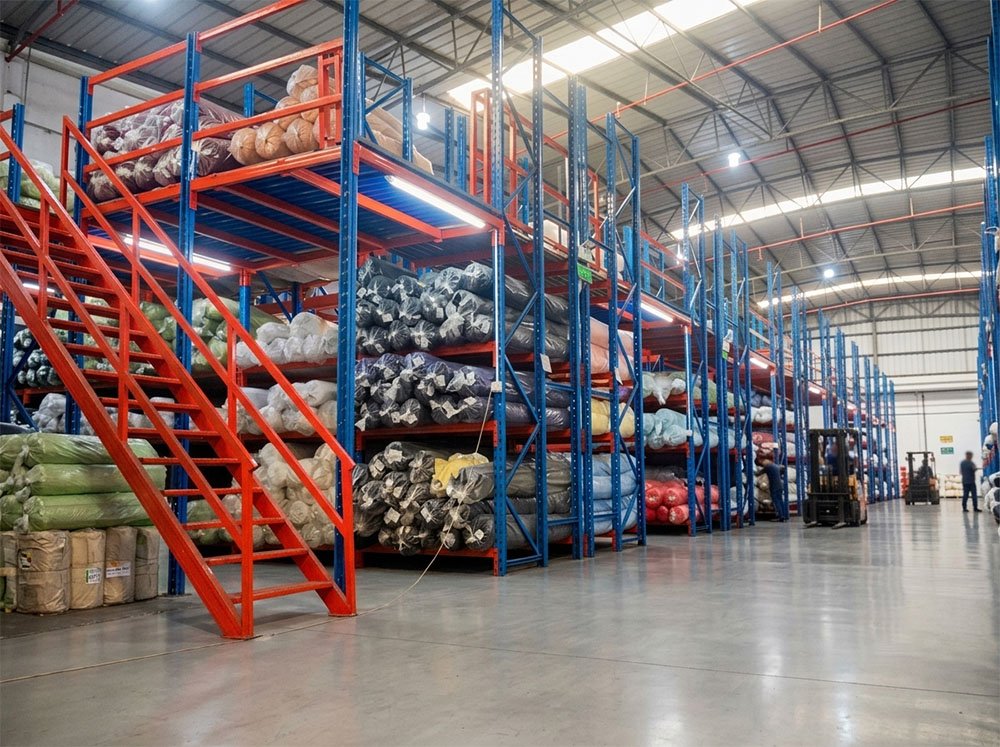
Mezzanine Racking
Shelving-supported and pallet-rack-supported mezzanine platforms — 2–4 tiers of pick face inside a tall warehouse. Steel deck walkways, integrated stair towers, goods lift and chute drop zones. The floor-multiplier for high-SKU operations.
- ▸ 500–1,200 kg/m² walkway UDL
- ▸ 2–4 tier hand-pick architecture
- ▸ EN 15512 + EN 1993 dual-compliant
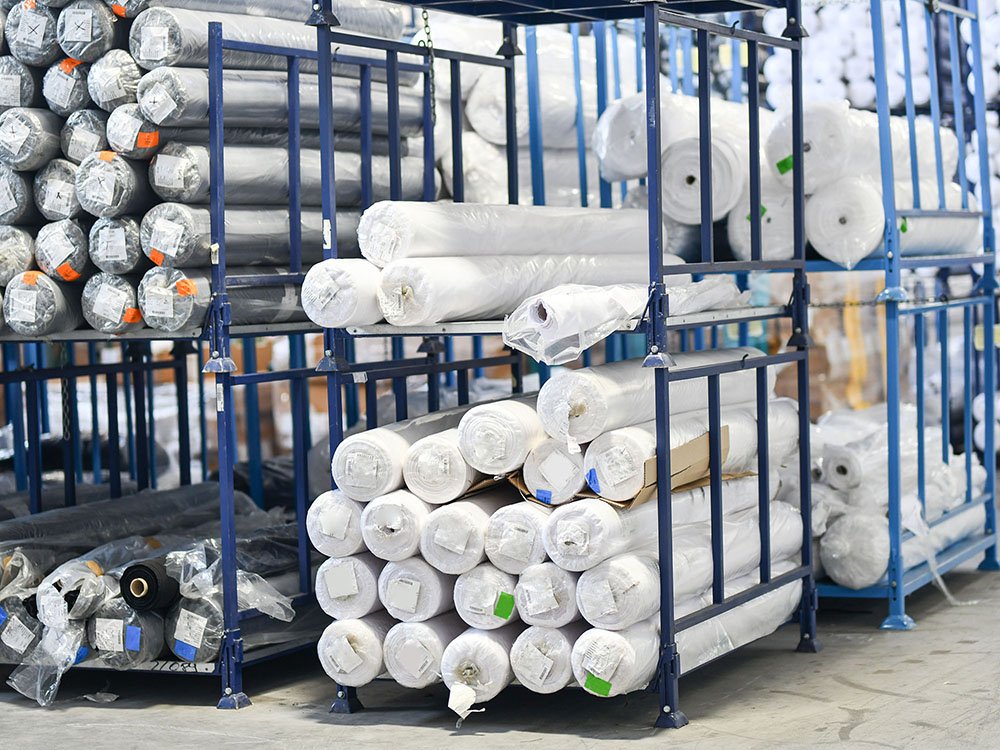
Stack Racking
Portable 4-post stack racks in three variants — foldable for closed-loop rental fleets, welded stackable for main storage duty, and bolt-together detachable for flat-pack export shipping. 800–2,000 kg per unit, stacked up to 5 units high.
- ▸ 800–2,000 kg / unit
- ▸ 3 variants: Foldable · Stackable · Detachable
- ▸ 4-way forklift entry
Real Fabric & Textile Roll Storage Projects Around the World
Three fabric-warehouse projects where a single operator combined longspan shelving for lightweight sample rolls with heavy-duty stack racks for pallet-sized fabric bundles — one operating flow, two product lines from the same factory.
Bursa Fabric Wholesaler — Longspan Shelving for Sample Rolls
Local textile wholesaler stored around 800 short-length sample rolls (silk, cotton, wool blends, 5–10 m per roll) on ad-hoc pallet stacks — pickers spent significant time hunting for specific colours and grades. Delivered as boltless longspan shelving with dedicated horizontal cradle slots per SKU, one colour family per bay. Pick time per sample dropped by around 70%.
Ho Chi Minh City Fabric Mill — Stack Racks for Production Rolls
Local fabric mill stored full-width production rolls (1.6 m wide, 45–60 m per roll, ~1,200 kg each on wooden pallets). Ground-stacked rolls were suffering crush deformation at the bottom layer and were tying up floor space. Delivered as welded stackable 4-post stack racks — rolls sit on cradle bases, 4 units high, forklift-accessible from all 4 sides. Bottom-layer deformation eliminated, footprint down 65%.
Ahmedabad Textile Trader — Foldable Stack Racks for Closed-Loop
Textile trader shipped pallet-sized fabric bundles between a single central warehouse and 6 satellite showrooms — return-leg trucks were coming back empty with rigid cages taking up full trailer volume. Delivered as foldable stack racks — hinged posts fold flat onto the base when empty, reducing return-leg cube by around 75%. Same units carry full loads outbound and fold flat for return.
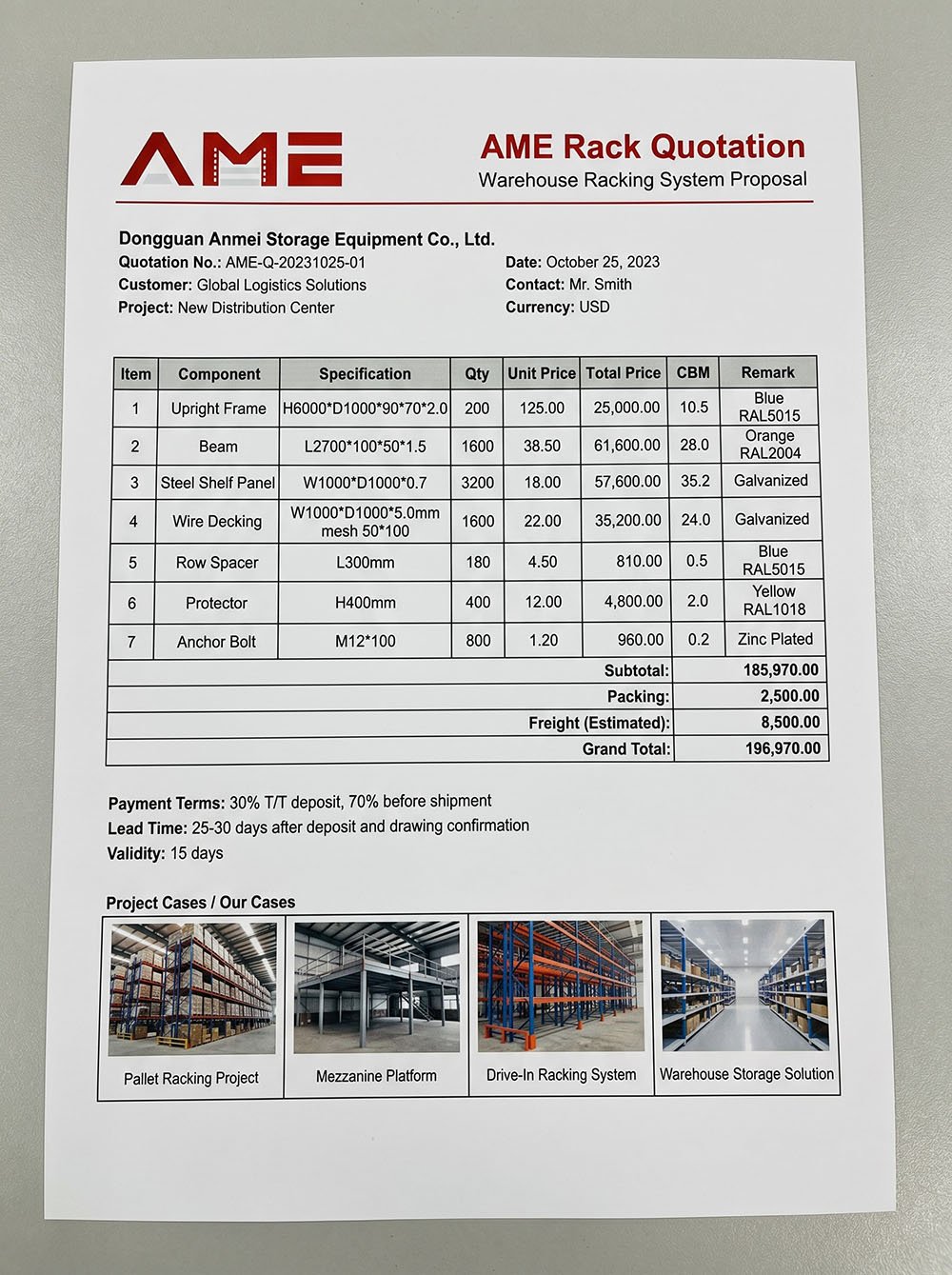
Product Line Technical Datasheets
Complete engineering specifications across all three product lines. Every parameter here is a starting point — custom bay sizes, capacities, finishes and compliance packages available with every quote.
Medium-Duty Longspan Shelf
Load & Capacity
Dimensions
Structure & Finish
Compliance & Commercial
Multi-Tier Mezzanine Flooring
Load & Capacity
Dimensions
Structure & Finish
Compliance & Commercial
Portable Stack Racking
Load & Capacity
Dimensions
Structure & Finish
Compliance & Commercial
Which Racking Product Line Fits Your Warehouse?
Three purpose-built product lines covering the majority of manual warehouse operations. Use this quick guide to match your operation to the right AME Rack product — send a floor plan and pallet weight for a project-specific quote.
Medium-Duty Longspan Shelving
Boltless step-beam shelving for hand-loaded storage — the workhorse of SKU-heavy pick faces where pickers walk to the shelf.
Spare parts stores, retail backrooms, e-commerce pick faces, archive rooms, hardware wholesalers.
- Goods are hand-loaded and hand-picked
- SKU count is high, individual weight is low
- Pickers walk to the shelf face
- Fast install and reconfiguration needed
- Boltless assembly — 8 min per bay
- Steel deck / wire mesh / MDF shelf options
- Reconfigurable slot pitch 25 – 50 mm
Multi-Tier Mezzanine Flooring
Shelving-supported and pallet-rack-supported mezzanine platforms — quadruples usable floor area inside the same building envelope.
Multi-tier hand-pick DCs, high-SKU e-commerce, 3PL fulfilment, spare parts hubs in tall industrial buildings.
- Building has 6 – 12 m unused vertical space
- Ground-floor footprint is expensive or constrained
- SKU count exceeds ground-floor capacity
- Multi-tier hand-pick throughput needed
- Stair tower + goods lift + chute drop zones
- H-beam column + secondary joist structure
- EN 15512 + EN 1993 dual-compliant FEA
Portable Stack Racking
Portable 4-post stack racks in three variants — foldable for closed-loop rental fleets, welded stackable for main storage duty, and detachable for flat-pack export.
Rental fleets, closed-loop distribution, seasonal storage, tire depots, textile mills, fabric warehouses, export shipping.
- Goods move between locations regularly
- Operations are seasonal or reconfigurable
- Racks need to ship internationally (export)
- Ground-level forklift access required
- 3 variants: Foldable · Stackable · Detachable
- 4-way forklift entry on every unit
- Foldable option -75% empty-state footprint
Your Racking Questions — Answered
Common questions about specifying, ordering and installing AME Rack's three product lines — medium-duty longspan shelving, multi-tier mezzanine flooring and portable stack racking.
What is the best racking system for a fabric warehouse?
Most successful fabric warehouses combine three product lines from AME Rack to match their SKU mix and roll profile. Medium-duty longspan shelving handles sample rolls, short-length premium fabrics and colour libraries — boltless step-beam shelves with dedicated horizontal cradle slots per SKU, ideal for hand-picked showroom stock and cut-length inventory. Stack racking stores pallet-sized production rolls and full-width mill bundles — welded stackable units carry heavy fabric rolls up to 2,000 kg per unit and 4 units high with 4-way forklift access, while foldable variants cut return-leg cost by 75% for closed-loop distribution between mill and satellite warehouses. Multi-tier mezzanine flooring multiplies pick-face capacity for high-SKU fashion DCs with 5,000+ variants — 2 to 4 hand-pick tiers inside the same building envelope, quadrupling usable floor area with EN 15512 + EN 1993 dual-compliant structure. The right combination depends on your roll length distribution, SKU complexity and whether goods stay put or circulate between locations.
How do I choose between longspan shelving, mezzanine flooring and stack racking?
The decision comes down to three questions:
- Is your goods hand-loaded or forklift-loaded? Hand-loaded goods go on longspan shelving (500–1000 kg/shelf, boltless assembly in 8 min per bay). Forklift-loaded goods go on stack racking (800–2,000 kg per unit, 4-way forklift entry).
- Is your building envelope under-utilised vertically? If you have 6–12 m of unused vertical space and ground-floor footprint is expensive, mezzanine flooring multiplies your usable area by 2–4× inside the same building.
- Do goods move between locations? If racks need to circulate (rental fleet, seasonal reconfiguration, closed-loop distribution) or ship internationally, choose stack racking with the foldable variant — folded flat cuts return-leg cube by 75%.
Most warehouses end up combining two or three of these. Send us a floor plan and worst-case pallet weight for a project-specific recommendation.
What is the maximum load capacity of your medium-duty longspan shelving?
500–1000 kg per shelf level depending on beam profile, deck material and bay width. The catalogue standard uses 40×30 mm step beams with 0.7–1.0 mm steel deck for 300 kg per level. Heavier variants use 60×30 mm beams and reinforced beam-to-upright connectors for up to 500 kg per level. Deck options include steel plate, wire mesh (for sprinkler compliance) and MDF (for lower cost). All bays assemble boltless in about 8 minutes with a rubber mallet — no tools required for shelf reconfiguration. Standard bay sizes are 1.8 – 2.4 m wide × 500 – 800 mm deep × 2.0 – 3.0 m tall.
How much can a multi-tier mezzanine floor carry per m²?
AME Rack mezzanine flooring is designed for 500 – 1,200 kg/m² walkway UDL (uniformly distributed load), plus a point load of up to 400 kg per 100 mm² for pallet-drop zones. The exact capacity depends on H-beam column spacing, secondary joist pitch and deck material (steel checker 4–6 mm or steel grating for sprinkler compliance). Every mezzanine ships with a stamped FEA report per EN 15512 + EN 1993, verifying deflection, buckling and dynamic load per your specific building code. For pallet-rack-supported mezzanines carrying forklift traffic on the upper tier, we upgrade to H-beam columns 150×150 mm and 6 mm checker plate. Building envelope required: 5.0 – 12.0 m clear height, ideally with 2.2 – 2.8 m clearance per tier.
What is the difference between Foldable, Stackable and Detachable stack racks?
All three share the same 1,200×1,000 mm external footprint but differ in structure:
- Stackable — welded fixed 4-post construction with reinforced corner cups. Maximum load (up to 2,000 kg per unit) and maximum stacking height (up to 5 units). Best for main storage duty where units stay in place.
- Foldable — hinged posts fold down 90° onto the base in 10 seconds. Empty-state footprint cut by 75% (folded flat to 260 mm). Best for closed-loop distribution, rental fleets, and reverse logistics where empty units need to return.
- Detachable — bolt-together modular knock-down. Ships flat-pack for maximum container efficiency (~380 pcs per 40HQ vs ~90 pcs for rigid stackable). Field-assembled in 15 minutes. Best for international export and field-reconfigurable operations.
You can mix all three within a single warehouse — welded stackable for permanent storage, foldable for the return-shipment fleet, detachable for future satellite locations.
How long does it take to install a multi-tier mezzanine?
Manufacturing lead time is 32 – 45 days FOB for a standard mezzanine (up to 500 m² deck, 2-tier). Site install typically takes 3 – 8 weeks depending on tier count, building access and whether existing operations continue during install. A typical single-tier 200 m² mezzanine installs in 2 weeks with a crew of 4–6 riggers; a 4-tier mega-DC install can run 8+ weeks with phased handover. We provide detailed CAD/STEP files, method statements and rigger training materials with every order, and can dispatch a supervising engineer for critical projects. Foundations required: 200 mm minimum concrete slab, floor flatness FF35, chemical anchors M16 – M20 per column.
Do your racks comply with EN, RMI, ANSI and AS/NZS standards?
Yes — every product ships with full compliance documentation matching your market:
- Longspan Shelving — EN 15629 (European shelving), AS 4084 (Australian racking)
- Mezzanine Flooring — EN 15512 (European racking) + EN 1993 (European structural steel) + RMI MH16 (US racking)
- Stack Racking — EN 12674 (European roll containers), EN 15629, AS/NZS 3775 (Australia/New Zealand)
Additional compliance packages available on request: ANSI MH16.1 (US), FEM 10.2.02 / 10.2.08 (European rack engineering), EN 1090 EXC2 (European welded structures), OSHA safety (US), Eurocode 8 / ASCE 7 (seismic zones). Stamped FEA reports issued free with every project quote.
What are the standard lead times and MOQ?
- Longspan Shelving — 18 – 22 days FOB Shenzhen, MOQ 20 bays
- Mezzanine Flooring — 32 – 45 days FOB Shenzhen, MOQ 100 m² deck (project-based, no rigid unit MOQ)
- Stack Racking — 12 – 20 days FOB Shenzhen, MOQ 50 units
Custom colour, HDG finish, seismic packages and stamped FEA reports may add 3–7 days to standard lead time. Every project ships with a firm 48-hour quotation including Excel BOM, CAD/STEP files and full compliance documentation.
Can I mix all three product lines in one warehouse project?
Yes — this is actually the most common configuration for mid-size warehouses. A typical multi-product project combines:
- Longspan shelving — ground-floor pick face for hand-loaded SKUs (spare parts, small items, fast-mover picking)
- Mezzanine flooring — upper tier(s) for high-SKU count storage, offices, or secondary picking zones
- Stack racking — dispatch staging area, seasonal overflow, or reverse-logistics fleet
Because all three come from the same Dongguan factory, you get single-supplier accountability, one shipping consolidation, and one FEA report package covering the entire installation. Send us your full floor plan and workflow, and we'll return a coordinated 3-product quote within 48 hours.
Do you provide CAD drawings and stamped engineering reports?
Yes — every project quote includes free:
- 2D CAD drawings (DWG format) showing bay layout, dimensions and access aisles
- 3D STEP files for BIM integration and clash detection with sprinklers, lighting and HVAC
- Stamped FEA report verifying load capacity, deflection, buckling and (where applicable) seismic performance per your building code
- Excel BOM for procurement and installation planning
- Method statement and rigger training materials for on-site install
For mezzanine and complex mixed-product projects, we can also supply method statements approved by a locally-registered PE / P.Eng / RPEQ engineer for markets that require it (Australia, Canada, some US states). Contact Lily@amerack.com with your building code and we'll confirm.
❓ Have a question not answered above?
📧 Ask Lily — 4-hour responseReady to Design the Right Rack Mix for Your Fabric Warehouse?
Send your fabric mix (fashion / mill / industrial / wide-format), SKU count, roll dimensions and building layout — receive a full 3D design, FEA report, humidity-control recommendations and FOB quotation within 4 working hours. Zero commitment.