Mold Storage Racking — Engineered to Hold 3-Tonne Dies, Cut Change-Over Time & Eliminate Floor Waste
A purpose-built racking architecture for injection moulding plants, stamping shops, die-casting facilities and mould-maintenance hubs: standard mold racks, full-open heavy-duty mold racks with drawer-out design, and heavy-duty selective pallet racks — all engineered for 500–3,000 kg single-mould loads, crane or forklift access, and SMED-friendly die-change workflow.
Mold & Mould Storage Racking, Summed Up in 10 Quick Facts
- Best rack mix: Standard mold rack + Full-open heavy-duty mold rack + Heavy-duty selective — the three-tier mold-shop layout.
- Capacity per drawer: Standard 1,000–2,000 kg; full-open heavy-duty 2,000–3,000 kg; XXL configurations up to 5,000 kg.
- Die-change SMED: Drawer-out design cuts mould change-over from 45 min to 12 min — direct hit on production OEE.
- Access method: Crane loading for > 2,000 kg moulds; forklift for < 1,500 kg; full-open drawers support both.
- Floor space saving: Vertical mold racks recover 60–70% of floor area vs traditional floor storage.
- Drawer slide rating: Heavy-duty bearing slides rated to 3× working load for safe full-extension operation.
- Surface protection: PE-coated drawer surfaces protect parting lines, cavities and polished mould faces from contact damage.
- Mould ID traceability: Bay-level signage, colour-coded zones and optional RFID tagging integrate with MES / ERP systems.
- Compliance: EN 15512 · AS 4084 · RMI MH16 · FEM 10.2.02 + mould-shop crane clearance design rules.
- AME Rack lead time: Standard 25–30 days FOB Shenzhen; XXL drawers add 5–7 days for bearing slide fabrication.
If You Run a Tooling Shop, You've Lived These 6 Production Killers
We've designed mold racking for injection moulders, stamping shops and die-casting plants across 65 countries. Six failure patterns come up in nearly every kick-off — each one bleeds OEE and production margin.
"60% of tool-room floor is moulds on pallets"
Heavy injection moulds (1–3 tonnes each) sit on floor pallets because standard racking can't hold them. Floor storage wastes 60–70% of available cube and blocks crane access paths.
"Mould change-over kills 45 min per swap"
Searching for the right mould, hooking up the crane, manoeuvring to the press — manual die-change takes 45+ min per swap. Multiplied across 12 daily changes that's 9 hours of lost production.
"Forklift gouged a $40K parting line"
Moulds stored on plain floor or open shelves get hit by forklifts, dropped from cranes, or scratched against adjacent moulds. Every damage event is a 1–3 week repair plus production downtime.
"Stored moulds rusted during the rainy season"
Cooling channels and parting lines accumulate condensate in high-humidity environments. After 3–6 months of storage, rust spots require expensive polishing or refinishing.
"Wrong mould loaded — wrong part cavity for the order"
Mould part numbers are stamped on small plates that get covered in oil or rust. Wrong mould loaded into the press = entire production batch scrap + customer return.
"Auditor flagged unsecured tooling storage"
ISO 9001 / IATF 16949 / TS 16949 audits require traceable tooling storage with stamped structural certification. Floor-stored moulds and unbranded shelving trigger findings.
4 Racking Systems Built for Mold & Mould Storage
A mold-shop rarely uses one rack type. Below are the four configurations we deploy in injection moulding plants, stamping facilities, die-casting shops and heavy-press die stores — combined to maximise floor density, accelerate die-change and protect tooling investment from 1 T to 8 T per position.
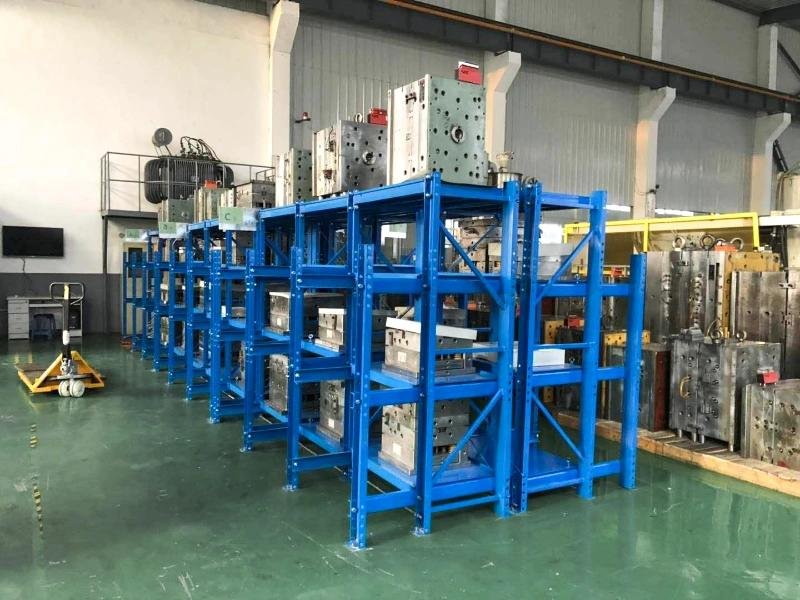
Standard Mold Rack
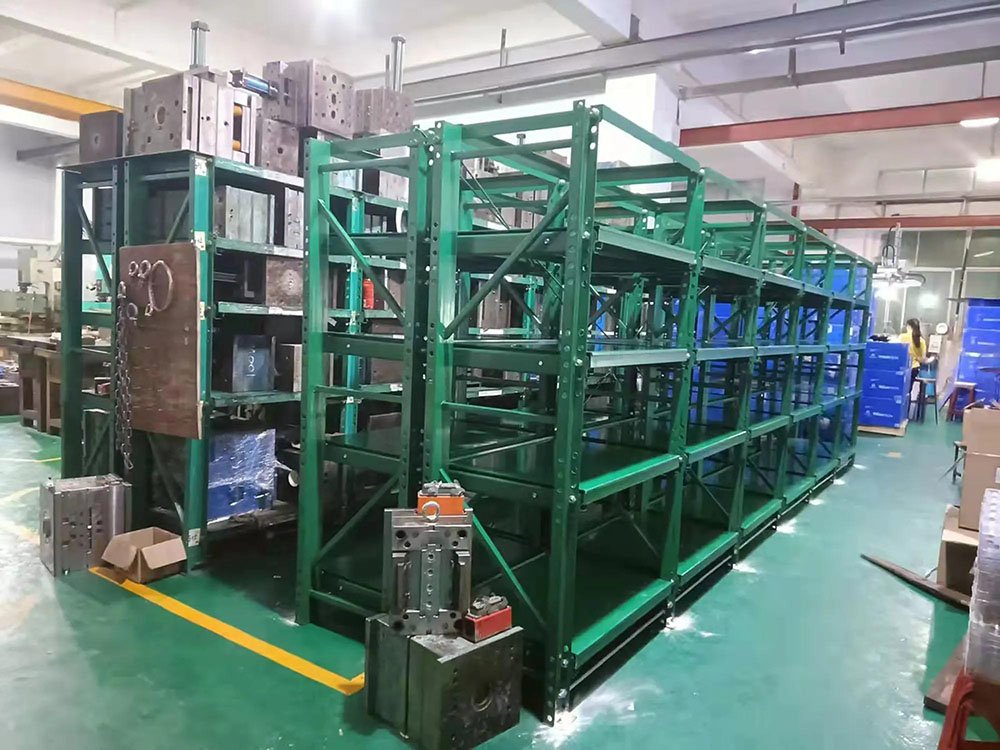
Drawer-out mold racking with bearing slides — rated to 1,000 kg per drawer. The entry-level workhorse for injection moulders handling small to mid-size moulds. Cuts die-change time from 45 min to under 20 min.
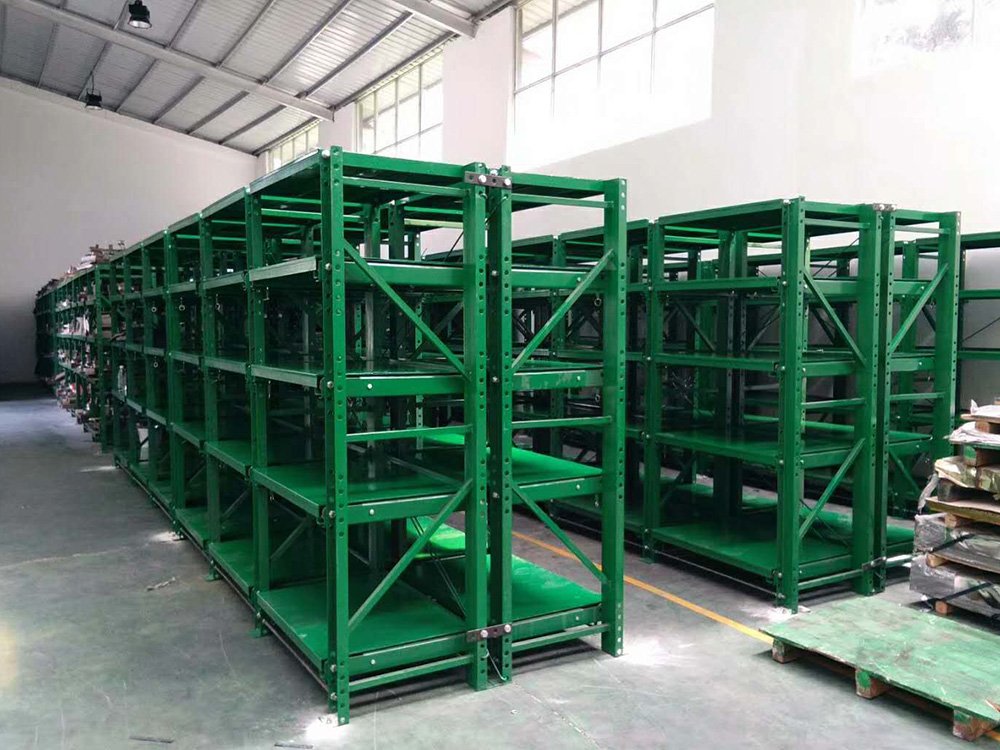
Full-Open Mold Rack
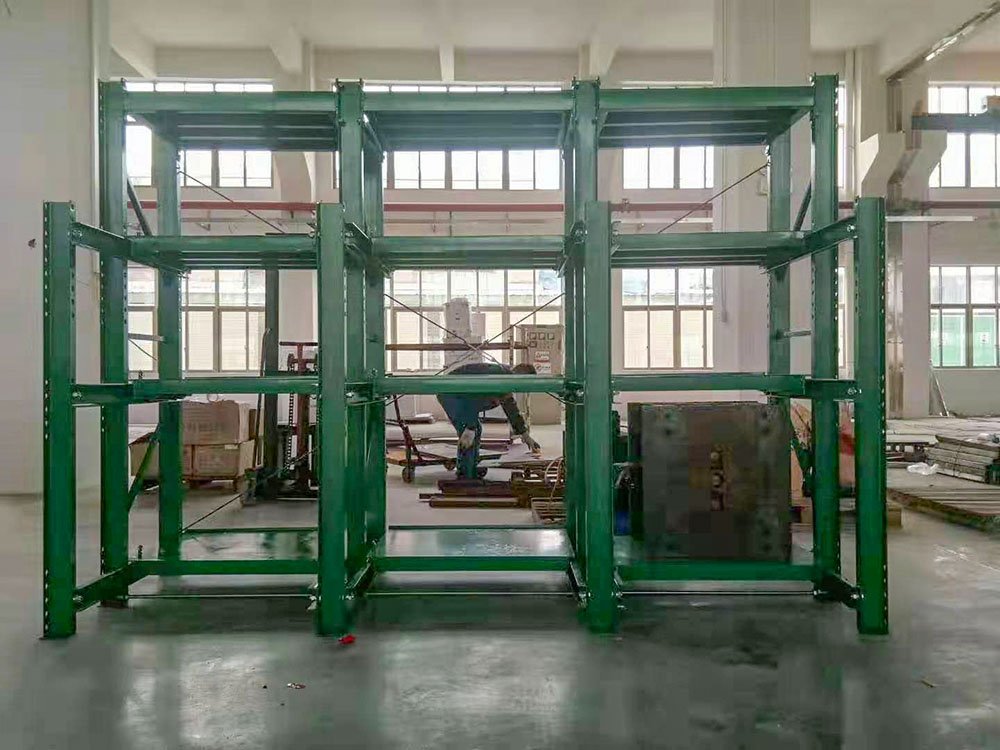
100% full-extension drawer design — 1,000–3,000 kg per drawer. Drawer fully clears the upright so the overhead crane can lift directly from above with zero obstruction. The volume seller across injection, stamping and die-casting shops.
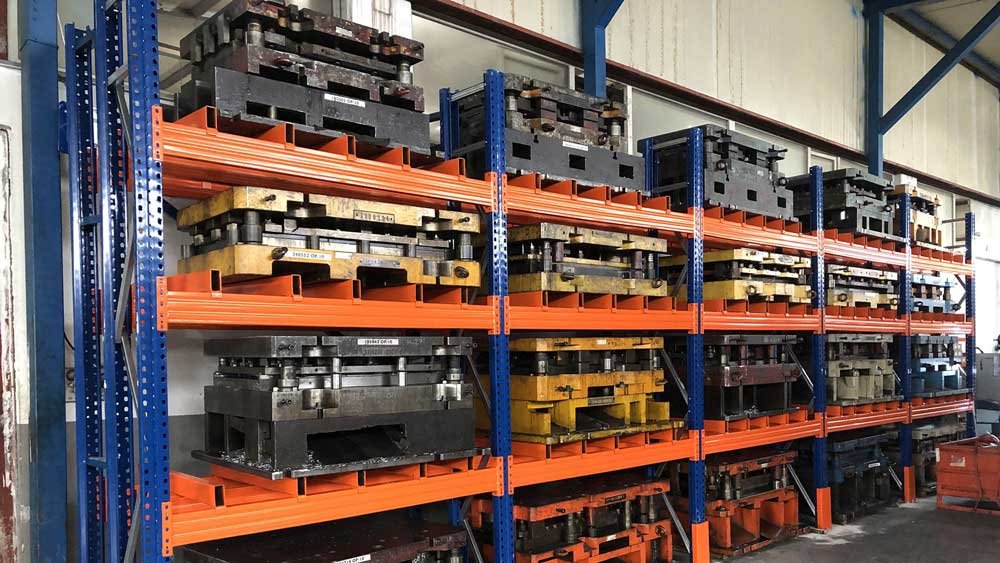
Selective Pallet Rack for Moulds
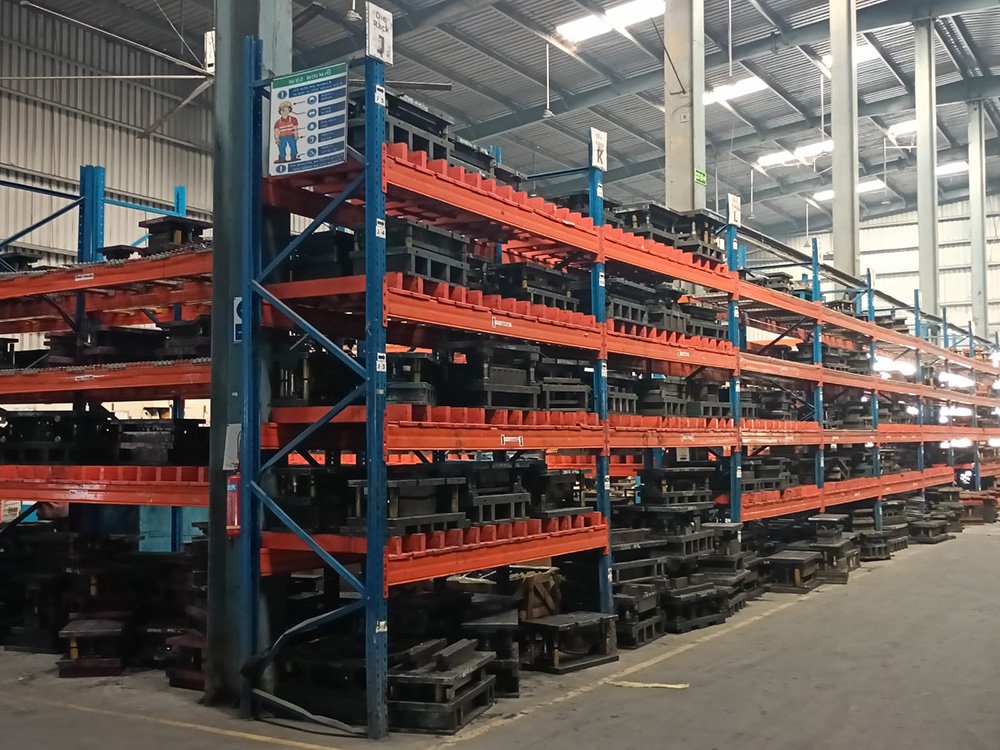
Heavy-duty selective racking adapted for mould storage — 1,000–4,000 kg per pallet position on reinforced steel cradles or bolted-down carriers. Forklift access, lowest cost-per-position, ideal for low-rotation mould archives and overflow inventory.
H-Steel Ultra Heavy-Duty Mold Rack
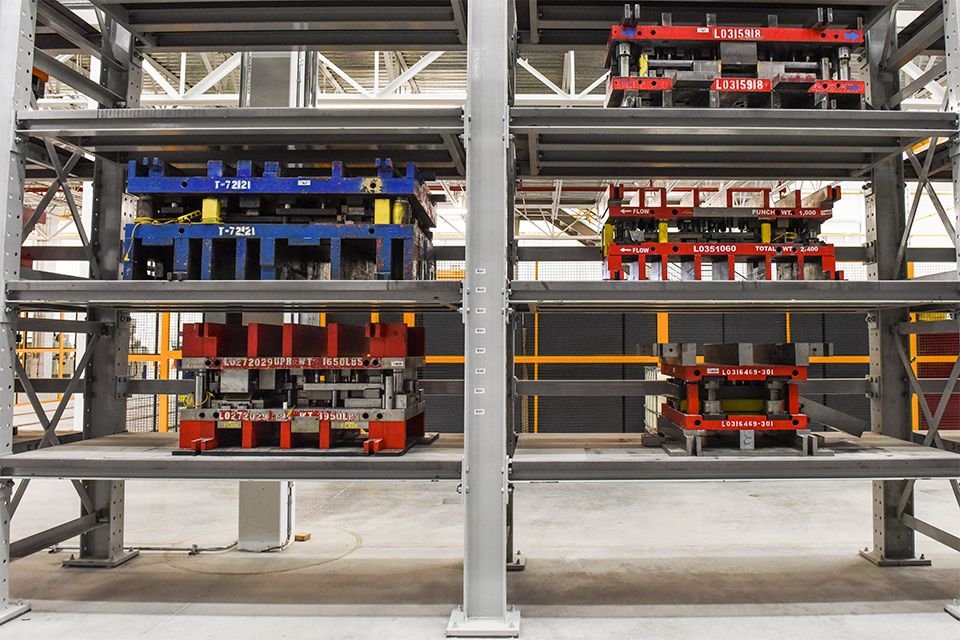
Hot-rolled H-beam column and cross-member construction rated to 5,000–8,000 kg per position. Purpose-built for large stamping dies, forging tools and heavy-press moulds where standard cold-formed racks simply cannot carry the load. Crane-only access with reinforced anchor plates.
Mold Storage Builds Cutting Change-Over Time on Real Plants
Three recent tooling storage installations where AME Rack designed the full mold racking architecture. Names, scales and operating duration available with signed buyer feedback on request.
Heavy-Duty Mold Racks for EU Injection Plant
40 full-open heavy-duty mold racks rated 2,500 kg each for a German injection moulding plant supplying an automotive Tier 1 supplier. Die-change time fell from 42 min to 11 min — a 73% SMED improvement validated by independent OEE audit.
XXL Mold Racks for Chinese Die-Casting Plant
XXL drawer-rack configuration rated 4,000 kg per drawer for a Chinese aluminium die-casting plant handling large-press tooling. Recovered 1,200㎡ of floor area previously wasted on pallet-stored dies; cut maintenance crew search time by 65%.
Standard Mold Racks for SE Asian Stamping Plant
30 standard mold racks (1,000 kg/drawer) for a Vietnamese stamping plant supplying an OEM truck programme. Mixed crane + forklift access design accommodated existing tool-room equipment without capex on new lifting gear.
Mold & Mould Racking Engineering Specs
The parameters tool-room managers, plant engineers and Tier 1 supplier procurement teams ask for first. Full datasheets and stamped FEA reports issued free with every project — IATF-compatible documentation language available on request.
| Parameter | Standard Mold | Full-Open HD Mold | XXL Mold | HD Selective | Mezzanine |
|---|---|---|---|---|---|
| Capacity per Drawer / Pair | 1,000–2,000 kg | 2,000–3,000 kg | Up to 8,000 kg | Up to 4,000 kg | 500–800 kg/㎡ |
| Drawer Extension | 80–100% | 100% full-open | 100% full-open | n/a | n/a |
| Access Method | Crane + forklift | Crane + forklift | Crane only | Forklift | Manual + light hoist |
| Drawer Slide Type | Standard bearing | HD bearing | XXL bearing + lock | n/a | n/a |
| Standard Height | 3–4 m (3–4 levels) | 3–5 m (3–4 levels) | 3–5 m (2–3 levels) | 4–8 m | 2–3 tiers |
| Steel Grade | Q345B | Q345B heavy gauge | Q345B XXL gauge | Q345B | Q345B + H-beam |
| Upright Gauge | 3.0–4.0 mm | 4.0–5.0 mm | 5.0–6.0 mm | 2.5–3.0 mm | 3.0–4.0 mm |
| Surface Protection | PE-coated drawer | PE-coated drawer | PE-coated drawer | Powder coat | Powder coat |
| Coating DFT | 80–100 μm | 80–120 μm | 80–120 μm | 60–100 μm | 80–120 μm |
| Compliance | EN 15512 · AS 4084 · RMI MH16 · FEM 10.2.02 · IATF-friendly documentation | ||||
| Crane Clearance Design | Custom per project — verified during 3D layout phase | ||||
| Typical Lead Time | 25 days | 25–30 days | 30–35 days | 20 days | 25–35 days |
How to Choose: When A vs B for Your Tool Room
Six trade-off decisions specific to mold and mould storage. Use these as the first-pass filter before requesting a detailed layout from our tooling-storage engineering desk.
Standard Mold Rack vs Full-Open HD Mold Rack?
Standard Mold Rack for moulds up to 2,000 kg with 80–100% drawer extension — best capex efficiency for typical injection plants. Full-Open HD Mold Rack mandatory for moulds 2,000–3,000 kg requiring 100% drawer extension for direct crane lift — cuts die-change time by additional 30%.
Mold Rack vs Heavy-Duty Selective?
Mold Rack (drawer-out) for any mould stored more than 30 days — drawer access cuts die-change time and protects mould faces. Heavy-Duty Selective only for moulds shipped on standardised pallets where crane access is not available.
Crane Access vs Forklift Access?
Crane Access mandatory for moulds > 2,000 kg — forklift mast capacity and pallet stability become unsafe above that weight. Forklift Access acceptable for moulds < 1,500 kg with pre-fitted lifting eye-bolts. Many shops use mixed access: forklift on lower drawers, crane on upper.
Vertical Mold Rack vs Floor Storage?
Vertical Mold Rack wins on every metric — recovers 60–70% of tool-room floor area, accelerates die-change, protects mould surfaces, traceable to IATF audit. Floor Storage only acceptable for moulds > 5,000 kg or used less than 4 times per year.
How to design for SMED die-change?
Four engineering tools: (1) full-open drawer-out racks — zero search time, mould fully exposed for crane; (2) zoned slotting by mould family — related moulds stored close to the right press; (3) bay-level signage + RFID for instant ID verification; (4) crane-clearance aisle design — direct hook-up without manoeuvring.
How to prevent mould rust during long-term storage?
Three engineering tools: (1) enclosed mezzanine zones with controlled humidity (<55% RH); (2) VCI paper-friendly drawer slots for chemical rust inhibition; (3) PE-coated drawer surfaces to prevent water pooling. Critical for moulds stored more than 90 days between production runs.
Side-by-Side: Which Mold Rack Wins for Your Tool Profile
Five rack types × eight tool-room criteria — the shortcut most tool-room managers wish they had before issuing the RFP. Use to narrow rack mix per mould weight class, lifting equipment and change-over frequency.
| Selection Criteria | Standard Mold | Full-Open HD | XXL Mold | HD Selective | Mezzanine |
|---|---|---|---|---|---|
| 500–2,000 kg Mould | ★★★★★ | ★★★★ | ★★★ | ★★★ | ★ |
| 2,000–3,000 kg Mould | ★★★ | ★★★★★ | ★★★★ | ★★★ | ★ |
| 3,000+ kg Mould | ★ | ★★★ | ★★★★★ | ★★★ | ★ |
| Die-Change Speed (SMED) | ★★★★ | ★★★★★ | ★★★★ | ★★★ | ★★ |
| Floor Recovery vs Floor Storage | ★★★★ | ★★★★★ | ★★★★ | ★★★★ | ★★★★★ |
| Capex (per mould stored) | $$ Mid | $$$ High | $$$$ Very High | $ Low | $$ Mid |
| IATF / ISO Audit Friendly | ★★★★ | ★★★★★ | ★★★★ | ★★★★ | ★★★★ |
| Best Match Operation | Injection plant | Heavy injection / die-cast | Large-press / forging | Palletised mould stock | Inserts & accessories |
Mold Storage Racking Buyer's FAQ
The 15 questions tool-room managers, injection plant engineers and Tier 1 supplier procurement teams ask before issuing the first PO.
01What is the best racking system for an injection mold warehouse?
02How heavy a mould can a single drawer hold?
03How much die-change time can mold racks save?
04How much floor space can vertical mold racks recover?
05Can mold racks be accessed by both crane and forklift?
06How do you protect mould parting lines and cavities from damage in storage?
07How do you prevent mould rust during long-term storage?
08How do you trace mould inventory for IATF 16949 audits?
09What height is achievable for mold racks?
10Are AME Rack mold racks compliant with IATF 16949 and ISO 9001?
11What is the warranty on mold racking?
12What is the typical lead time for mold racks?
13Do you ship mold racks to North America, Europe and Asia-Pacific?
14What payment terms work for tool-room buyers?
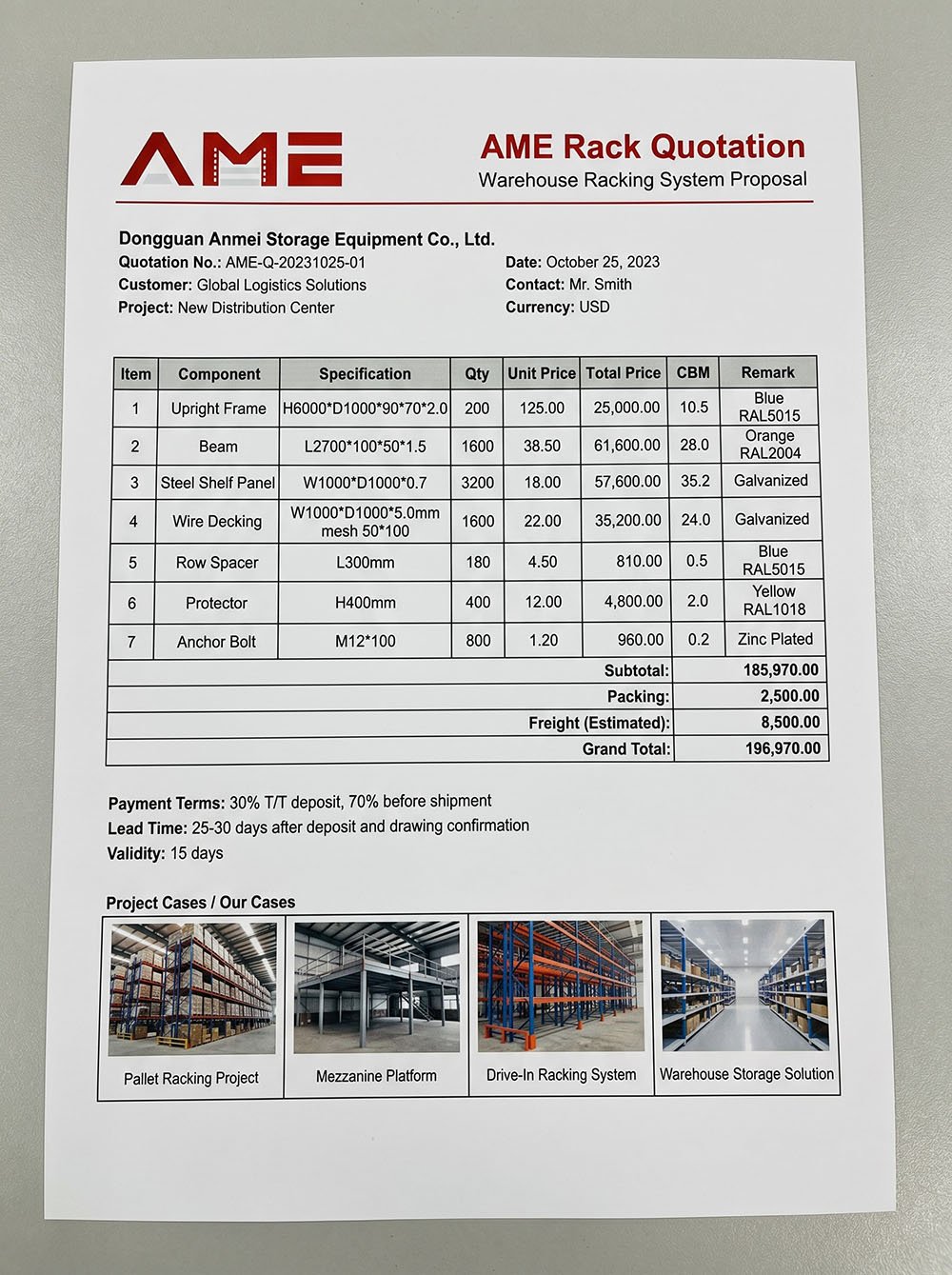
15How does AME Rack pricing compare for mold rack projects?
Ready to Design the Right Mold Rack Mix for Your Tool Room?
Send your mould weight distribution, change-over frequency, lifting equipment (crane / forklift) and building dimensions — receive a full 3D layout, FEA report, IATF-friendly documentation pack and FOB quotation within 4 working hours. Zero commitment.