Manufacturing facilities handling injection molds, die-casting tooling, stamping dies, and hardware molds face a persistent storage challenge: molds are heavy, expensive, and require frequent access during production changeovers. A well-engineered mold storage rack — often called a drawer rack or die rack — directly influences production efficiency, mold longevity, and workplace safety. Sourcing from a China mold storage rack manufacturer has become the default approach for injection molding factories, automotive parts producers, and die-casting operations worldwide, driven by the combination of specialized production capacity, competitive pricing, and mature OEM customization capabilities.
The Chinese mold rack sector, however, is fragmented. Hundreds of storage equipment producers list mold racks in their catalog, but only a subset actually operate dedicated tooling for drawer bearings, guide rails, overhead hoist support beams, and reinforced upright frames required for multi-ton mold loads. This guide profiles ten notable China mold storage rack manufacturers with documented mold rack product lines, explains why the Chinese supply chain delivers strong value for international buyers, and outlines the technical and commercial criteria that determine a successful procurement outcome.
What Is a Mold Storage Rack
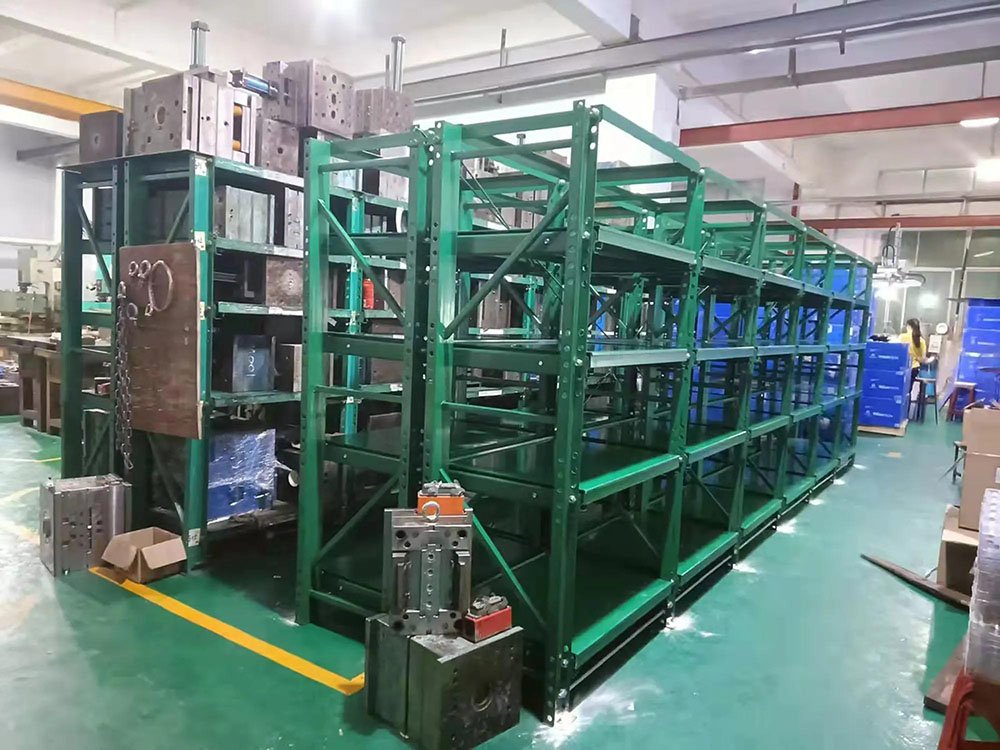
A mold storage rack is a heavy-duty industrial storage structure designed to hold injection molds, die-casting molds, stamping dies, and hardware molds on horizontal drawer panels that can be pulled out for direct access. The rack typically consists of reinforced upright columns, horizontal load beams, drawer panels mounted on rolling bearings, U-type or roller guide rails, safety positioning devices, and an optional overhead hoist beam with manual or electric chain hoist for lifting molds in and out of position.
Unlike standard pallet racking, mold racks are engineered around three specific requirements: high concentrated load per drawer (typically 500 kg to 3,000 kg per level), horizontal sliding access without forklift entry, and vertical lifting integration for safe mold handling. Product variants include:
- Standard mold racks — light to medium-duty, 200 kg to 800 kg per drawer, for smaller injection molds and hardware dies
- Heavy-duty mold racks — 800 kg to 1,500 kg per drawer, for medium-sized industrial molds
- Ultra heavy-duty H-steel mold racks — 1,500 kg to 3,000 kg per drawer, for large automotive and packaging molds
- Fully open mold racks — drawer pulls out 100% for full mold access
- Standard drawer mold racks — drawer pulls out 50% to 75%, suitable for smaller footprint installations
The system is widely deployed in injection molding plants, automotive stamping facilities, die-casting operations, hardware die manufacturers, and precision tooling workshops.
Overview of China’s Mold Rack Manufacturing Industry
China’s mold storage rack production is concentrated in two industrial belts that also dominate the broader storage equipment sector. Guangdong Province — Dongguan, Foshan, Guangzhou — sits close to the country’s largest injection molding cluster and produces the majority of mold racks destined for South China’s manufacturing base and export markets in Southeast Asia. Jiangsu Province, particularly Nanjing and surrounding industrial zones, hosts larger-scale producers with strong integration into automotive tooling and heavy machinery supply chains serving East China and international heavy-industry buyers.
Both belts support the full range of mold rack configurations, but the sourcing profile differs. Guangdong producers typically offer higher flexibility on small-batch and custom-drawer configurations, benefiting from immediate proximity to injection mold end-users who inform rapid product iteration. Jiangsu producers frequently handle larger industrial contracts with dedicated engineering departments and heavier structural configurations required for automotive and container-mold applications.
Xiamen (Fujian) and Shanghai also host individual producers with strong export orientation, though at smaller aggregate volumes than the two dominant belts.
Why International Buyers Source Mold Racks from China
The commercial advantages of sourcing mold storage racks from Chinese manufacturers extend well beyond unit price. Four structural factors combine to produce the value proposition that has made China the default sourcing origin for mold storage equipment worldwide.
Vertically integrated production. Established Chinese mold rack manufacturers operate in-house steel processing, CNC punching, roll forming, welding (often robotic), powder coating or hot-dip galvanization, and drawer bearing assembly. This vertical integration eliminates multiple middleman margins and shortens lead times.
Specialized tooling for drawer components. Mold racks require precision-manufactured drawer bearings, guide rails, and locking mechanisms that differ from standard pallet racking components. Chinese producers have amortized this tooling investment across two decades of high-volume production, making custom drawer geometry economically feasible even at moderate order quantities.
Engineering capacity for custom load specifications. Larger Chinese producers maintain in-house engineering teams providing CAD-based drawer layout, FEA structural calculations, and 2D/3D drawings — services frequently included at no additional cost for standard project sizes.
Container-optimized packing. Standard mold rack configurations pack efficiently into 20 GP and 40 HQ containers in knock-down form, delivering the lowest possible freight cost per drawer bay when combined with disciplined packing engineering.
The combined effect is delivered mold rack unit costs typically 40% to 60% below equivalent European and North American manufacturers, with lead times of 15 to 45 days for engineered projects and 7 to 15 days for stock configurations.
10 Notable China Mold Storage Rack Manufacturers
The following ten manufacturers are widely recognized in the Chinese mold rack sector and consistently appear in industry supplier directories, international B2B platforms, and Fortune 500 supplier qualifications. The list is not a ranked comparison — each producer serves different market segments, and suitability depends entirely on project requirements.
Mracking (Guangdong Xinmiao Storage Equipment Co., Ltd.)
Established in 2008 in Dongguan, Mracking maintains a dedicated mold rack product line covering standard and fully-open drawer configurations for injection molds, die-casting molds, and hardware molds. The company reports over 16 years of manufacturing experience, ISO 9001 certification, and export coverage across Asia, Europe, and the Americas.
Strengths: Clear mold rack product focus; multi-configuration drawer options; free 2D and 3D CAD design service for custom projects; established Alibaba and Made-in-China presence for straightforward RFQ.
Buyer Considerations: Buyers should request current factory audit reports and confirm which specific drawer capacity classes are held as stock tooling versus fully custom fabrication.
Lijin (Guangdong Lijin Storage Equipment Co., Ltd.)
Founded around 2000–2002 in Dongguan, Lracking operates a factory of approximately 15,000–23,000 m² and reports mold rack heavy-duty capacity up to 3 tons per drawer level. The company lists exports to more than 70 countries and holds ISO 9001, CE, and AS 4084 certifications.
Strengths: Documented heavy-duty capacity extending to 3 tons per drawer; long operating history in the Guangdong cluster; multiple international certifications; established design and installation services.
Buyer Considerations: Because the company covers many product categories beyond mold racks, buyers should confirm the dedicated tooling in place for their specific drawer size and load class.
Gieantech (Dongguan Giean Intelligent Storage Equipment Co., Ltd.)
Established in 2008, Gieantech operates a 20,000 m² factory in Dongguan with approximately 200 employees. Mold rack offerings include space-saving drawer-type configurations supporting 1,000 kg to 3,000 kg per level with smooth sliding overhead crane access. The company reports FEM/EN 15512 and AS 4084 compliance and exports to more than 57 countries.
Strengths: Modern vertically integrated facility; dedicated in-house engineering team; documented FEA structural calculation capability; robotic welding stations improve drawer frame consistency.
Buyer Considerations: Being a mid-sized producer with a broad product mix, buyers should confirm project queue availability during peak season before committing to tight delivery windows.
AME Rack (Dongguan Anmei Storage Equipment Co., Ltd.)
Founded in 2005, AME Rack specializes in warehouse storage racks and logistics equipment. The mold rack product line covers medium-duty (800 kg to 1500 kg per layer) and heavy-duty (1500 kg to 3,000 kg per layer) configurations with optional galvanized or powder-coated finishes. Drawer plates use rolling bearings and U-type slides for low-resistance pull-out even under full load. The company operates under AS 4084 compliance.
Strengths: Dedicated mold rack product focus with documented light-duty and heavy-duty variants; free color and finish customization; OEM/ODM support.
Buyer Considerations: Factory size and total capacity are less publicly documented than some larger peers — buyers should request factory area and production line details during qualification.
Kingmore (Jiangsu Kingmore Storage Equipment Manufacturing Co., Ltd.)
Based in Jiangsu with head office in Nanjing and a production base in Jinhu, Kingmore operates two factories covering 80,000 m² with reported annual capacity of 200,000 tons. Mold rack lines include medium-duty drawer racks below 750 kg per layer and heavy-duty drawer racks above 750 kg per layer, with optional manual or power-driven overhead hoists. Certifications include AS 4084, FEM, RMI, and CE.
Strengths: Very large production capacity; heavy investment in automated production lines and welding robots; strong presence on international project bids requiring high-volume drawer rack production.
Buyer Considerations: The head office in Nanjing and production base in Jinhu are separated by roughly 250 km, so factory visits require additional logistical planning.
Aceally (Aceally Xiamen Technology Co., Ltd.)
Founded in 1999, Aceally operates from Xiamen (Fujian Province) with a Nanjing production facility and reports service coverage across 60+ countries. Product coverage includes electric drawer-type sheet metal storage systems, pallet racking, mezzanine floors, and cantilever racking. Warranty on racking systems is stated at 10 years subject to installation and use conditions.
Strengths: Long operating history; documented electric drawer product line for larger sheet-form molds and dies; 15+ year engineering team experience; extended warranty terms.
Buyer Considerations: Buyers should verify which drawer configurations are manufactured in-house versus sourced from partner facilities, and confirm structural calculation availability for custom heavy-duty projects.
A-Plus (A-Plus Metal)
Founded in 1993, A-Plus specializes in sliding mold racks with idler wheel rails on each level, allowing drawer panels to be freely pulled out under load. Product line focuses on heavy-duty slide mold racks with manual movable carriage integration on top for mold handling.
Strengths: One of the longest-established mold rack producers in China; documented specialization in sliding drawer configurations; idler-wheel rail engineering distinguishes the drawer mechanism from bearing-only competitors.
Buyer Considerations: Public information on international certification coverage is limited — buyers should request ISO, CE, and destination-market certificates during supplier qualification.
Huade (Nanjing Huade Storage Equipment Manufacturing Co., Ltd.)
Nanjing-based Huade produces mold storage racks alongside drive-in racking, cold storage systems, and automated shuttle-carrier systems. Since 2016, Huade has developed multiple generations of 4-way shuttle systems, and mold rack production benefits from the same welding and coating infrastructure serving the shuttle line. Export coverage includes Europe, America, Australia, Japan, Kenya, Iran, Holland.
Strengths: Broad export footprint; robotic welding under rectification and epoxy powder electrostatic paint coating lines under upgrading; integration with adjacent heavy-industrial storage product lines.
Buyer Considerations: Because mold racks are one of several product categories, dedicated mold rack engineering resources should be confirmed for larger custom projects.
Nanjing Jinhui Storage Equipment Co., Ltd.
Founded in 2006 in Nanjing, Jinhui operates two production plants covering approximately 40,000 m². Product coverage includes standard mold racks, heavy-duty mold racks, and H-steel ultra heavy-duty mold storage racks. The company is verified by SGS and BV.
Strengths: Solid production capacity for mid-sized projects; documented H-steel ultra heavy-duty mold rack variant for large tooling; third-party inspection verification.
Buyer Considerations: Cantilever and mold-specific project references should be validated during supplier qualification, as public project documentation is less extensive than for some larger peers.
NOVA Racking (Nanjing)
Nanjing-based NOVA operates in the warehouse racks and automation warehouse systems segment with export coverage to more than 120 countries across five continents. Product line covers mezzanine racking, AS/RS systems, heavy-duty racking, and mold racking.
Strengths: Very broad export coverage; automation warehouse experience benefits mold rack projects requiring integration with automated retrieval; established reputation in both domestic and overseas markets.
Buyer Considerations: Given the automation focus, buyers requiring simple manual-drawer mold racks should confirm pricing competitiveness against more focused mold rack specialists.
Comparative Summary Table
| Manufacturer | Location | Founded | Approx. Factory Area | Mold Rack Capacity | Export Reach |
|---|---|---|---|---|---|
| Mracking | Dongguan, GD | 2008 | Not publicly disclosed | Standard + fully-open | Global |
| Lijin | Dongguan, GD | 2000–2002 | 15,000–23,000 m² | Up to 3,000 kg / drawer | 70+ countries |
| Gieantech | Dongguan, GD | 2008 | 20,000 m² | 1,000–3,000 kg / drawer | 57+ countries |
| AME Rack | Dongguan, GD | 2005 | 15,500 m² | 1,000–3,000 kg / drawer | 65+ countries |
| Kingmore | Nanjing / Jinhu, JS | Not disclosed | 80,000 m² (2 plants) | Medium & heavy-duty | Global |
| Aceally | Xiamen / Nanjing | 1999 | Not publicly disclosed | Electric drawer type | 60+ countries |
| A-Plus | China | 1993 | Not publicly disclosed | Sliding heavy-duty | Global |
| Huade | Nanjing, JS | Not disclosed | Not publicly disclosed | Standard + heavy-duty | Europe, Americas, Asia, Oceania |
| Jinhui | Nanjing, JS | 2006 | 40,000 m² (2 plants) | Standard, heavy, H-steel ultra | Global |
| NOVA Racking | Nanjing, JS | Not disclosed | Not publicly disclosed | Mold + broader racking | 120+ countries |
Key Procurement Considerations for Mold Storage Racks
Beyond manufacturer selection, the technical specifics of a mold storage rack order determine whether the delivered system performs as expected. Buyers evaluating Chinese suppliers should confirm the following categories before releasing a purchase order.
Drawer load specification. Kilograms per drawer level should be documented explicitly in the RFQ — not general terms like “heavy-duty.” Overspecified capacity increases cost unnecessarily; underspecified capacity creates safety risk and premature bearing failure. Buyers should provide the heaviest single mold to be stored, the maximum total load per drawer if multiple molds share one level, and the frequency of drawer cycling per shift.
Drawer bearing and guide rail specification. The drawer mechanism is the most heavily engineered component of a mold rack and the primary source of long-term reliability differences between suppliers. Rolling bearings, U-type slides, and idler-wheel rails each have different load ratings, pull-out force requirements, and maintenance intervals. Buyers should specify bearing type, pull-out percentage (50%, 75%, or 100%), and required smoothness under full load.
Upright column and beam engineering. Multi-drawer racks stack cumulative load onto the upright frames. Q235B is the standard steel grade for medium-duty configurations; Q345 or hot-rolled H-beam sections are required for heavy-duty and ultra heavy-duty variants above 1,500 kg per drawer. Material certificates should be requested for each production batch.
Overhead hoist integration. If the mold rack will be paired with a manual or electric hoist for mold lifting, the hoist support beam must be engineered as part of the rack structure — not added as an afterthought. Hoist track length, hoist capacity, and required clearance above the top drawer should all be specified during RFQ.
Base plate and floor anchoring. Base plate dimensions, anchor bolt specification, and required floor slab thickness are essential for structural integrity, particularly for ultra heavy-duty variants concentrating point loads onto small footprints.
Design documentation. Buyers commissioning custom configurations should require full 2D and 3D CAD drawings and a structural calculation report showing drawer capacity, column buckling capacity, base overturning resistance, and overall system stability.
Common Mistakes to Avoid in Mold Rack Procurement
Buyers new to sourcing from Chinese mold rack manufacturers frequently encounter a consistent set of issues that can be prevented with disciplined RFQ management.
- Assuming standard drawer capacities. Suppliers often quote against generic capacity classes without universal definition. Always specify capacity in kilograms per drawer and confirm the safety factor applied.
- Overlooking drawer cycling frequency. Bearing life depends on load cycles, not just static capacity. High-cycle operations (frequent mold changeovers) require heavier bearings than static-storage applications, even at the same load rating.
- Skipping bearing inspection during factory audit. For orders above one to two container loads, physical or verified video factory audit of drawer bearing quality significantly reduces the risk of receiving substandard components.
- Accepting vague delivery commitments. Lead time should be written into the sales contract with penalty clauses for delay, not left as a verbal agreement.
- Neglecting installation guidance. Even prefabricated mold racks require correct installation to reach rated capacity. Suppliers should provide installation drawings, torque specifications, and post-installation inspection checklists.
- Focusing on unit price without accounting for hoist integration. A mold rack without properly engineered hoist support is often unusable for its intended purpose — hoist compatibility and support beam design should be part of initial quotation comparison.
Certification and Compliance Requirements
Mold storage racks installed in commercial and industrial facilities are subject to structural design codes that vary by region. Buyers should ensure supplier certifications align with the destination market:
- ISO 9001 — Baseline quality management system certification; standard among established Chinese manufacturers.
- CE Marking (Europe) — Required for machinery-classified installations and for import into the European Economic Area.
- AS 4084 (Australia / New Zealand) — The steel storage racking design standard; mandatory reference for Australian buyers.
- FEM 10.2.08 (Europe) — European design specification governing storage-related structural requirements.
- RMI / ANSI MH16.1 (North America) — U.S. design standard published by the Rack Manufacturers Institute.
- SGS / BV inspection certificates — Third-party production inspection frequently used by international buyers to validate quality claims.
Buyers should not rely on marketing statements alone. Original certificates with valid dates, issuing body, and scope of coverage should be provided during supplier qualification. Additional guidance on structural racking safety is published by the Material Handling Institute and the Rack Manufacturers Institute for reference.
Frequently Asked Questions
How is the load capacity of a mold rack drawer determined?
Drawer load capacity depends on drawer panel gauge, supporting frame section, bearing rating, guide rail specification, and applied safety factor — typically 1.5 to 2.0 for industrial mold racks. Reputable manufacturers publish capacity tables cross-referencing drawer size, panel thickness, and rated load. For custom heavy-duty configurations, buyers should request an FEA structural calculation report before accepting the design.
What is a typical MOQ for mold storage racks from Chinese manufacturers?
MOQ varies by supplier and configuration. Standard mold rack bays often start at 5 to 10 units, while ultra heavy-duty H-steel configurations may require 10 to 20 units due to specialized tooling setup. Consolidated container shipments across multiple product lines can often justify lower mold rack quantities. Sample orders below MOQ are available from most producers at adjusted unit pricing.
How do buyers verify that a China mold storage rack manufacturer is not a trading company?
Direct manufacturers welcome factory audits — either on-site or via live video walkthrough of raw material storage, drawer bearing assembly, welding stations, and powder coating booths. Trading companies typically resist or delay such requests. Buyers can also cross-check the company’s registered business scope on China’s National Enterprise Credit Information Publicity System to confirm that manufacturing is listed among the registered business activities.
Should overhead hoists be purchased from the same mold rack supplier?
Yes, in most cases. Hoist selection, track integration, and support beam engineering are structurally interconnected with the rack itself. Purchasing hoist and rack from the same supplier ensures compatibility, single-source accountability, and simplified installation. Manual chain hoists are standard for lighter mold ranges; electric hoists are recommended above 1,000 kg per lift or for high-cycle applications.
How many mold rack bays fit into a 20-foot container?
Standard cold-formed mold racks packed in knock-down form typically load 30 to 60 bays per 20 GP container, depending on drawer size, upright height, and number of drawer levels per bay. Ultra heavy-duty H-steel configurations load fewer units per container due to higher section weight. Efficient packing design significantly reduces freight cost per bay, and container loading plans should be part of the RFQ response.
What is the typical lead time for mold rack production in China?
Stock-specification mold rack configurations typically ship within 7 to 15 days after order confirmation. Custom-engineered projects with non-standard drawer geometry, load class above 1,500 kg per drawer, or integrated overhead hoist systems generally require 25 to 45 days. Peak season (September to December) often extends lead times by 30% to 50%. Written lead time commitments with penalty clauses should be documented in the sales contract.
What steel grade should be used for heavy-duty mold rack construction?
Q235B is the standard structural steel for medium-duty mold rack configurations up to approximately 800 kg per drawer. For heavy-duty configurations above 1,000 kg per drawer, Q345 delivers higher yield strength and better long-term durability under repeated loading. Ultra heavy-duty configurations above 2,000 kg per drawer frequently use hot-rolled H-beam sections. Material certificates should be requested for each production batch.
Conclusion
Sourcing mold storage racks from China offers substantial cost and customization advantages, but only when supported by disciplined supplier evaluation. The ten manufacturers profiled above represent a cross-section of the Chinese mold rack sector — spanning the Guangdong cluster with strong customization flexibility and the Jiangsu cluster with larger heavy-industrial production capacity, covering standard cold-formed to ultra heavy-duty H-steel configurations, and serving buyers from small injection molding plants to Fortune 500 automotive OEMs.
No single manufacturer suits every project. Buyers operating injection molding facilities, automotive stamping plants, die-casting operations, and precision tooling workshops each face different mold weight, cycling frequency, and space constraints, and the right supplier is the one whose drawer engineering, bearing specification, and production scale align with those specifics. A structured RFQ process — with documented drawer load, verified certifications, factory audit, and written contract terms — remains the most reliable path to a successful mold rack procurement outcome.
Producers specialising in engineered drawer-type mold storage often combine reinforced upright frames with precision-manufactured bearing systems designed for high-cycle industrial use. Among such specialists is AME Rack, whose Dongguan facility produces standard, heavy-duty, and fully-open mold rack configurations engineered for injection mold, die-casting, and hardware die storage. Buyers building out complete tooling storage environments frequently combine mold racks with adjacent solutions — full injection mold and mould storage layouts, heavy-duty racking for auxiliary tooling and consumables, and industry-standard pallet systems referenced in the broader overview of China pallet racking manufacturers.