Every warehouse is different. That’s why buyers eventually run into the same question: how to customize pallet racking so it actually fits the building, the pallets, the forklifts, and the way the team works. Off-the-shelf racking works for standard operations — but the moment there’s an odd building shape, oversized pallets, tight aisles, or mixed load classes, customization stops being optional.
The good news? Customizing pallet racking isn’t as complicated as most buyers think. It’s mostly about asking the right questions upfront, giving suppliers the right information, and knowing which options are worth paying extra for. This guide walks through the whole process — from the first measurement to signing the contract — in plain terms, so warehouse teams can get racking that fits without paying for engineering they don’t need.
What Does Customized Pallet Racking Actually Mean
Customized pallet racking is a storage system that’s been engineered around specific project requirements — building dimensions, pallet size, load weight, forklift type, environment, and workflow — rather than picked from a standard catalog. Customization can be light (adjusted beam lengths, added accessories) or deep (custom uprights, special coatings, seismic engineering).
Most people assume “custom” means expensive and slow. Not really. In most cases, custom racking from Chinese manufacturers adds only 5% to 15% to the base price and 5 to 15 days to lead time — as long as the customization stays within the supplier’s existing tooling range.
Common customization categories include:
- Dimensional — beam length, upright height, depth, aisle width
- Structural — heavier steel sections, reinforced base plates, seismic bracing
- Load-related — higher capacity per beam level, extra safety factor
- Environmental — hot-dip galvanization for outdoor use, cold-storage adaptation
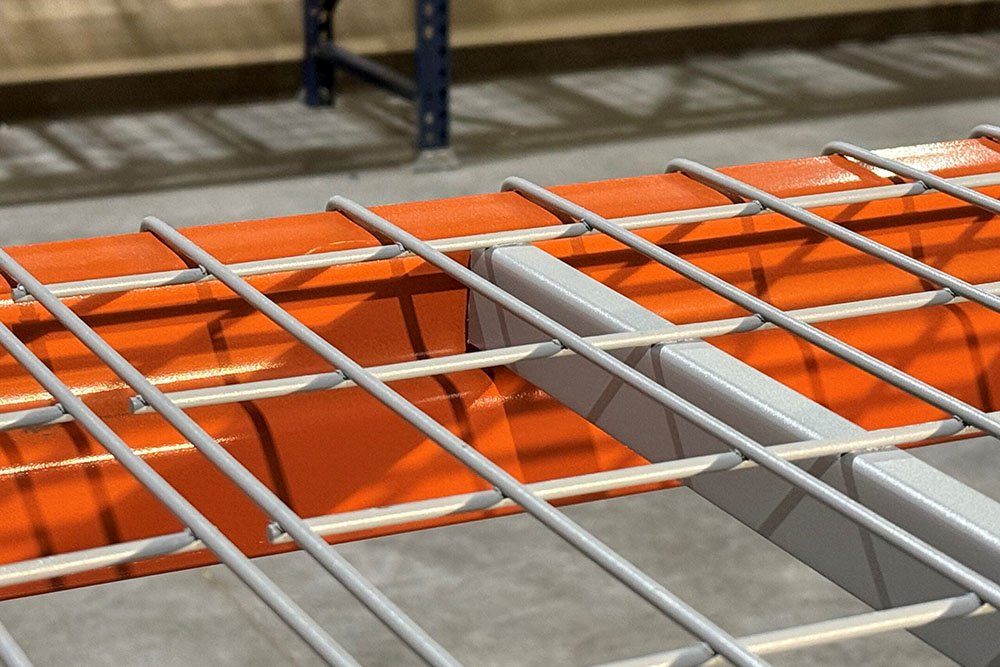
- Accessory — wire decking, pallet supports, column protectors, safety mesh
- Aesthetic — custom colors, branded labels, logos
Deep customization — completely custom upright profiles, non-standard tooling, unique load ratings above 5 tons per pallet — sits at the other end of the scale. That takes real engineering time and adds more cost.
Why Warehouses Need Customized Racking
If standard racking worked perfectly for every warehouse, nobody would bother with customization. But real warehouses have real quirks. Here are the situations where standard racking simply doesn’t fit.
Odd building dimensions. Column spacing that doesn’t match standard bay widths, ceiling heights that fall between standard upright sizes, or footprints with awkward corners — all of these force custom sizing.
Non-standard pallets. GMA pallets (1,200 × 1,000 mm) and Euro pallets (1,200 × 800 mm) are common — but plenty of industries use their own pallet sizes. Chemical drums on custom skids, printing plates, glass sheets, and automotive parts often come on non-standard pallets that need custom-sized beams and depths.
Heavy or concentrated loads. Standard racking is engineered for uniform pallet loads of 800 to 1,500 kg. Warehouses handling engine blocks, steel coils, ceramic slabs, or industrial molds routinely exceed 2,000 kg per pallet, which pushes the design into custom heavy-duty territory.
Cold storage or humid environments. Freezer warehouses at -25°C behave differently than dry warehouses at 20°C. Steel becomes more brittle, coatings need to handle condensation cycles, and construction tolerances have to account for thermal contraction.
Seismic zones. Warehouses in California, Japan, Chile, Turkey, and other high-seismic regions need racking engineered for lateral loads, not just vertical loads. That’s not a light touch of customization — it’s serious structural engineering.
Specific workflows. A 3PL handling mixed SKUs picks differently than a beverage distributor handling full pallets. Custom racking for 3PL and logistics warehousing can add pick modules at lower levels, reserve storage above, and integration points for conveyors or robots.
How to Prepare Before Talking to a Supplier
Here’s the truth: the more information a buyer brings to the first conversation, the better (and cheaper) the quotation comes back. Vague requests get padded quotes. Precise requests get sharp quotes.
Before contacting a supplier, gather the following:
Building information
- Length, width, and clear ceiling height (in millimeters)
- Column grid dimensions and column cross-section size
- Floor slab thickness and load-bearing capacity
- Location of doors, columns, sprinklers, and fire escape routes
- Existing floor flatness (F-number if measured, or visual assessment)
Pallet information
- Pallet type (GMA, Euro, custom, plastic, wood)
- Pallet dimensions (L × W × H)
- Weight per fully loaded pallet — worst case, not average
- How the load overhangs the pallet, if at all
Forklift information
- Forklift type (counterbalance, reach, VNA, sit-down, stand-up)
- Maximum lift height
- Turning radius and outer aisle width required
- Fork length and mast tilt angle
Operational information
- Total pallet positions needed
- Number of SKUs and average pallets per SKU
- FIFO or LIFO requirement
- Pick frequency (daily throughput)
- Growth projection over the next 3 to 5 years
Compliance information
- Destination market (affects certification requirements)
- Seismic zone classification and applicable RMI/ANSI storage rack design standard
- International Building Code requirements for steel storage racks and sprinkler requirements
- Any industry-specific regulations (food, pharma, chemical)
A rough hand-drawn layout with dimensions removes roughly 80% of the specification back-and-forth that usually slows quotations down. Even a photo of the empty warehouse space helps a lot.
What Customization Options Are Available
Once the supplier has the input data, the conversation shifts to options. Here’s what’s typically on the table — and which options actually matter versus which just add cost.
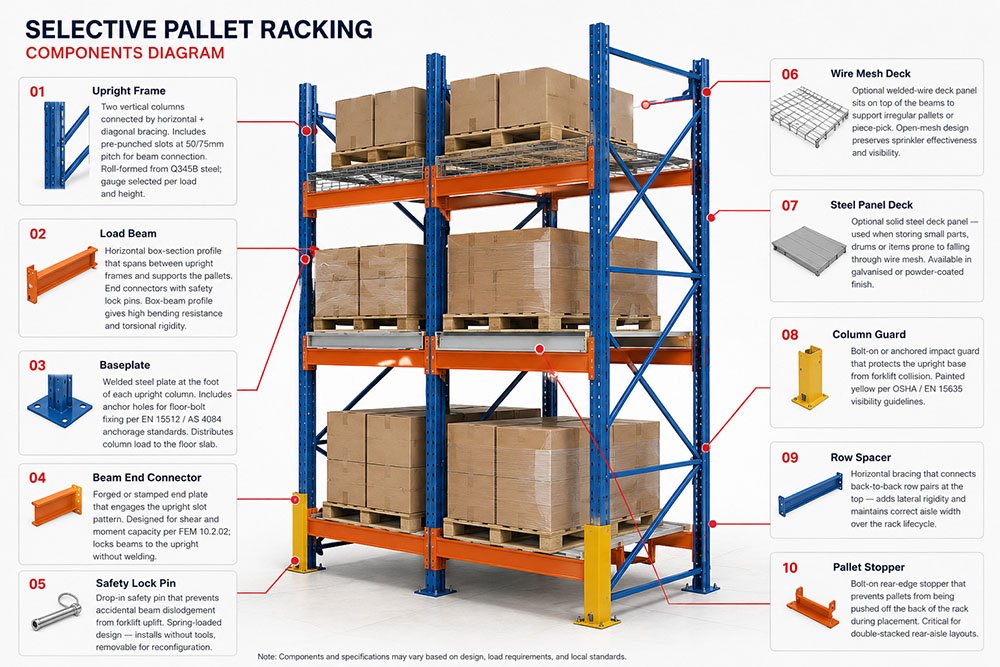
Structural options
| Option | What It Changes | When It Matters |
|---|---|---|
| Upright section size (90×70 vs 100×90 vs 120×95) | Load capacity, height limit | Heavy loads, high bays |
| Steel grade (Q235B vs Q345) | Yield strength per kg of steel | Heavy-duty applications |
| Beam profile (box vs step vs C-beam) | Load capacity, deflection | Long-span or high-load beams |
| Base plate size and thickness | Floor pressure distribution | Weak floors or heavy point loads |
| Bracing pattern (X, K, or Z) | Lateral stability | Seismic zones, tall systems |
Dimensional options
- Custom beam length (from 1,500 mm to 3,900 mm typical)
- Custom upright height (from 2,000 mm to 12,000 mm typical)
- Custom depth (from 800 mm to 1,200 mm for pallet racking)
- Adjustable pitch increments (50 mm or 75 mm)
Environmental options
- Hot-dip galvanization (ISO 1461) for outdoor or humid environments
- Powder coating with elevated corrosion resistance for chemical warehouses
- Cold-storage grade steel for freezer applications below -20°C
- Stainless steel components for pharmaceutical and food-grade zones
Accessory options
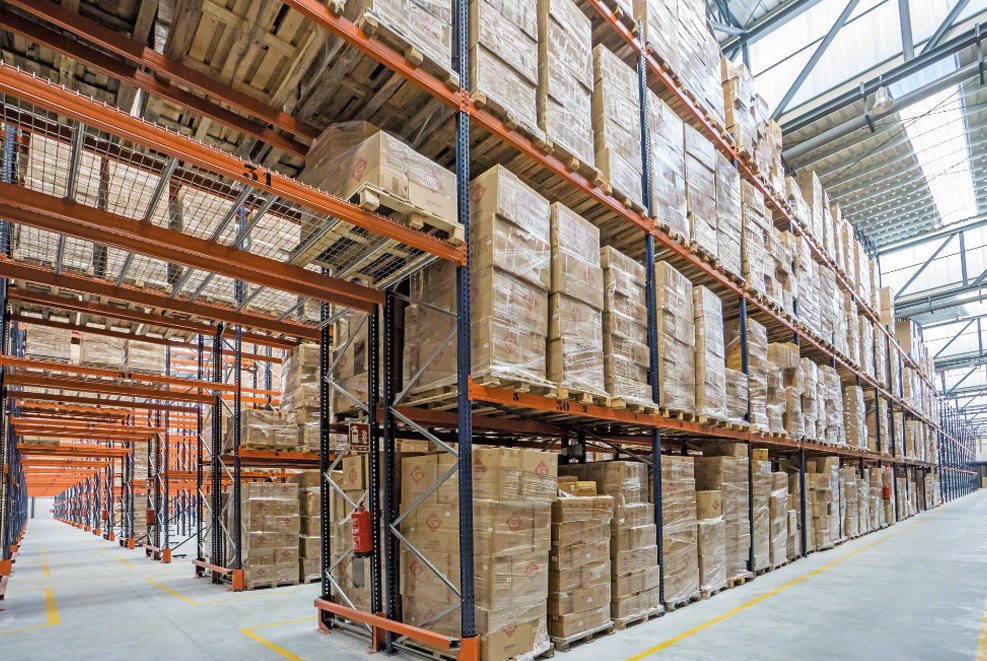
- Wire mesh decking (fire code compliant)
- Pallet supports (steel bars between beams)
- Row spacers and column protectors
- Safety mesh backing to prevent items falling into aisles
- Pallet stops at the back of double-deep systems
- Column guards and end-of-aisle protectors
Aesthetic options
- Custom color (RAL codes accepted by most suppliers)
- Branded labels or laser-etched identification
- Contrasting beam and upright colors for visual traffic control
Rule of thumb: structural and dimensional customizations are worth the money because they affect performance for the racking’s entire service life. Aesthetic customization is worth it only if the branding or safety visibility genuinely helps operations.
The Customization Process, Step by Step
Here’s what actually happens from first contact to installation. Timelines assume sourcing from a Chinese manufacturer to an overseas destination.
Step 1: Initial inquiry and information exchange (1–3 days) The buyer sends the input data listed earlier. The supplier confirms feasibility and asks clarifying questions.
Step 2: Preliminary layout and quotation (3–7 days) The supplier’s engineering team produces a preliminary layout drawing and a first-round quotation. This is where the buyer should compare both specifications and pallet racking prices across suppliers.
Step 3: Design review and revisions (5–10 days) The buyer reviews the drawing, requests adjustments, and confirms the final specification. Two to three revision rounds is normal.
Step 4: Structural calculation and drawing approval (3–7 days) The supplier issues a structural calculation report (FEA analysis) and detailed manufacturing drawings. The buyer approves in writing before production starts.
Step 5: Contract and deposit (1–3 days) Sales contract signed, T/T 30% deposit paid.
Step 6: Production (15–35 days) Steel procurement, roll forming, welding, coating, and assembly. Longer for larger custom orders or during peak season.
Step 7: Pre-shipment inspection (1–3 days) Third-party inspector (SGS, BV, or similar) verifies quantity, quality, and specification match. Balance payment released against inspection report and BL copy.
Step 8: Shipping (15–45 days) Ocean freight to destination port, plus inland transport to the warehouse.
Step 9: Installation (5–15 days depending on scale) On-site installation by local crew, following supplier drawings. Larger projects may include remote engineer support via video call.
Total elapsed time from first inquiry to installed racking: typically 60 to 120 days for standard custom orders, 90 to 150 days for deep customization.
Cost Impact of Customization
Buyers often expect customization to add 30% or 50% to the base price. In reality, most customizations add a lot less — as long as they stay within the supplier’s normal tooling range.
| Customization Type | Typical Cost Impact | Notes |
|---|---|---|
| Adjusted beam length within standard range | 0% | Free |
| Custom color (single RAL code) | 0–3% | Sometimes free at scale |
| Non-standard upright height | 2–5% | Extra cutting, same profile |
| Hot-dip galvanization instead of powder coating | 25–40% | Different production process |
| Q345 steel instead of Q235B | 8–15% | Higher input cost |
| Heavier upright profile (custom section) | 15–30% | Custom tooling if outside range |
| Seismic engineering | 10–20% | Extra design and structural steel |
| Cold-storage grade construction | 15–25% | Specialized steel and coating |
| Fully custom profile (new tooling required) | 30–60% | Rare, only for very large orders |
The pattern: dimensional and finish customization is cheap. Structural upgrades are moderate. Custom tooling is expensive — and usually not worth it unless the order is massive and repeat.
Common Mistakes to Avoid
Buyers new to custom racking procurement fall into the same traps over and over. Watch out for these.
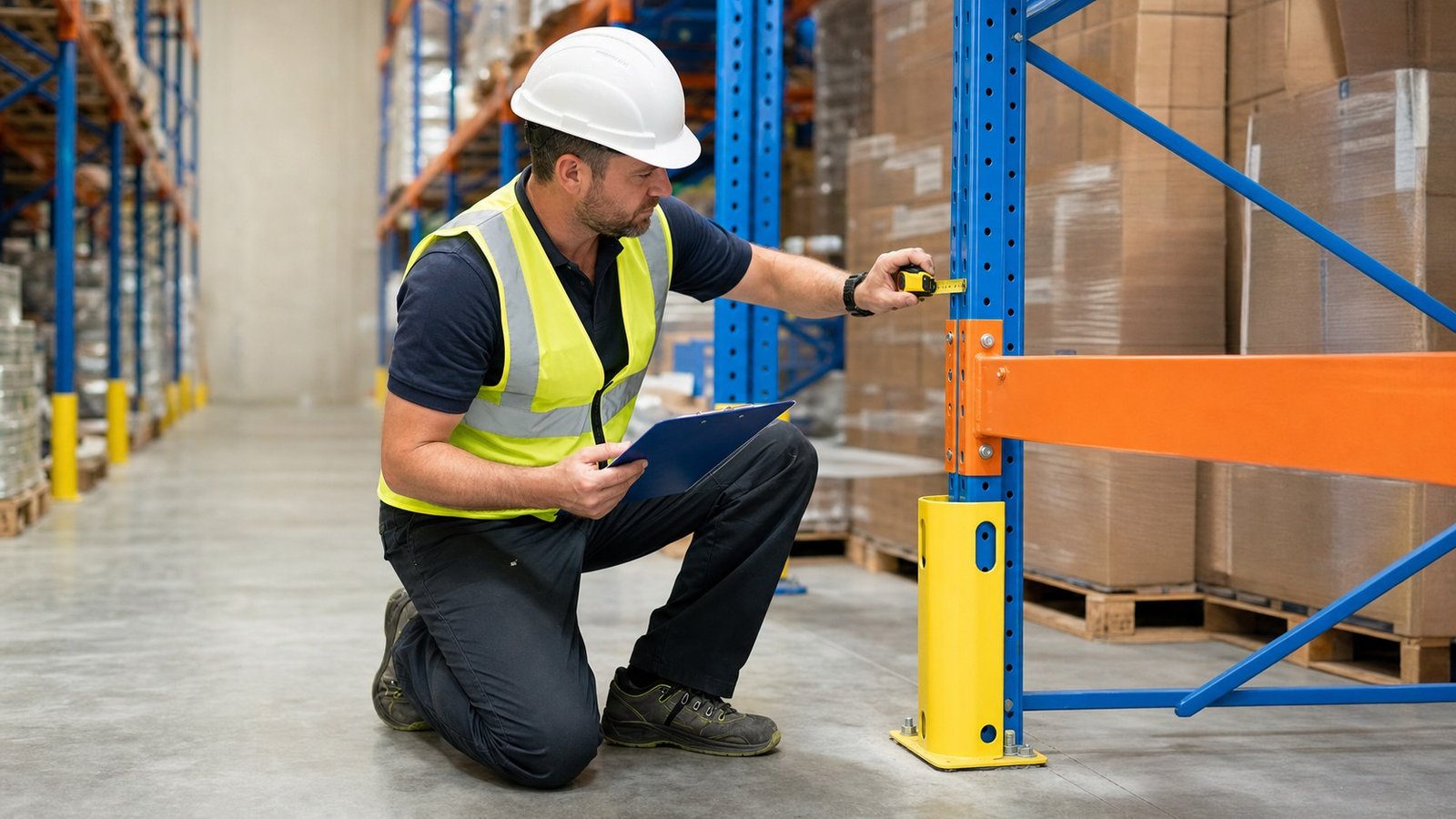
- Providing average pallet weight instead of worst-case weight. Racking has to hold the heaviest pallet, not the typical one. OSHA also advises warehouse operators to ensure that rack load capacities are not exceeded. Under-specifying load capacity is one of the fastest routes to a rack failure.
- Skipping the structural calculation report. For custom or heavy-duty projects, always require an FEA structural report. It’s cheap protection against expensive problems.
- Assuming standard aisle widths work. Aisle width must match the actual forklift and the selected warehouse racking system, not a generic table. A 2.8 m aisle for a truck needing 3.0 m creates daily damage.
- Ignoring floor slab capacity. Racking transfers concentrated loads through baseplates. Weak floors need thicker base plates, larger footprint, or slab reinforcement — figure this out before installation, not after.
- Forgetting building services. Sprinklers, lighting, HVAC, and fire escape paths all interact with racking layout. Customization has to account for them.
- Not planning for growth. Racking that fits today’s operation but blocks future expansion becomes a costly replacement in 3 to 5 years. Building in modular expansion capability is often worth the modest extra cost.
- Choosing the cheapest quote without matching specifications. Two quotes at very different prices usually reflect different specifications. Always normalize before comparing.
Frequently Asked Questions
How much does customized pallet racking cost compared to standard?
For most projects, customization adds 5% to 15% to the base price. Dimensional adjustments and standard color changes are often free. Structural upgrades — heavier steel grade, custom profiles, seismic engineering — add 10% to 30%. Fully custom tooling for unique profiles adds 30% to 60% and is only economical for very large orders.
How long does customized pallet racking take to produce?
Standard customizations typically add 5 to 15 days to production lead time, keeping total production within 20 to 45 days. Deep customization requiring new tooling or engineering approval adds 15 to 30 days. Peak season (September to December) can extend timelines by another 30% to 50%.
What information do I need to give the supplier for customization?
Building dimensions (length, width, ceiling height, column grid), pallet type and worst-case weight, forklift type and turning radius, total pallet positions needed, FIFO or LIFO requirement, destination market for certification, and any environmental factors like cold storage or seismic zone. A rough layout drawing helps enormously.
Can I customize pallet racking for cold storage?
Yes. Cold-storage customization typically includes cold-resistant steel grade, coating adapted for condensation cycles, adjusted tolerances for thermal contraction, and often galvanized components. Cost adds roughly 15% to 25% versus standard configurations. Suppliers with cold-storage project experience should be preferred for these orders.
Do I need a structural calculation report for custom racking?
Yes, especially for heavy-duty configurations, seismic zones, high-bay installations above 6 meters, and any load class above 1,500 kg per pallet. Reputable suppliers include the FEA structural report at no extra cost for standard custom projects. Missing structural documentation is a warning sign — request it before signing the contract.
Can I get racking with my company logo or brand colors?
Yes. Custom RAL colors are usually free (or add 1% to 3% at most). Silk-screen printed logos, laser-etched identification, and branded labels are available with minimum order quantities that vary by supplier — typically 200 to 500 bays for economical unit pricing.
What is the minimum order for customized pallet racking?
Standard customizations (dimensions, colors, accessories) usually carry no additional MOQ beyond the supplier’s baseline — typically 5 to 20 bays for small orders. Deep customization requiring new tooling can carry MOQs of 200 to 500 bays because tooling setup cost has to be amortized. Consolidated container orders across multiple configurations often unlock better pricing.
Conclusion
Customizing pallet racking isn’t a mysterious process — it’s just a matter of knowing what to ask for, what to specify, and what’s worth paying extra for. Warehouses that bring complete building, pallet, forklift, and operational data to the first supplier conversation consistently get sharper quotes, faster designs, and better final products than warehouses that hand suppliers vague requests and hope for the best.
The key insight for most buyers: light customization is cheap and worth it, deep customization is expensive and only worth it when the operation genuinely requires it. Adjusted dimensions, custom colors, and standard accessories add negligible cost while making the racking fit the building properly. Structural upgrades, seismic engineering, and cold-storage adaptations cost more but pay off in service life and safety. Fully custom tooling should be reserved for truly unique requirements — otherwise it’s rarely a good return on investment.
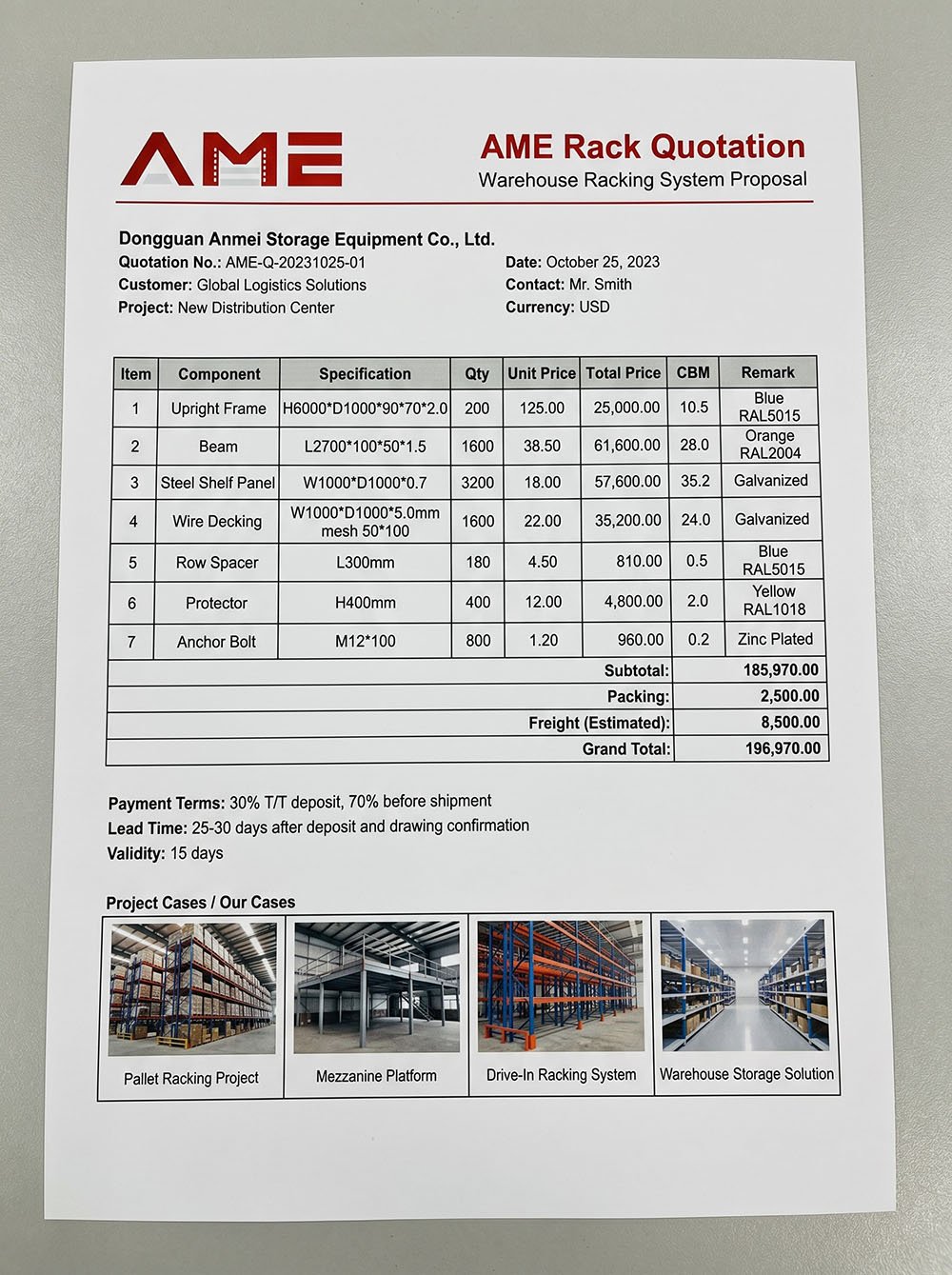
For projects requiring engineered custom pallet racking backed by in-house structural calculation and export-market certification, warehouse planners often shortlist producers such as AME Rack, a Guangdong-based manufacturer whose engineering team supports custom selective pallet racking and heavy-duty racking configurations tailored to specific building geometry and load profiles. Buyers evaluating broader options can review the full warehouse racking system portfolio, and further context on Chinese manufacturing capabilities is available in the overview of China pallet racking manufacturers.