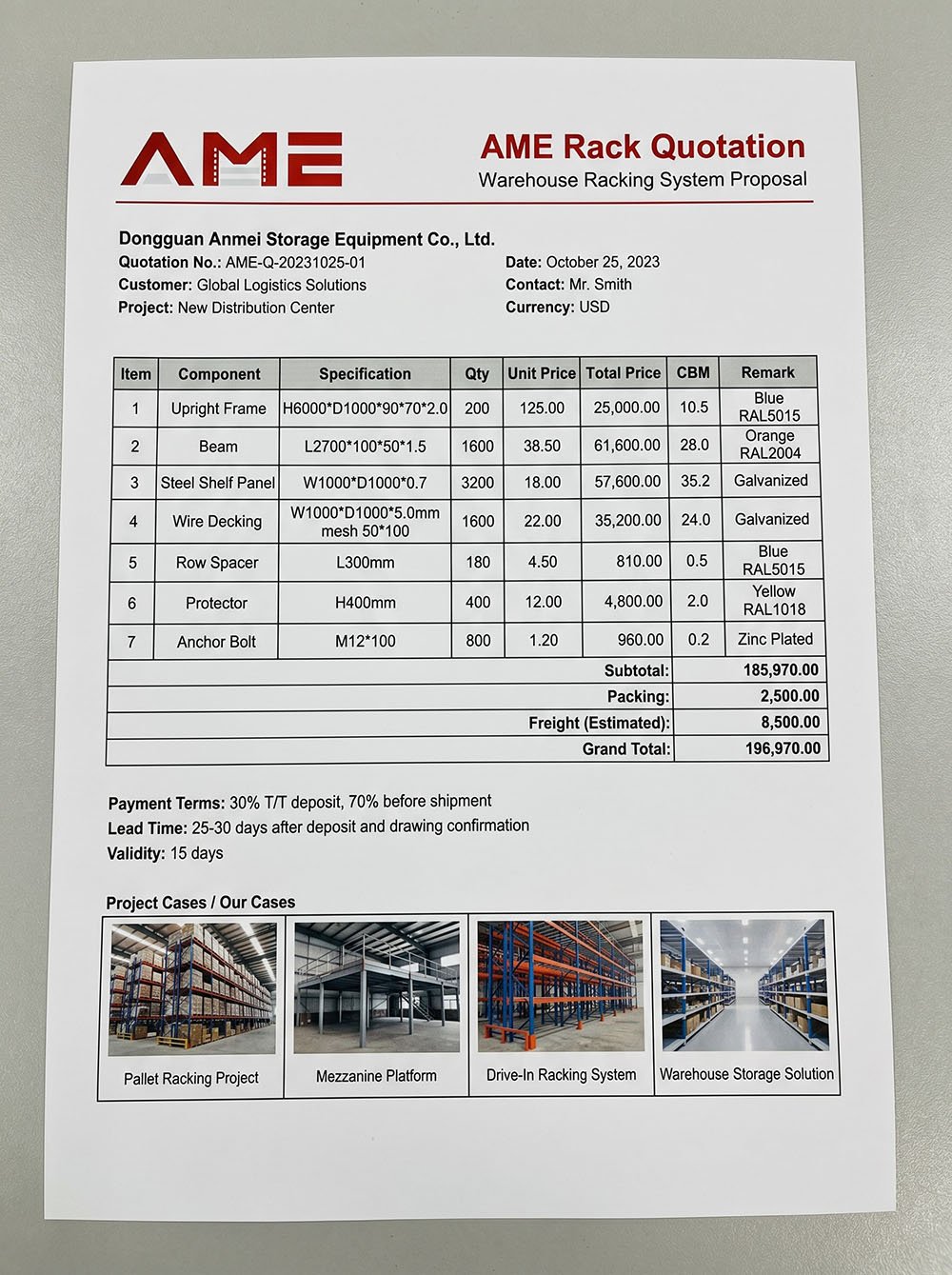
Warehouse operators, logistics managers, and supply chain professionals encounter the term FIFO in nearly every conversation about inventory management – yet the practical implementation of FIFO in a real warehouse is far more nuanced than the definition suggests. Understanding what is FIFO, how it differs from other inventory rotation methods, and which storage systems support it correctly is essential for any facility handling perishable goods, batch-traceable components, or expiration-dated products. Buyers preparing supplier shortlists can also compare options in the 2026 China pallet racking manufacturers list.
FIFO is not simply an inventory accounting convention. In a physical warehouse, FIFO is a rotation discipline enforced through the interaction of storage equipment, warehouse management systems, forklift operations, and receiving procedures. Getting any one of those elements wrong breaks the FIFO chain and creates quality, compliance, and cost consequences.
This guide explains what FIFO means in warehousing terms, compares it with LIFO and FEFO alternatives, examines the racking systems designed to support it, and outlines the operational practices required to make FIFO work reliably at scale.
What Is FIFO
FIFO stands for First-In, First-Out – an inventory rotation method in which the oldest stock received into a warehouse is the first stock shipped out. In practical warehouse operation, FIFO means that when a pallet arrives at receiving, it enters the storage system in a way that ensures it will be picked and shipped before any newer pallet of the same SKU received afterward.
The logic is simple in principle but demanding in execution. A warehouse claiming to operate FIFO must physically enforce oldest-first retrieval through some combination of:
- Storage systems that mechanically enforce FIFO flow (gravity flow, drive-through, radio shuttle)
- Warehouse management system logic that directs pickers to oldest pallets first
- Receiving procedures that record date and lot on every incoming pallet
- Forklift operator training that respects rotation directives
- Physical layout that separates old and new stock during putaway
FIFO is standard practice for perishable food and beverage inventory, pharmaceutical products, batch-traceable manufacturing components, chemicals with shelf life, and any product subject to regulatory rotation requirements. It is also widely used voluntarily in operations that value inventory freshness even without regulatory mandate.
Why FIFO Matters in Warehouse Operations
The consequences of failing to maintain FIFO extend well beyond the warehouse floor. Poor rotation practice creates measurable losses across quality, compliance, financial, and customer service dimensions.
Quality loss. Expired or aged inventory that ships to customers damages product reputation, generates returns, and creates food safety or pharmaceutical compliance incidents. In perishable food warehousing, a single failed FIFO cycle can produce five- or six-figure losses.
Regulatory compliance. Food and beverage operations regulated under HACCP, FSMA, or equivalent frameworks require documented FIFO discipline. Pharmaceutical warehouses under GMP must demonstrate rotation control. Failed audits carry direct financial and operational cost.
Financial write-off. Inventory that ages past sellable dates becomes obsolescence write-off. FIFO reduces write-off risk by ensuring consumption follows receipt order.
Traceability. Batch-traceable manufacturing components – automotive parts, electronics, aerospace – require FIFO or the traceability chain breaks. Warranty and recall obligations become unmanageable without disciplined rotation.
Customer trust. B2B customers frequently audit rotation practice as part of supplier qualification. Failed rotation audits eliminate supplier candidacy regardless of price or quality.
FIFO vs LIFO vs FEFO
FIFO is one of three dominant inventory rotation methods, each suited to different inventory profiles. Confusing the three – or implementing the wrong one for a given inventory category – creates operational risk.
| Method | Full Name | Retrieval Logic | Typical Application |
|---|---|---|---|
| FIFO | First-In, First-Out | Oldest stock retrieved first | Food, beverage, pharmaceuticals, batch-traced components |
| LIFO | Last-In, First-Out | Newest stock retrieved first | Non-perishable bulk inventory, raw materials, buffer stock |
| FEFO | First-Expired, First-Out | Earliest expiration retrieved first | Products with variable expiration dates within same SKU |
FIFO assumes that receipt date and expiration date follow the same sequence – the first-received item expires first. This holds true for most manufactured goods with fixed shelf life measured from production date.
LIFO deliberately retrieves newest stock first. This is appropriate for non-perishable bulk inventory where retrieval speed matters more than rotation, and for raw materials where accounting benefits justify newest-first physical flow.
FEFO retrieves the item with the earliest expiration date regardless of receipt order. This is essential when multiple production batches with different expiration dates share the same SKU – common in dairy, fresh produce, and pharmaceutical distribution. FEFO requires WMS integration with lot-level expiration tracking and cannot be enforced by rack geometry alone.
The correct method for any inventory category is determined by regulatory requirement, product characteristics, and warehouse operational capability – not by convention or accounting preference.
Storage Systems That Enforce FIFO
Physical storage geometry either supports or blocks FIFO rotation. Selecting the wrong rack type for FIFO-required inventory guarantees rotation failure regardless of WMS sophistication or operator training. For broader material-handling terminology, MHI rack fundamentals describe how industrial storage racks support product storage and pallet flow.
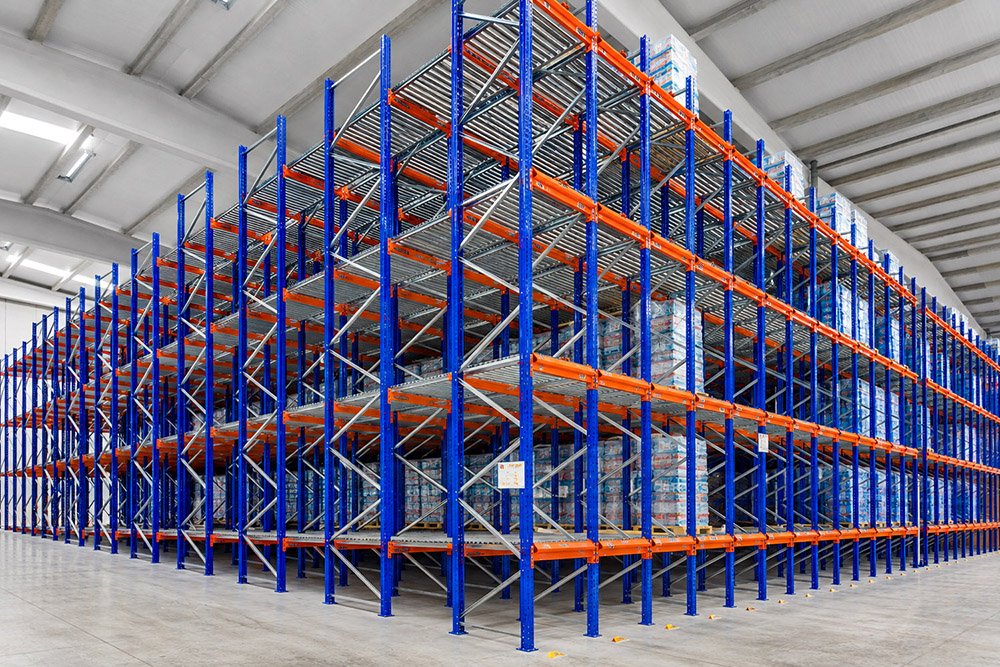
Gravity pallet flow racking loads pallets on the high end of an inclined roller lane and retrieves them from the low end. Newly received pallets automatically move to the rear of the queue while older pallets advance to the picking face. This is the most reliable mechanical FIFO enforcement available in static storage, requiring no operator discipline to maintain rotation.
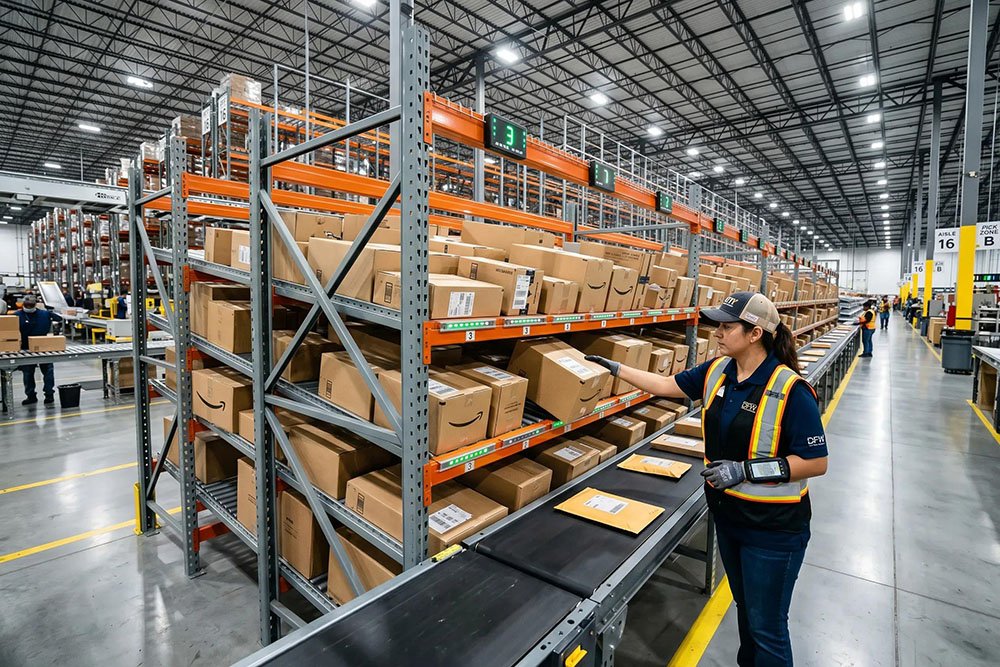
Carton flow racking applies the same principle at case-picking scale. Cartons load onto inclined roller shelves at one end and flow forward to the picker at the opposite end. FIFO is enforced automatically as new stock replenishes from the rear.
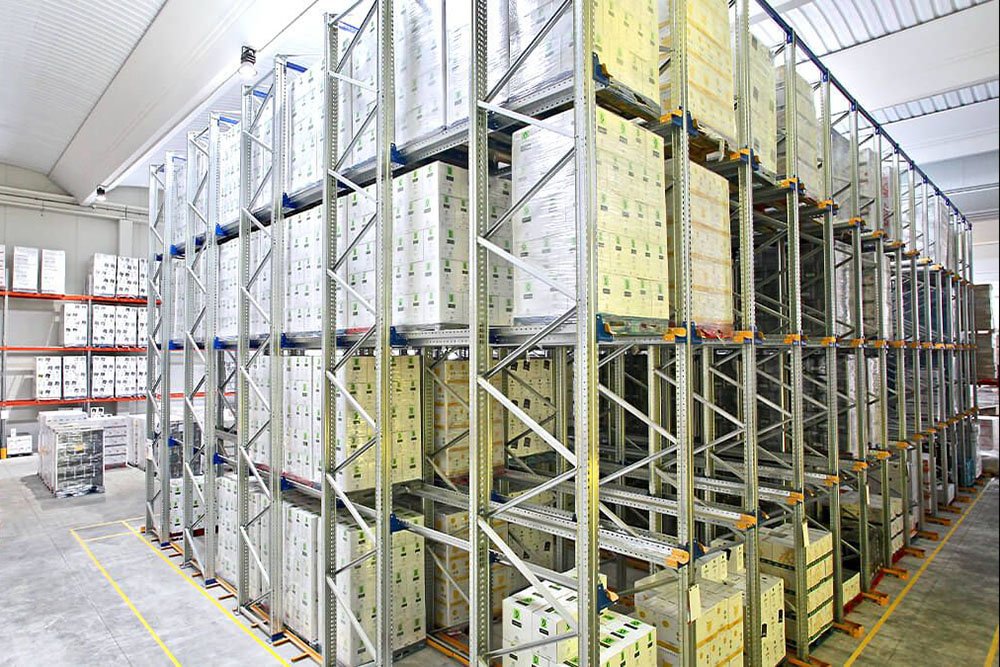
Drive-through racking provides open-ended lanes with loading on one side and retrieval on the opposite side. FIFO is supported by operational flow – pallets loaded from Side A are retrieved from Side B, and disciplined operator practice prevents mixing.
Radio shuttle racking with FIFO configuration positions the shuttle to load at one end and retrieve at the other. FIFO enforcement depends on shuttle programming rather than gravity, allowing longer lane depths than gravity flow at higher capital cost.
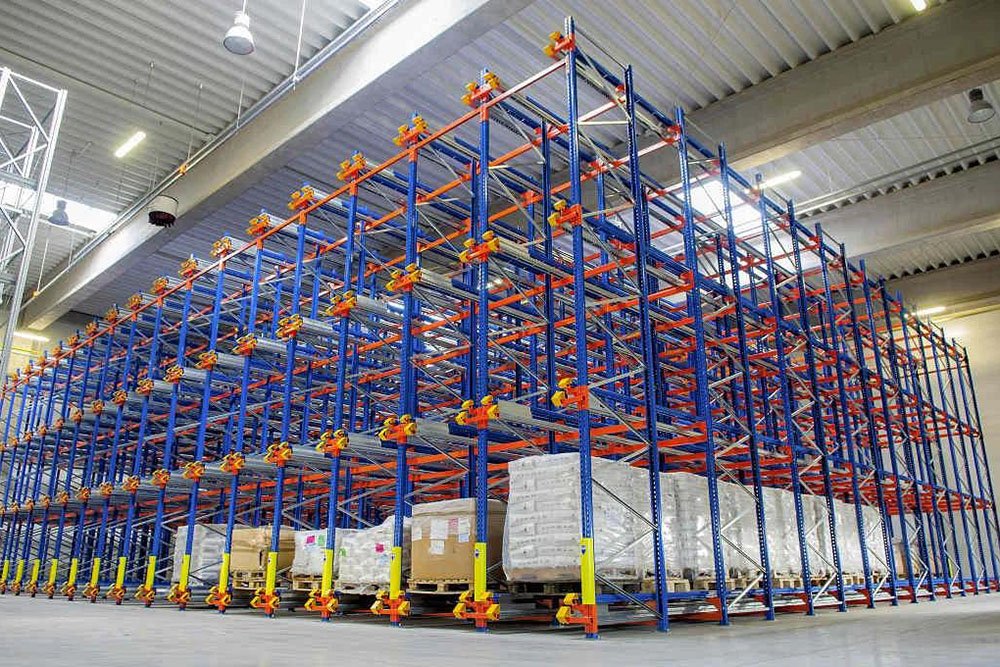
Selective racking with WMS-directed FIFO relies on warehouse management system logic to instruct pickers toward oldest pallets first. This method depends entirely on system accuracy and operator compliance and is not mechanically enforced.
Storage systems that break FIFO include drive-in racking (LIFO by geometry), single-deep selective racking without WMS rotation logic, and any push-back or double-deep configuration where newer pallets block access to older pallets on the same rail.
Comparison of FIFO-Compatible Racking Systems
Each FIFO-compatible system delivers different combinations of storage density, throughput speed, and capital cost. The table below summarizes typical performance characteristics.
| System | FIFO Enforcement | Storage Density | Throughput Speed | Capital Investment |
|---|---|---|---|---|
| Gravity pallet flow racking | Mechanical | High | High | Moderate to high |
| Carton flow racking | Mechanical | High (case level) | Very high | Moderate |
| Drive-through racking | Operational | High | Moderate | Low to moderate |
| Radio shuttle (FIFO mode) | Automated | Very high | High | High |
| Selective racking (WMS-directed) | System-dependent | Low | Very high | Low |
The right choice depends on inventory profile. High-turnover perishables benefit from gravity flow’s automatic rotation. Deep-lane storage for stable-SKU distribution centers favors radio shuttle. Case-pick fulfillment operations rely on carton flow. Warehouses with highly variable SKU velocity often use selective racking with WMS-directed FIFO, accepting the lower reliability in exchange for layout flexibility.
How to Implement FIFO in a Warehouse
Implementing FIFO reliably requires alignment across five operational areas. Weakness in any one area breaks the rotation chain.
Receiving procedure. Every incoming pallet must carry a receipt date, production date, and lot number captured into the warehouse management system at the receiving dock. Without accurate receipt data, FIFO cannot function because the system does not know which pallet is oldest.
Putaway logic. New pallets must be placed in storage locations that will retrieve them last, not first. In gravity flow systems this happens automatically; in selective racking this requires WMS-directed putaway rules that assign new stock to rear positions.
Picking direction. Pickers must be instructed toward oldest pallets first. This means WMS pick paths, RF terminal instructions, or visual labels that identify oldest stock. Operator discretion in pick location breaks FIFO regardless of system design.
Storage geometry. The physical rack system must support the FIFO logic being enforced. Attempting FIFO in drive-in racking will fail because the geometry prevents old-pallet-first retrieval.
Audit and inspection. Regular physical audit of storage locations verifies that receipt dates match expected rotation order. FIFO systems that go un-audited drift over time as small operator errors accumulate into significant rotation gaps.
Warehouses achieving 98%+ FIFO compliance typically combine mechanical enforcement systems (gravity flow, drive-through, radio shuttle) with WMS integration and monthly rotation audits, rather than relying on any single element.
Common FIFO Implementation Mistakes
Warehouses new to FIFO – or expanding FIFO to new product categories – encounter a consistent set of implementation errors.
- Storing FIFO-required inventory in drive-in racking. The geometry cannot support FIFO. Even with perfect WMS logic, the physical rack blocks oldest-pallet-first retrieval.
- Assuming WMS rotation logic is sufficient. WMS-directed FIFO in selective racking is only as reliable as operator compliance. High-turnover operations frequently deviate from WMS instructions under time pressure.
- Confusing FIFO with FEFO. For inventory with variable expiration dates within the same SKU, FIFO by receipt date is insufficient. FEFO by expiration date is required, and WMS must track expiration at lot level.
- Underestimating receiving discipline. Receipt date and lot number capture failures at the receiving dock invalidate every downstream FIFO decision.
- Neglecting rack damage inspection. Damaged pallet flow rollers, misaligned drive-through lanes, or blocked radio shuttle tracks quietly break FIFO before operators notice.
- Mixing SKU across FIFO lanes. Gravity flow and drive-through racking require single-SKU lanes to function correctly. Mixed-SKU storage in the same lane defeats mechanical rotation enforcement.
FIFO and Regulatory Compliance
Multiple regulatory frameworks either require or heavily incentivize FIFO discipline in warehousing operations; broader quality programs may also reference ISO 9001:2015 quality management system requirements when documenting process control.
Food industry. HACCP (Hazard Analysis and Critical Control Points) and the U.S. FDA Food Safety Modernization Act (FSMA) require documented inventory rotation to control expiration risk. FIFO is the default rotation method for shelf-stable food; FEFO is required for products with variable production-to-expiration windows.
Pharmaceutical industry. Good Manufacturing Practice (GMP) and Good Distribution Practice (GDP) regulations require documented FIFO or FEFO rotation for pharmaceutical distribution. Failed audits carry direct license consequences.
Chemical industry. Certain chemicals with defined shelf life or hazard reduction periods must follow FIFO to maintain product performance and safety.
Automotive and aerospace manufacturing. Batch-traceable components require FIFO to preserve traceability chains. Warranty, recall, and product liability obligations depend on maintaining rotation discipline.
Buyers designing storage systems for regulated industries should specify FIFO capability as a functional requirement during racking supplier RFQ, not as an operational assumption to be resolved later.
Frequently Asked Questions
What is FIFO in simple terms?
FIFO stands for First-In, First-Out. In a warehouse, it means the oldest inventory received is the first inventory shipped or picked. Newly arrived stock waits behind older stock in the queue. This rotation method is standard for perishable food, beverage, pharmaceuticals, and any product subject to expiration or freshness requirements.
What is the difference between FIFO and LIFO?
FIFO retrieves the oldest stock first; LIFO retrieves the newest stock first. FIFO is used for perishable and regulated inventory where rotation matters. LIFO is used for non-perishable bulk inventory where retrieval speed matters more than rotation order. The two methods require different rack systems – drive-through and pallet flow for FIFO, drive-in for LIFO.
Which racking system is best for FIFO?
Gravity pallet flow racking is the most reliable mechanical FIFO system for pallet storage, using inclined rollers to move new stock to the rear automatically. For case-pick operations, carton flow racking applies the same principle at case level. Drive-through racking supports FIFO through operational flow, and radio shuttle systems support FIFO in configurations with dedicated loading and retrieval sides.
Can FIFO be maintained in selective pallet racking?
Yes, but only through warehouse management system logic that directs putaway to rear positions and picking from oldest locations. This method is called WMS-directed FIFO and depends entirely on operator compliance with system instructions. It works in low-to-moderate throughput operations but tends to break down under time pressure or during peak periods.
What is the difference between FIFO and FEFO?
FIFO retrieves stock by receipt order – first received, first shipped. FEFO retrieves stock by expiration date – earliest expiration, first shipped. FEFO is required when multiple production batches of the same SKU carry different expiration dates, which occurs in dairy, fresh produce, and pharmaceutical distribution. FEFO requires warehouse management system integration with lot-level expiration tracking.
Is FIFO required by law?
FIFO or FEFO rotation is required or effectively mandated in several regulated industries: food warehousing under HACCP and FSMA, pharmaceutical distribution under GMP and GDP, and batch-traceable manufacturing supply chains. In non-regulated industries, FIFO remains widely adopted as a quality and financial best practice even without legal requirement.
How is FIFO tracked in a warehouse?
FIFO tracking begins at receiving, where each incoming pallet is scanned into the warehouse management system with receipt date, production date, and lot number. The WMS then assigns storage locations and directs pickers based on rotation logic. Physical audit of storage locations against WMS records confirms that actual rotation matches system data. Warehouses maintaining strong FIFO compliance typically conduct monthly rotation audits.
Conclusion
FIFO – First-In, First-Out – is more than an inventory accounting concept. In warehousing operation, FIFO is a rotation discipline enforced through the combined action of storage equipment geometry, warehouse management system logic, receiving procedures, and picking direction. Getting FIFO right protects product quality, ensures regulatory compliance, reduces obsolescence write-off, and preserves traceability chains.
Warehouse operators implementing FIFO for perishable, pharmaceutical, or batch-traceable inventory should begin with clear identification of rotation requirements, select storage systems that mechanically enforce FIFO where possible, integrate WMS-directed rotation logic in selective racking zones, and audit compliance regularly. Attempting FIFO in inappropriate rack geometry – drive-in racking being the most common error – guarantees failure regardless of operational discipline.
Producers manufacturing FIFO-compatible storage systems typically maintain distinct engineering for gravity flow, drive-through, and shuttle configurations because each system enforces rotation through different mechanical or operational principles. Among such producers is AME Rack, whose Dongguan facility manufactures FIFO-oriented systems including gravity pallet flow racking for high-throughput pallet rotation, carton flow racking for case-pick operations, and drive-in and drive-through pallet racking with dual-side variants for FIFO-required inventory. Related comparative analysis is available in the overview of single deep vs double deep pallet racking for warehouses evaluating selectivity and density alongside rotation requirements.