Walk into any modern warehouse and the first thing you notice is the racking. It’s what turns an empty box of a building into a working storage operation. But not all racking is the same — far from it. There are more than a dozen distinct warehouse racking types on the market, each engineered for a different combination of load, density, throughput, and access.
Choosing the wrong type is one of the most expensive mistakes a warehouse operator can make. Racking is a 10 to 20 year investment, and changing it later means shutting down operations, hiring installers, and often paying for it twice. So the smart move is to understand every major racking type before writing the first quotation request.
This guide walks through every major type of racking system used in warehouses today — what it is, how it works, when it fits, and when it doesn’t. Whether the project is a small e-commerce operation or a 20,000-pallet distribution center, the right racking type is somewhere in this list.
What Are Warehouse Racking Types
Warehouse racking types are the different structural configurations used to store palletized goods, cases, and long-form materials in warehouses and distribution centers. The RMI/ANSI industrial storage rack standards provide authoritative design context. In application, each type balances four core trade-offs differently: storage density, selectivity (how easily you access a specific item), throughput speed, and capital cost.
At the highest level, warehouse racking falls into six broad categories:
- Selectivity-oriented systems — direct access to every pallet (selective, teardrop, VNA)
- Density-oriented systems — deeper storage, less access (drive-in, drive-through, push-back)
- Flow-oriented systems — gravity or shuttle-driven pallet movement (pallet flow, carton flow, radio shuttle)
- Long-load systems — for non-palletized bulky items (cantilever)
- Vertical-space systems — using building height (mezzanine, multi-tier)
- Automated systems — integrated with automation (ASRS, shuttle-based)
Nobody uses one type for everything. Most warehouses combine two or three types across different zones — fast-moving SKUs in selective racking near shipping, bulk reserves in drive-in, and long items in cantilever. Getting the mix right is where the real cost and efficiency gains happen.
Selective Pallet Racking
The workhorse. Selective pallet racking is the most widely deployed type worldwide because it delivers 100% selectivity — every pallet is directly accessible from the aisle without moving any other load.
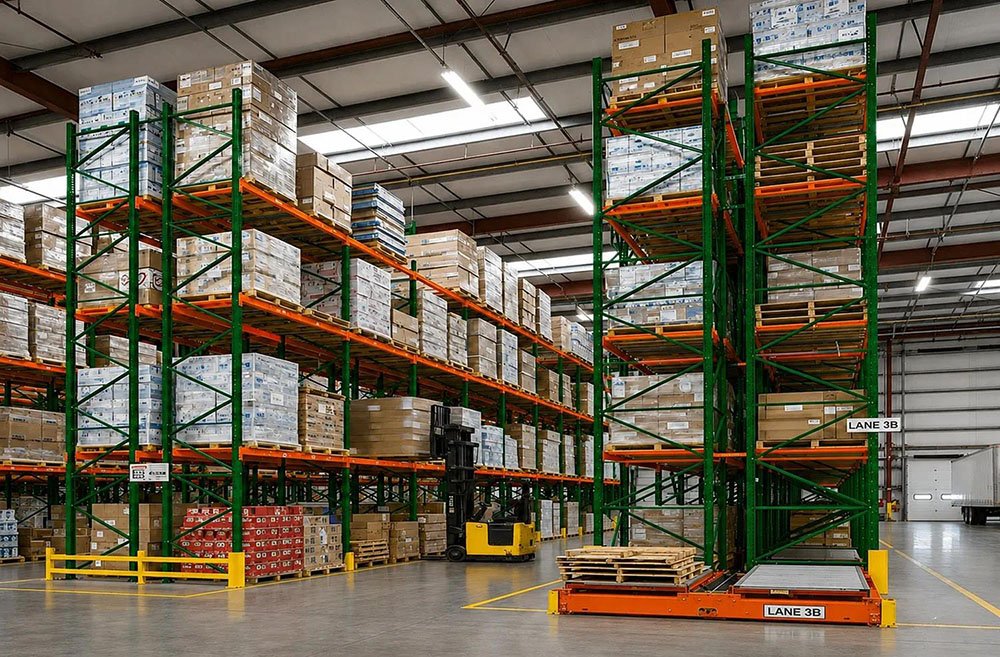
The system uses upright frames, horizontal beams, and safety pins. Forklifts operate in standard aisles (2.8 to 3.5 meters wide) with counterbalance or reach trucks. Beam levels adjust in 50 mm or 75 mm increments, and adding accessories like wire decking or pallet supports is easy.
Best for: distribution centers with high SKU variety, 3PL operations, e-commerce fulfillment, cold storage where quick access matters, general-purpose warehouses.
Trade-off: lowest storage density among pallet racking types — about 900 to 1,100 pallet positions per 1,000 m² of floor area. If cube utilization matters more than pick speed, other types deliver more.
Cost signal: the baseline for pallet racking pricing — everything else compares against this.
Teardrop Pallet Racking
Teardrop pallet racking is a specific style of selective racking with a distinctive teardrop-shaped hole pattern on the upright column. It’s the dominant profile in North America and offers boltless assembly — beams snap into place using clip connections rather than nuts and bolts.
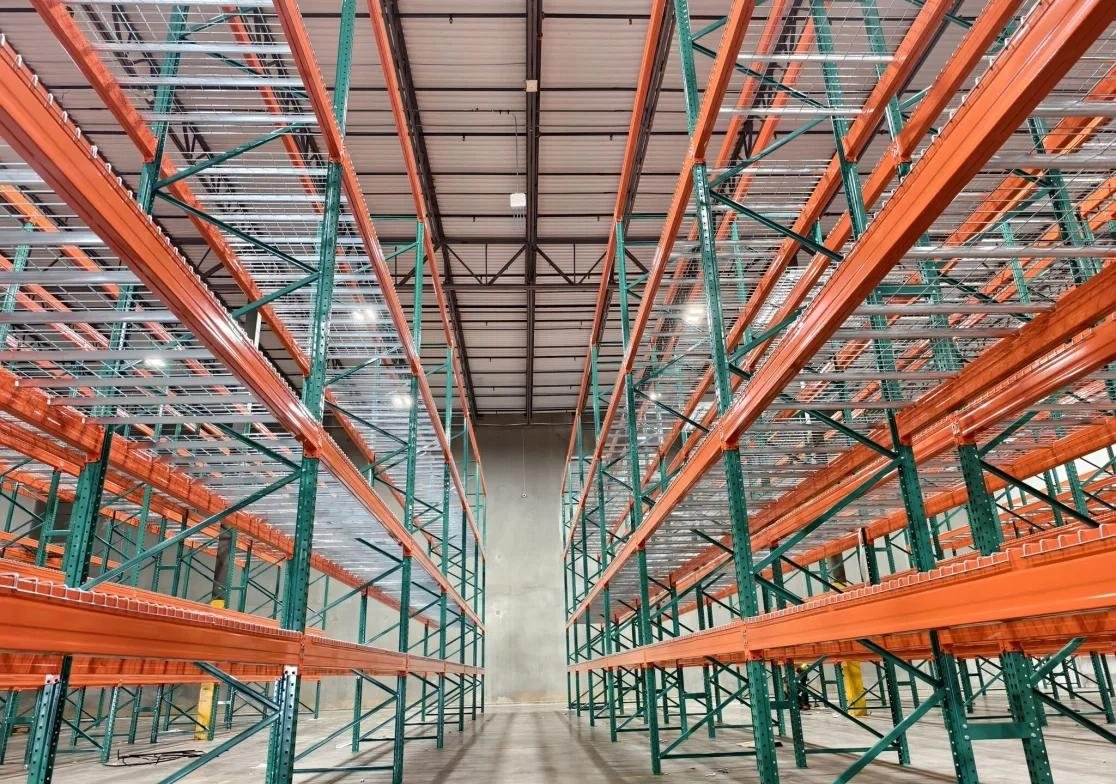
Structurally, teardrop racking behaves like standard selective racking. The differences are cosmetic (the hole pattern) and operational (faster assembly, easier reconfiguration).
Best for: any operation preferring the North American standard profile, warehouses that anticipate future layout changes, buyers wanting easier field adjustment.
Trade-off: essentially none versus European-style selective racking. The choice is usually driven by regional standards rather than technical requirements.
Double Deep Pallet Racking
A variation on selective racking that stores two pallets deep instead of one. Storage density jumps 30% to 40% by cutting aisle count in half, at the cost of losing direct access to the rear pallet.
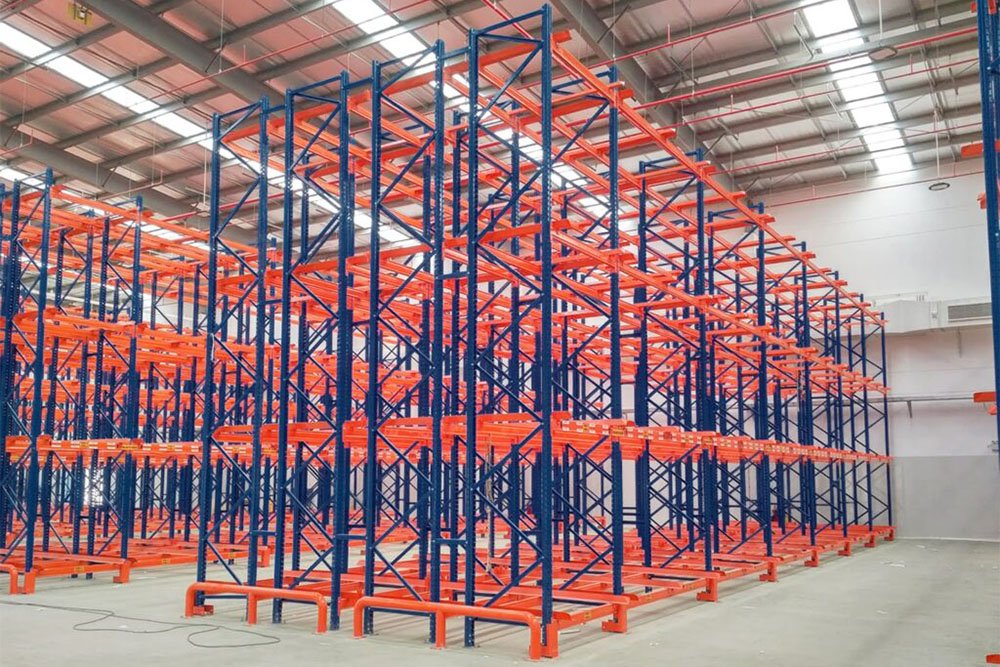
The system needs a specialized reach truck with telescopic forks (deep-reach truck) to reach the rear pallet. Selectivity drops to about 50% — you can’t get to a rear pallet without moving the front one first.
Best for: operations with multi-pallet SKUs where the same product occupies more than one pallet position, moderate turnover profiles, warehouses balancing density and access.
Trade-off: requires specialized forklifts (higher equipment cost) and slower picking versus single-deep selective.
Drive-In and Drive-Through Racking
Drive-in and drive-through racking are high-density systems that eliminate access aisles by letting forklifts drive directly into the storage lanes. Drive-in racking is open at one end (LIFO — Last-In, First-Out), while drive-through has both ends open (FIFO — First-In, First-Out).
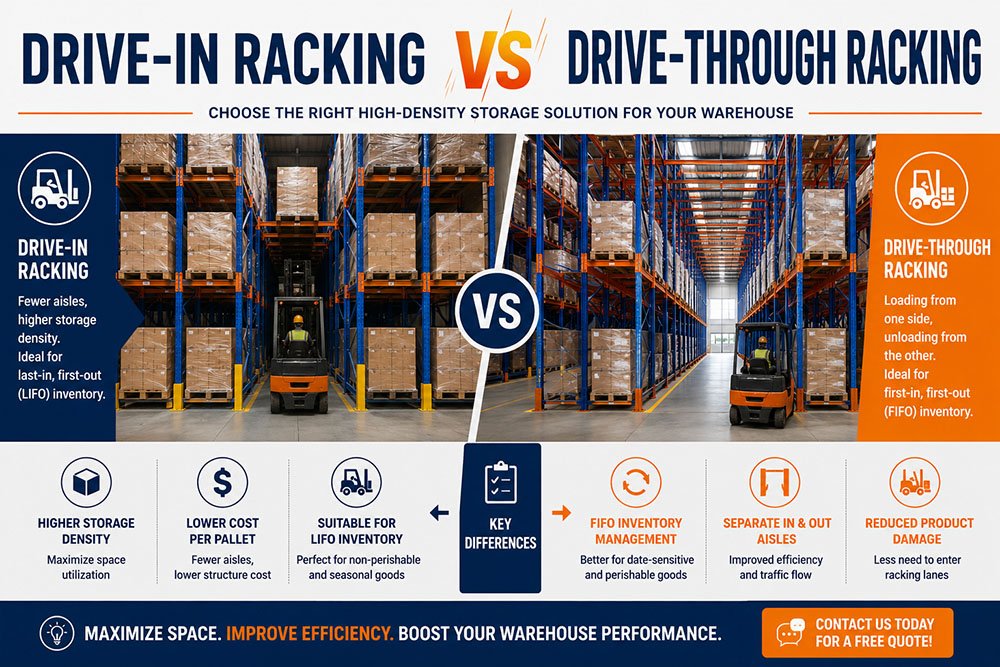
Storage density gains are dramatic — 60% to 75% higher than selective for drive-in, 50% to 65% higher for drive-through. But forklifts operating inside the rack structure need careful training, slower speeds, and upright frame protectors. OSHA likewise recommends installing upright guards and maintaining safe storage-rack operating practices.
Best for: bulk storage of homogeneous inventory, cold storage of frozen food, beverage warehouses, raw material buffer storage, seasonal storage.
Trade-off: limited SKU selectivity (one SKU per lane), higher rack damage rates from forklift contact, LIFO limitation for drive-in.
Push-Back Pallet Racking
Push-back pallet racking stores 2 to 6 pallets deep on inclined rails with wheeled carts. Loading a new pallet pushes existing pallets backward; retrieving from the front lets rear pallets gravity-flow forward.
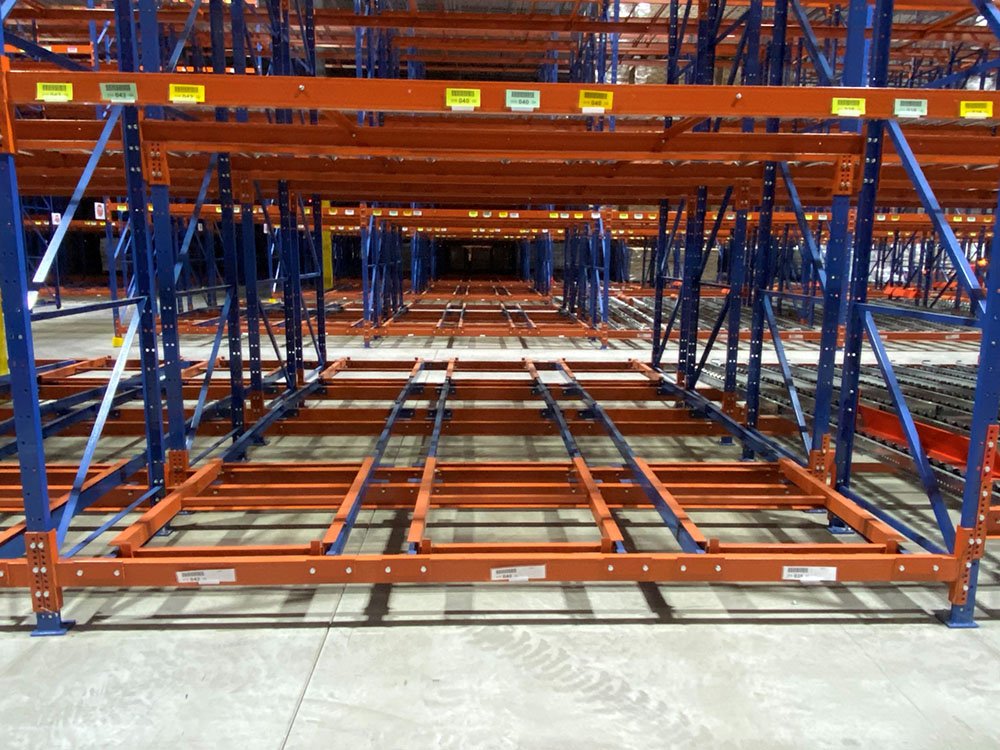
It combines moderate density (50% to 60% higher than selective) with reasonable selectivity (one SKU per lane but multiple pallets accessible from the aisle). Forklifts don’t need to enter the rack.
Best for: multi-SKU operations wanting density without LIFO limitations of drive-in, beverage and food distribution, 3PL operations with mid-turnover profiles.
Trade-off: higher cost per pallet position due to cart and rail system, still LIFO within each lane.
Gravity Pallet Flow Racking
In gravity pallet flow racking, pallets load on the high end of an inclined roller lane and roll forward to the picking face as front pallets are removed. Pure mechanical FIFO — no operator discipline required.
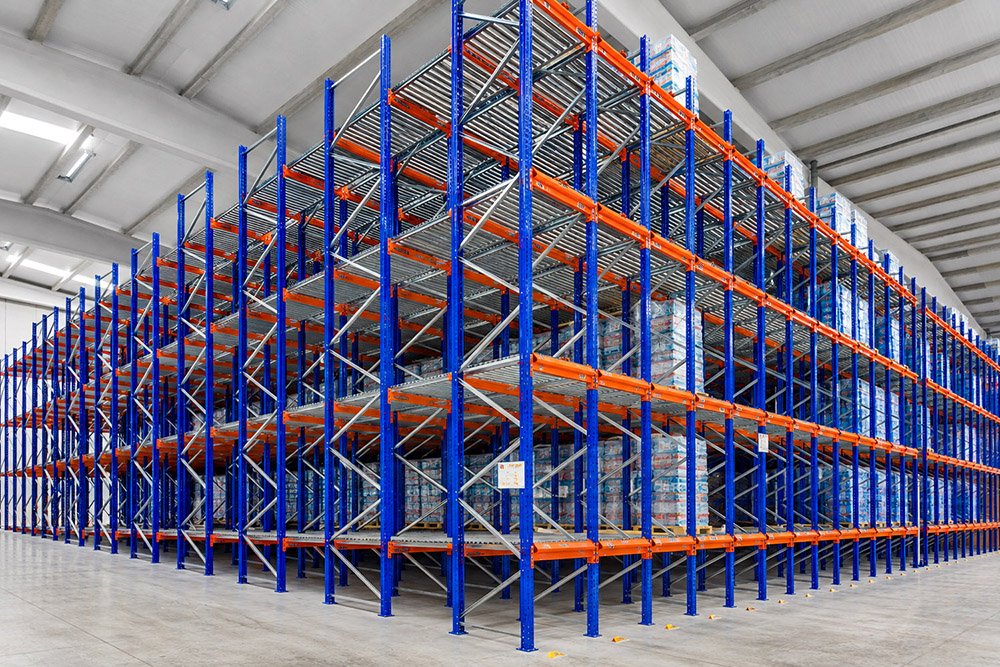
Lane depth typically 6 to 20 pallets. Storage density hits 60% to 70% higher than selective, and throughput is high because retrieval requires no forklift travel inside the rack.
Best for: high-throughput perishable food, dairy, beverage, and pharmaceutical operations where FIFO is required by regulation.
Trade-off: highest cost per pallet position among static systems, one SKU per lane, roller maintenance required.
Carton Flow Racking
Carton flow racking uses the same principle as pallet flow but at case-pick scale. Inclined roller shelves let cases flow forward to the picker as front cases are removed. Common in pick-to-order operations.
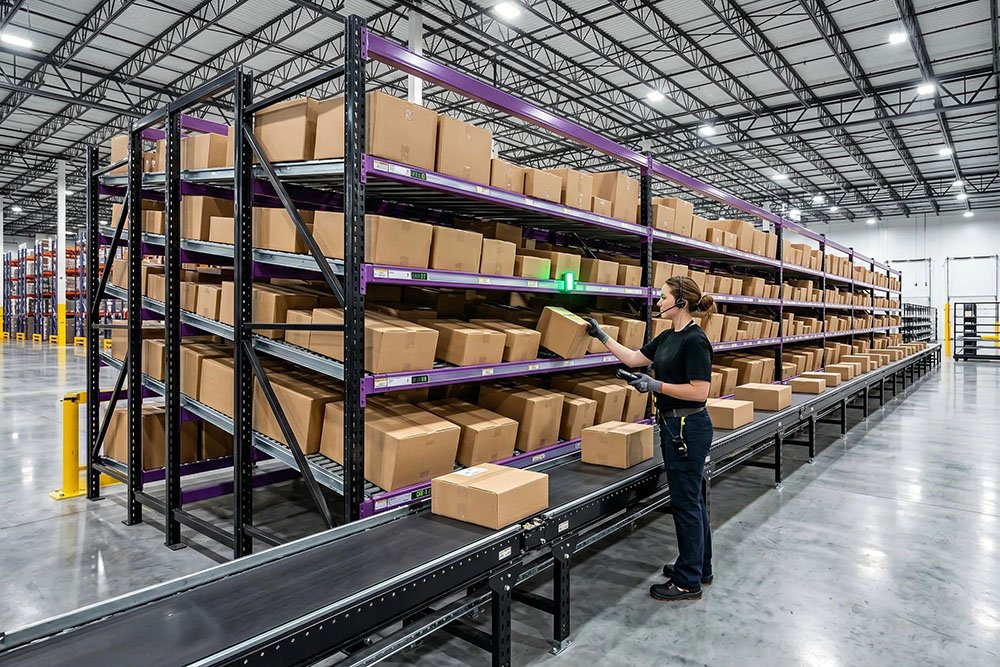
Density and throughput are both very high at case level. Configurations range from 1-meter deep pick fronts to 3-meter deep reserve depth.
Best for: e-commerce fulfillment, cosmetics, pharmaceutical picking, apparel case handling, any high-velocity case pick.
Trade-off: case-scale only (not for pallets), needs careful case dimension standardization.
Radio Shuttle Racking
Radio shuttle racking is the high-tech option in high-density storage. A battery-powered shuttle travels inside the lane, carrying pallets to the aisle face for forklift pickup. No forklift ever enters the rack structure, and lane depth can reach 30 to 50 pallets.
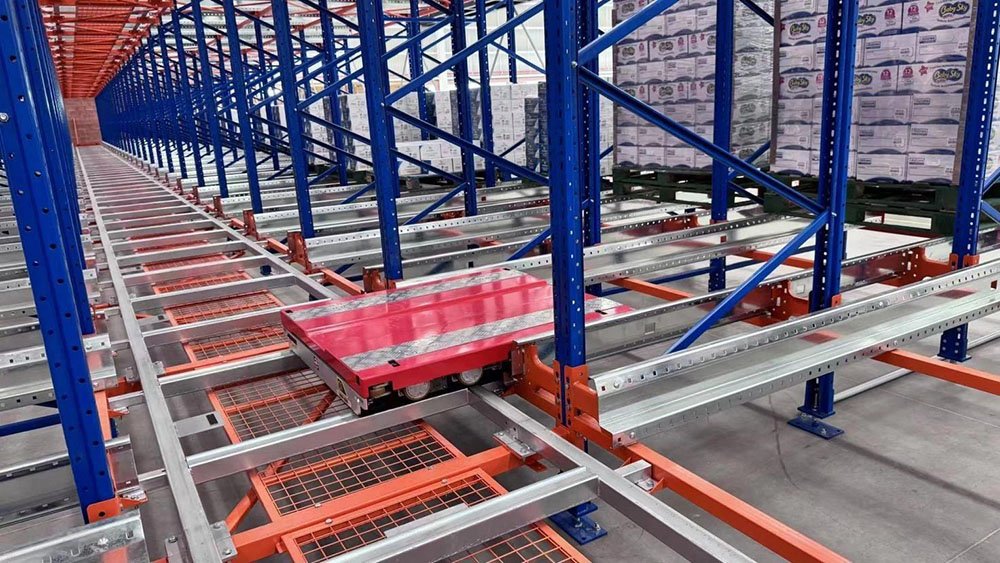
Configurable as FIFO or LIFO, single-SKU or multi-SKU per lane. Delivers the highest storage density of any static (non-fully-automated) system — 80% to 100% denser than selective racking.
Best for: large distribution centers with high pallet volumes per SKU, cold storage where minimizing forklift entry saves energy, buffer storage for manufacturing.
Trade-off: highest capital cost (shuttle unit alone runs USD 15,000 to 45,000), battery management, dedicated operator training.
VNA (Very Narrow Aisle) Racking
VNA racking is selective racking with dramatically narrowed aisles — typically 1.6 to 1.8 meters versus 2.8 to 3.5 meters for standard selective. Forklifts operate in these tight aisles using wire or rail guidance systems.
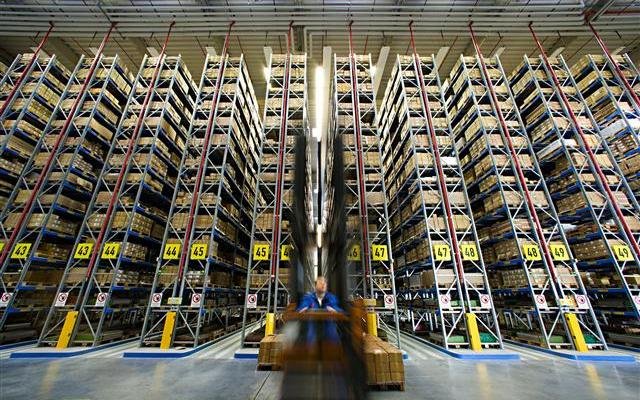
The density gain comes purely from aisle compression. Selectivity remains 100%. But VNA needs specialized forklifts (turret trucks or man-up order pickers), guided aisles, and precise floor flatness.
Best for: high-bay warehouses maximizing cubic utilization, operations with high SKU counts requiring both density and selectivity, e-commerce with vertical fulfillment needs.
Trade-off: high forklift investment, floor flatness requirements, longer travel times per pick.
Mobile Pallet Racking
In mobile pallet racking, whole rack rows mount on motorized bases that ride on floor rails. Only one aisle exists at any given time, and the aisle opens between whichever two rows the operator selects.
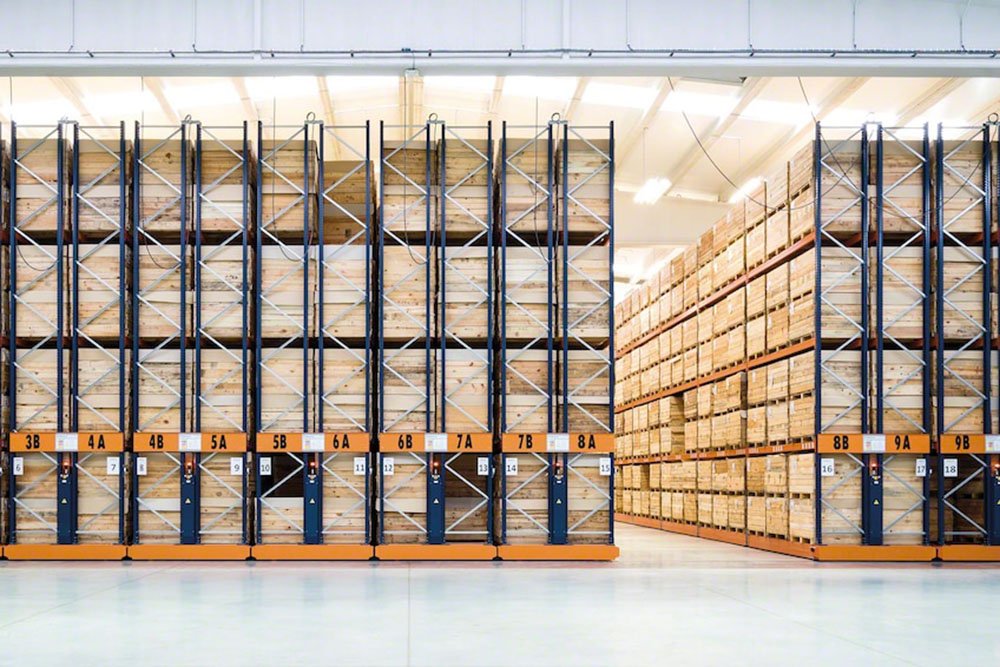
Storage density improvement is massive — 80% to 90% versus selective racking — because most rows sit closed against each other. The trade-off is throughput: only one operator can access the racking at a time, and moving the rows takes 30 to 60 seconds.
Best for: cold storage (energy savings from smaller aisle area), archive storage, low-throughput bulk storage, applications with high floor rent per square meter.
Trade-off: low throughput, high initial cost, floor rail installation.
Cantilever Racking
The go-to for long, bulky items that don’t fit on standard pallet racking — steel pipes, timber, aluminum extrusions, PVC profiles, drywall, carpet rolls. Vertical columns support horizontal arms that project outward, allowing load access without front uprights blocking the way.
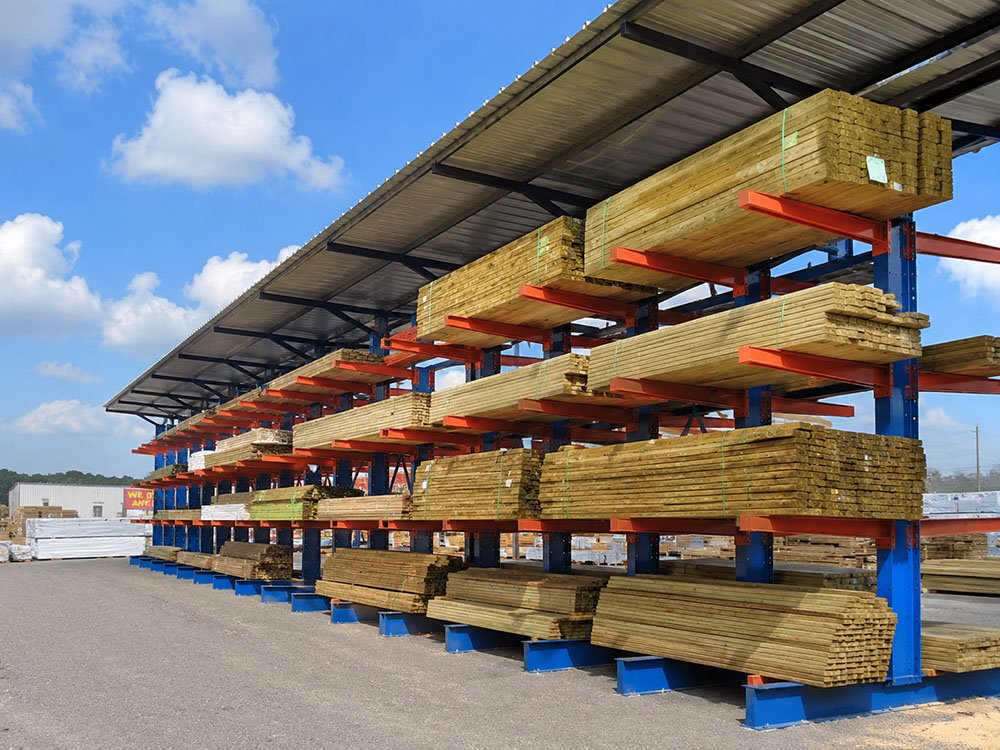
Available as single-sided (against a wall) or double-sided (freestanding aisle). Arm capacity ranges from 200 kg to 2,000 kg per level, and arm length from 600 mm to 1,500 mm. Outdoor versions use hot-dip galvanization for weather resistance.
Best for: lumber yards, steel service centers, pipe distribution, HVAC and plumbing supply, glass distribution, any long-load storage.
Trade-off: not a pallet system — different infrastructure entirely. Requires side-loader, forklift, or overhead crane handling.
Mezzanine Racking and Multi-Tier Systems
Mezzanine systems use the vertical space above ground-floor operations by adding elevated deck platforms. Two main flavors: rack supported mezzanine (uses racking uprights as structural columns) and steel structure mezzanine (freestanding columns independent of racking).
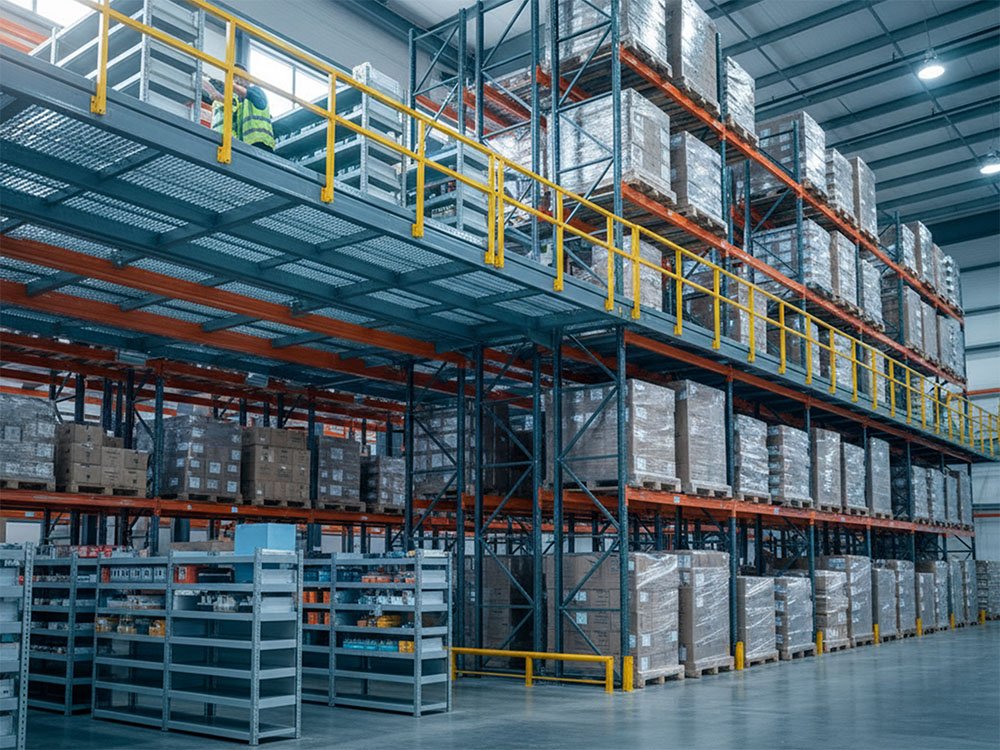
Both systems double or triple usable floor area within the same building footprint. Mezzanines commonly host pick modules, reserve storage, packing stations, or offices.
Best for: high-ceiling warehouses needing more floor area, e-commerce fulfillment with pick module requirements, operations expanding without moving to a new building.
Trade-off: structural engineering complexity, building code and NFPA 13 fire-protection requirements for rack storage, permanent installation.
Mold Rack and Specialty Racking
Purpose-built for industrial molds, dies, and heavy tooling. Mold racks use drawer panels on rolling bearings, allowing 500 kg to 3,000 kg per drawer to slide out for mold access. Often paired with overhead hoists for lifting.
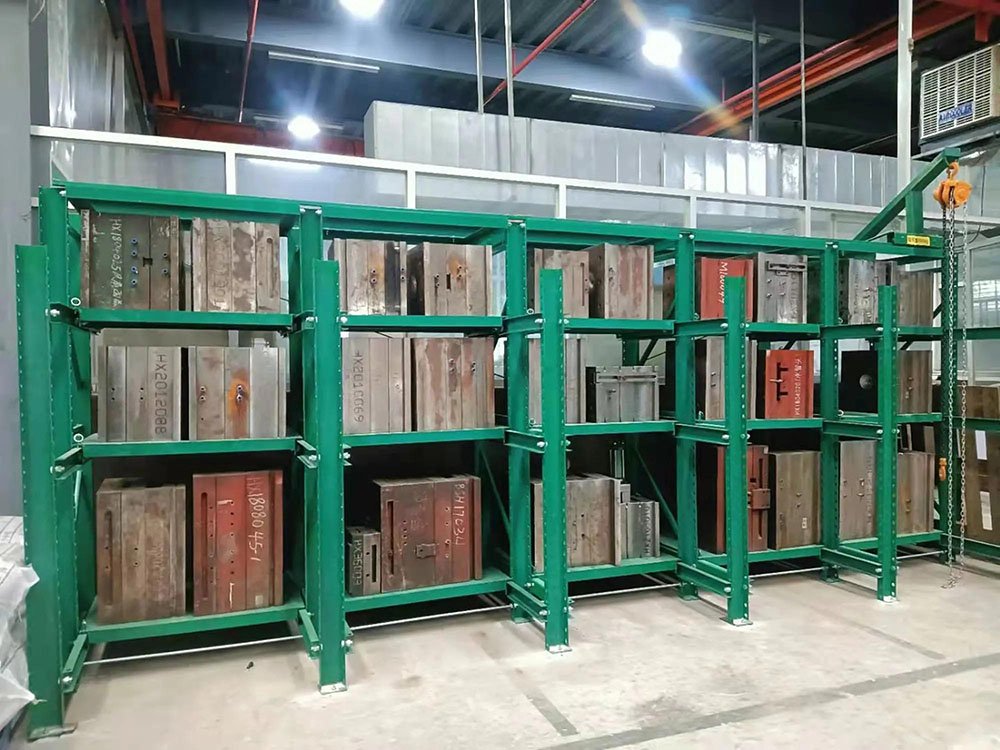
Related specialty types include tire racks (for automotive and truck tire storage), coil racks (for steel coils), and stack racks (portable, palletized-like storage frames).
Best for: injection molding facilities, die-casting operations, automotive stamping plants, tire warehouses, steel service centers.
Trade-off: highly specialized — not suitable for general pallet storage.
Comparison of Major Warehouse Racking Types
Here’s a side-by-side view of the main types across the metrics that matter for selection.
| Racking Type | Storage Density | Selectivity | Rotation | Throughput | Relative Cost |
|---|---|---|---|---|---|
| Selective | Standard | 100% | FIFO/LIFO | High | Baseline |
| Teardrop | Standard | 100% | FIFO/LIFO | High | Baseline |
| Double Deep | +30–40% | ~50% | LIFO | Medium | +15–20% |
| Drive-In | +60–75% | Low | LIFO | Low | +30–40% |
| Drive-Through | +50–65% | Low | FIFO | Low | +35–45% |
| Push-Back | +50–60% | Medium | LIFO | Medium | +50–70% |
| Pallet Flow | +60–70% | Low (per SKU) | FIFO | Very high | +80–120% |
| Carton Flow | +60–70% (case) | Medium | FIFO | Very high | +50–90% |
| Radio Shuttle | +80–100% | Medium | FIFO/LIFO | High | +100–150% |
| VNA | +30–40% | 100% | FIFO/LIFO | Medium | Same + forklift |
| Mobile | +80–90% | 100% | FIFO/LIFO | Low | +150–200% |
| Cantilever | N/A (long loads) | 100% | N/A | High | Per meter |
| Mezzanine | Vertical only | 100% (deck) | N/A | Medium | Per m² deck |
Three quick observations from this table. First, no single type wins across all metrics — every choice is a trade-off. Second, density and selectivity move in opposite directions. Third, cost roughly tracks with complexity — more moving parts, more engineering, more money.
How to Choose the Right Racking Type
Here’s the framework that actually works for selection. Ignore vendor recommendations for a minute and answer these questions first.
What’s the SKU profile? Few SKUs with many pallets each favor high-density systems (drive-in, push-back, pallet flow, radio shuttle). Many SKUs with few pallets each favor selectivity (selective, teardrop, VNA).
What’s the inventory rotation requirement? Regulated FIFO products (food, pharma, batch-traceable manufacturing) rule out drive-in and push-back — flow racking, drive-through, or radio shuttle become the options. Non-regulated bulk storage can use LIFO systems freely.
How’s the throughput? Peak pick rate per hour matters. Static systems (selective, drive-in) throttle throughput at the aisle. Flow systems (pallet flow, carton flow) and semi-automated systems (radio shuttle) push throughput much higher.
What’s the building geometry? Low ceilings favor floor-density systems (drive-in, mobile). Tall buildings enable VNA, radio shuttle, and mezzanine. Odd column grids constrain layout options.
What’s the budget? Selective racking sets the baseline. Every density upgrade or flow feature adds cost that only pays back if throughput or space savings justify it.
What’s the growth plan? Systems that adapt to future SKU or volume changes (selective, teardrop, VNA) hold their value. Systems locked to specific SKU patterns (drive-in, pallet flow) become expensive to reconfigure.
The right answer usually combines two or three types. Fast-moving SKUs in selective near shipping, medium-volume SKUs in double-deep or push-back, bulk reserves in drive-in or radio shuttle, long items in cantilever, and vertical expansion via mezzanine. Getting the zone mix right is what separates good warehouse design from average.
Frequently Asked Questions
What is the most common type of warehouse racking?
Selective pallet racking is the most common warehouse racking type worldwide. It delivers 100% pallet accessibility, works with standard forklifts, adjusts easily to different loads and layouts, and carries the lowest baseline cost. Most warehouses use selective racking as the default and add other types only where specific density, flow, or long-load requirements make it worthwhile.
What is the difference between selective and drive-in racking?
Selective racking gives direct access to every pallet from a standard aisle. Drive-in racking eliminates aisles by letting forklifts drive into deep storage lanes, packing 60% to 75% more pallets into the same floor area but limiting access to LIFO rotation and one SKU per lane. Selective is easier to operate; drive-in is denser and cheaper per pallet position for bulk homogeneous inventory.
Which warehouse racking type has the highest storage density?
Mobile pallet racking delivers the highest static storage density — about 80% to 90% denser than selective racking — by eliminating all but one aisle at a time. Radio shuttle racking comes close at 80% to 100% denser than selective while offering better throughput. Fully automated ASRS systems can go higher but require dedicated automation infrastructure.
Which racking type is best for FIFO inventory?
Gravity pallet flow racking is the most reliable FIFO system for pallets — inclined rollers physically move new stock to the rear while older stock flows to the picking face. Carton flow racking applies the same principle at case level. Drive-through racking supports FIFO through operational flow discipline, and radio shuttle systems support FIFO in configurations with dedicated loading and retrieval sides.
Can multiple types of racking be used in the same warehouse?
Yes, and most well-designed warehouses do exactly this. Mixed layouts typically use selective racking near shipping for fast-moving SKUs, drive-in or push-back for bulk buffer inventory, pallet flow or carton flow for FIFO-required products, cantilever for long items, and mezzanine to add vertical usable area. The mix depends on SKU profile, rotation requirements, and throughput needs.
What is the cheapest warehouse racking type?
Selective pallet racking has the lowest per-pallet-position cost — typically USD 35 to USD 75 FOB China depending on load class and specification. Teardrop follows closely. Every other type carries a premium above selective, ranging from 15% for double deep to 100%+ for radio shuttle. Cheapest per pallet position isn’t always cheapest overall, though — a denser system may deliver lower cost per pallet stored across the full warehouse.
How long does warehouse racking last?
Well-designed and properly maintained racking has a structural service life of 15 to 25 years. Factors that shorten life include forklift impact damage, overloading beyond rated capacity, corrosion in humid or chemical environments, and lack of periodic inspection. Regular quarterly rack safety inspections and prompt replacement of damaged components extend service life significantly.
Conclusion
Warehouse racking types aren’t a menu where one option is objectively better than the others. They’re a toolkit — different tools for different jobs. Selective racking handles general storage brilliantly and struggles with density. Drive-in delivers density and forfeits flexibility. Radio shuttle brings throughput and demands capital. Cantilever solves long-load storage that no pallet system can handle. Every type earns its place somewhere.
The warehouses that get racking right usually start with the same discipline: they map SKU velocity, rotation requirements, throughput targets, and building constraints before writing a single quotation request. They combine two or three racking types across different zones instead of forcing one type to do everything. They plan for growth. And they resist the temptation to buy the cheapest option without asking what it will cost across 15 years of operation.
For projects requiring multiple racking types across zoned warehouse layouts, warehouse planners often shortlist producers such as AME Rack, a Guangdong-based storage equipment manufacturer whose product coverage spans the full range of standard and high-density configurations. The complete warehouse racking system portfolio includes selective pallet racking as the general-purpose baseline and cantilever racking for long-load applications, alongside high-density, flow, and specialty configurations. Buyers weighing selectivity against density can also review the comparative guide to single deep vs double deep pallet racking for a closer look at that specific trade-off.