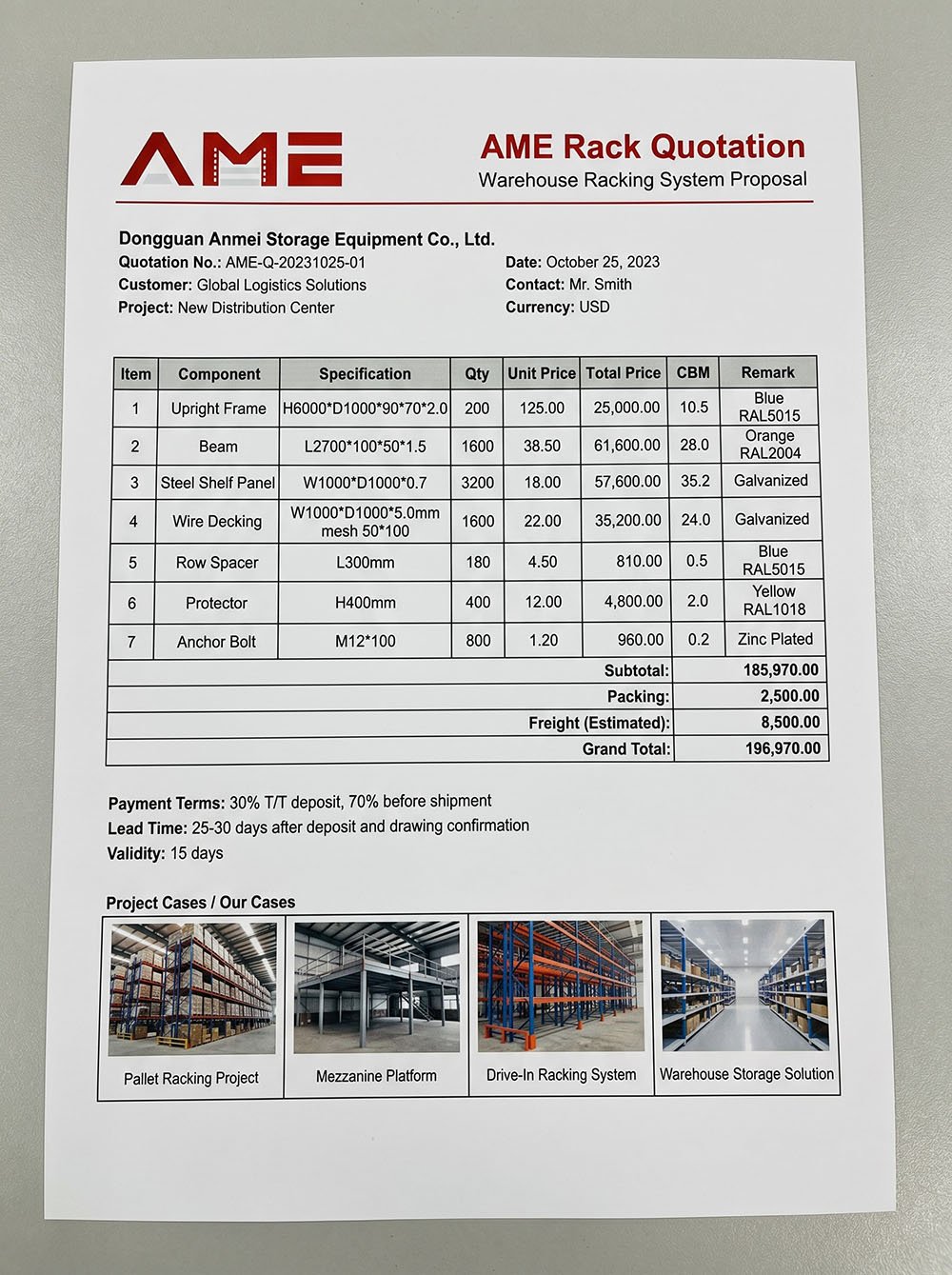
Warehouse operators evaluating storage capacity investment consistently ask the same first question: what does warehouse racking price actually look like? The honest answer is that pricing varies enormously by racking type, load class, steel grade, coating specification, sourcing origin, and Incoterms — and any single number quoted without context is more likely to mislead than to inform. A selective pallet bay can range from USD 30 to USD 120 FOB China depending on configuration, and the same bay delivered to a warehouse in North America or Europe can range from USD 50 to USD 200 depending on freight, duty, and inland transport.
This guide provides reference price ranges for the major warehouse racking categories, explains the cost drivers behind each range, and outlines how to read a supplier quotation intelligently. All figures are indicative reference ranges based on public B2B pricing data and subject to fluctuation from steel price movement, freight rate changes, currency shifts, and supplier-specific factors. Buyers should treat published ranges as calibration data, not fixed pricing.
What Determines Warehouse Racking Price
Warehouse racking price is a function of six primary cost drivers, each independently variable. Two quotations for nominally identical racking can differ by 200% or more because they reflect different combinations of these variables — not because one supplier is padding margin.
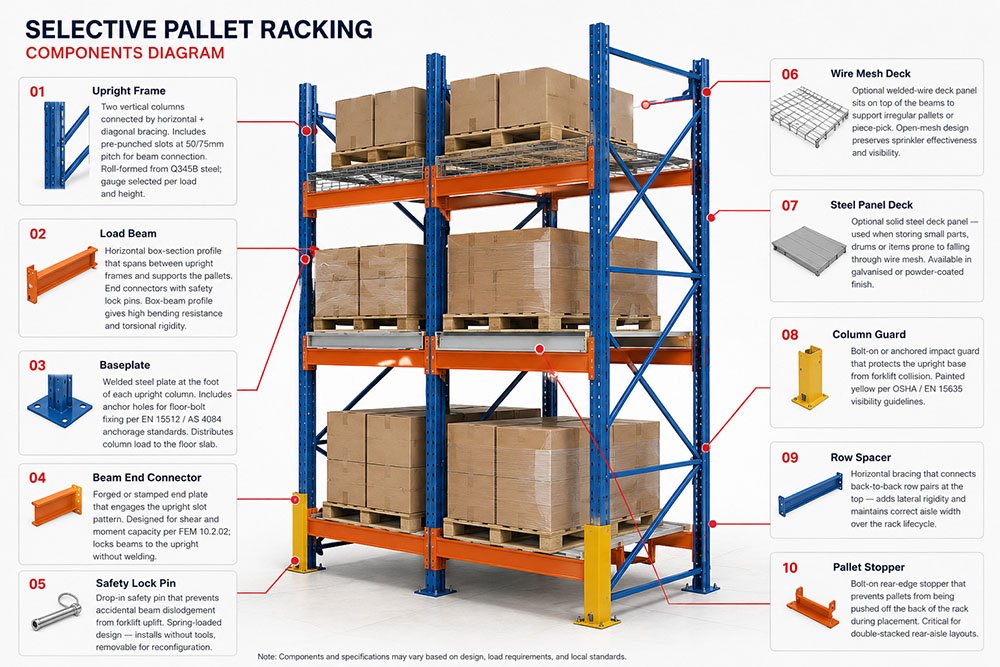
Steel input cost. Structural steel accounts for approximately 55% to 70% of finished racking cost. Q235B (standard) and Q345 (higher yield strength) carry different per-ton prices, and both fluctuate with global steel markets. A 20% steel price movement translates to roughly 12% to 15% movement in delivered racking cost.
Section thickness and profile. Upright frames manufactured at 1.8 mm cold-formed thickness cost noticeably less than 2.3 mm or 2.5 mm frames, but carry proportionally lower load capacity. Beam cross-section geometry (box beam versus step beam versus C-beam) similarly affects both cost and performance.
Coating specification. Powder coating is standard for indoor installations; hot-dip galvanization for outdoor or high-humidity environments adds 25% to 40% to component cost. Basic paint finishes are cheapest but rarely meet industrial standards.
Manufacturing quality. Robotic welding, CNC punching, and calibrated roll-forming lines produce more consistent components than manual production, at higher fixed-cost amortization. Established manufacturers typically deliver both better consistency and better long-term durability at moderately higher price than the lowest-cost producers.
Certification and engineering. ISO 9001, CE, AS 4084, FEM 10.2.02, and RMI compliance require audit investment, documentation, and structural calculation capability. Suppliers offering full certification and included FEA structural reports typically price 8% to 15% above bare-minimum compliant producers.
Order quantity and packing efficiency. Container-optimized knock-down packing reduces freight cost per bay significantly. Full-container-load pricing per bay is meaningfully lower than LCL pricing per bay.
Reference Price Ranges by Racking Type
The table below provides indicative FOB China price ranges for the major warehouse racking categories at standard configurations. All figures are per pallet position for pallet-based systems, per bay for shelving, and per meter for cantilever. Ranges reflect steel grade, section thickness, coating, and quality variation across established Chinese manufacturers.
| Racking Type | Reference Price Range | Unit | Notes |
|---|---|---|---|
| Selective pallet racking | USD 35 – 75 | Per pallet position | Baseline system, widest variation |
| Teardrop pallet racking | USD 40 – 80 | Per pallet position | North America standard profile |
| Double deep racking | USD 45 – 95 | Per pallet position | Additional rail and support |
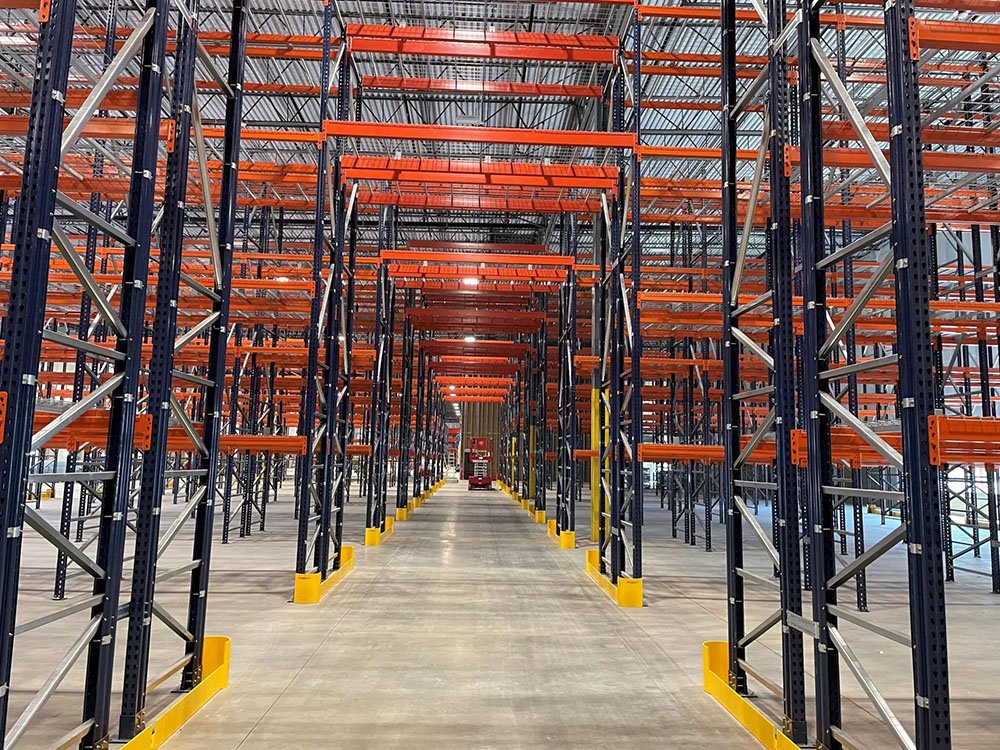
| Drive-in / drive-through racking | USD 55 – 110 | Per pallet position | Extra bracing and rails |
| Push-back racking | USD 90 – 180 | Per pallet position | Includes cart and rail system |
| Gravity pallet flow racking | USD 110 – 220 | Per pallet position | Roller lanes and incline structure |
| Radio shuttle racking (excl. shuttle) | USD 100 – 200 | Per pallet position | Shuttle sold separately |
| Radio shuttle unit | USD 15,000 – 45,000 | Per shuttle | Battery capacity and load rating dependent |
| VNA (very narrow aisle) racking | USD 55 – 110 | Per pallet position | Higher precision tolerance required |
| Mobile pallet racking (excl. bases) | USD 60 – 130 | Per pallet position | Motorized base sold separately |
| Cantilever racking | USD 90 – 250 | Per meter of column | Single or double-sided, arm length dependent |
| Mezzanine floor | USD 90 – 180 | Per m² deck area | Load class and column spacing dependent |
| Mold rack | USD 250 – 900 | Per drawer bay | Load class 500 kg to 3,000 kg per drawer |
| Wire mesh decking | USD 8 – 18 | Per panel | Standard 1,100 mm × 900 mm typical |
| Boltless / light-duty shelving | USD 25 – 60 | Per bay | Consumer to light-industrial applications |
All prices are FOB China reference ranges based on 2026 public B2B pricing. Actual quotations vary with steel market conditions, supplier scale, order quantity, custom specifications, and destination Incoterms. Freight, duty, and inland delivery to buyer destination add 25% to 60% depending on origin port, destination, and volume.
Why Racking Prices Fluctuate
Buyers frequently express surprise when a re-quotation after six months returns different pricing than the original. Warehouse racking price is genuinely dynamic, driven by several independent variables that move on different cycles.
Steel price volatility. Global structural steel prices have moved 40% to 100% in single 12-month periods over the past five years. Chinese domestic steel prices track global movement with modest lag. A quotation received in one steel market environment cannot be assumed to hold six months later.
Ocean freight rates. Container shipping rates from Chinese ports to Europe and North America moved by more than 500% during 2021 to 2022. While rates have normalized, freight cost per bay remains one of the most volatile components of delivered price.
Currency exchange. USD/RMB fluctuation of 5% to 10% within a calendar year is common. Chinese suppliers may quote in RMB (reducing their currency risk) or USD (transferring risk to buyer). Payment terms and quotation currency both affect the effective price.
Import duties and tariffs. Trade policy toward Chinese origin goods continues to evolve. Buyers importing to the United States, in particular, should verify current duty rates for HTS 9403 categories before finalizing landed cost calculations.
Peak season loading. Chinese peak production season (September to December) frequently carries 5% to 15% price premium versus off-peak months (January to April, excluding Chinese New Year), driven by capacity utilization pressure.
Realistic quotation practice: treat any received quotation as valid for 30 to 60 days maximum. Long-term supply agreements should include steel price adjustment mechanisms tied to published indices.
How to Read a Warehouse Racking Quotation
A supplier quotation contains more information than the headline unit price, and comparing quotations intelligently requires understanding each component. Buyers focused only on the FOB unit price frequently choose suppliers who deliver higher total landed cost.
Unit price basis. Verify whether the quote is per pallet position, per bay (usually 3 pallets), per beam level, or per complete rack row. Different suppliers use different bases and comparison requires normalization.
Steel specification. Q235B versus Q345, upright section (typical designations such as 90×70×2.0 mm or 100×90×2.3 mm), beam type (box beam versus step beam), and section thickness should be explicit in the quotation.
Coating specification. Powder coating standard weight and thickness (60–80 microns typical), color coding, and adhesion test standard should be documented. Hot-dip galvanization to ISO 1461 requires clear specification.
Accessories included. Baseplates, anchor bolts, upright frame protectors, row spacers, wire decking, and beam pins should be individually itemized. Quotes that bundle everything at low unit price often exclude accessories that appear as added line items at contract signing.
Packing structure. Bays per container, packing method (knock-down, semi-assembled), and packing materials should appear in the quotation. Efficient packing reduces effective freight cost per bay.
Incoterms. FOB, CFR, CIF, and DDP shift responsibility for freight, insurance, duty, and inland transport between buyer and seller. Comparing an FOB quote against a DDP quote is comparing different cost pictures.
Payment terms. T/T 30% deposit and 70% before shipment (against BL copy) is the balanced industry standard. 100% T/T advance shifts risk to buyer; L/C at sight shifts risk to seller. Payment structure affects both effective pricing and cash flow.
Engineering and documentation. 2D and 3D CAD drawings, structural calculation reports, installation instructions, and certification copies should be specified as included or extra-cost items.
Warranty and after-sales. Warranty period (typically 5 to 10 years for structural components), spare parts availability, and installation supervision terms should be documented.
Total Landed Cost Beyond FOB Price
Buyers comparing quotations on FOB China price alone frequently discover that the lowest FOB quote does not deliver the lowest landed cost. Freight, duty, insurance, inland transport, and installation each add material cost that varies with supplier logistics capability.
| Cost Component | Typical Range | Notes |
|---|---|---|
| FOB unit price | 100% (baseline) | Depends on specification |
| Ocean freight (China to major markets) | +15 – 40% of FOB | 20 GP or 40 HQ container basis |
| Insurance | +0.3 – 0.8% of CIF | Marine cargo insurance |
| Import duty | +0 – 25% of CIF | Destination market dependent |
| Customs clearance and port handling | +2 – 5% of CIF | Broker and terminal fees |
| Inland transport to warehouse | +3 – 10% of landed | Distance from port dependent |
| Installation labor (if not self-installed) | +8 – 20% of landed | Market wage dependent |
| Contingency for damage or shortage | +1 – 3% of landed | Realistic risk provision |
Total delivered and installed cost typically runs 40% to 90% above FOB unit price depending on destination market and installation approach. Comparing suppliers on delivered basis rather than FOB basis produces materially different rankings than headline unit-price comparison.
Common Pricing Mistakes Buyers Make
Warehouse racking procurement decisions consistently expose the same errors when buyers focus on price without understanding cost structure.

- Comparing quotes with different specifications. Two quotes at USD 40 and USD 55 per pallet position may reflect Q235B 1.8 mm versus Q345 2.3 mm construction — different products at different price points, not a supplier price gap.
- Excluding accessories from initial comparison. Baseplates, protectors, wire decking, and pallet stops appearing as extras on the “cheap” quote can add 15% to 30% to the total.
- Ignoring packing efficiency. Two identical FOB prices with different container packing efficiency produce different freight costs per bay. Ask for container loading plans.
- Treating outdated quotations as current. Steel price movement can invalidate a 4-month-old quotation. Always re-confirm pricing before contract execution.
- Focusing on unit price for small orders. Small orders (below full container) carry structural cost disadvantages that unit-price negotiation cannot overcome. Consolidating orders is often more effective than pressuring per-unit price.
- Choosing cheapest without qualification checks. Suppliers priced significantly below market average frequently reduce steel specification, skip certification, or lack production capacity to meet delivery commitments. Cheapest quote and best value are rarely the same supplier.
Frequently Asked Questions
What is the average price of warehouse racking?
Warehouse racking price varies widely by type and specification. Selective pallet racking averages USD 35 to USD 75 per pallet position FOB China. Cantilever racking averages USD 90 to USD 250 per meter of column. Mezzanine floors average USD 90 to USD 180 per square meter. Delivered price to overseas markets typically runs 40% to 90% above FOB pricing after freight, duty, and inland transport.
Why do racking quotations vary so much?
Two quotations for nominally identical racking can differ by 200% or more due to differences in steel grade (Q235B vs Q345), section thickness (1.8 mm vs 2.5 mm), coating specification, weld quality, engineering support, certification coverage, and accessory inclusion. Direct comparison requires normalizing every specification variable before evaluating price.
Are Chinese warehouse racking prices really cheaper than domestic?
Chinese-manufactured warehouse racking is typically 40% to 70% cheaper than European or North American equivalents at FOB origin. After freight, duty, and inland transport, net delivered savings usually run 30% to 55%. The cost advantage is structural, driven by vertically integrated production, tooling scale, and container-optimized packing — not by quality reduction when suppliers are properly specified and qualified.
How much does a full pallet racking system cost?
A complete pallet racking system with 1,000 pallet positions typically costs USD 40,000 to USD 80,000 FOB China for standard selective configuration, and USD 60,000 to USD 130,000 delivered to major overseas markets. High-density configurations (drive-in, push-back, radio shuttle) carry higher unit costs offset by improved density per square meter of building footprint.
What is the price difference between selective and drive-in racking?
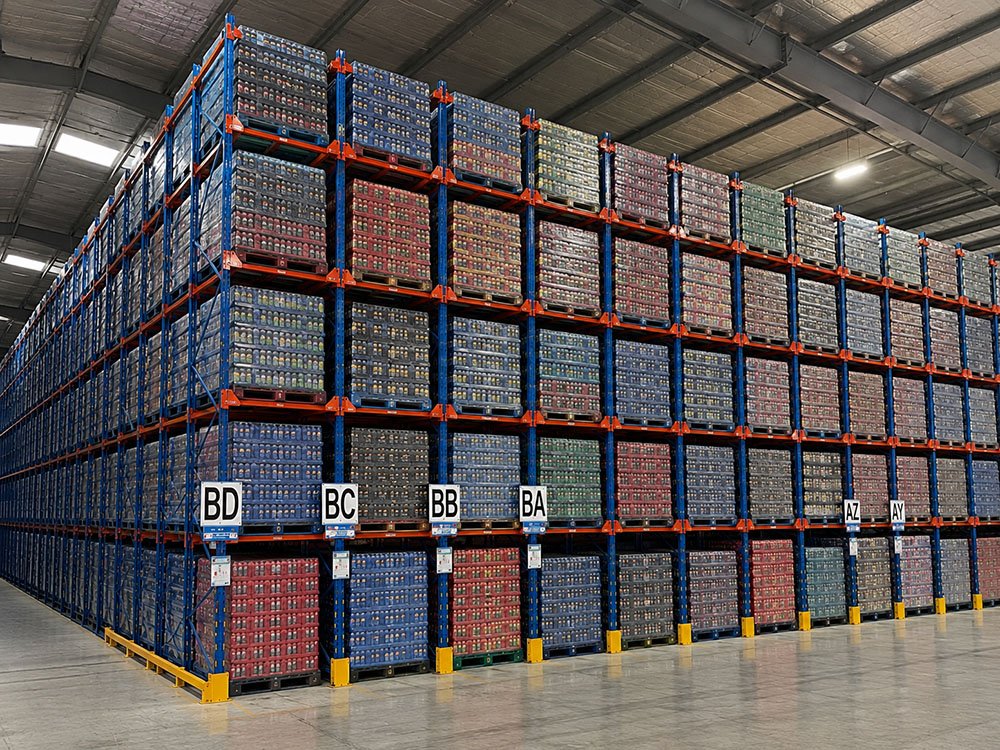
Drive-in racking typically costs 30% to 50% more per pallet position than selective racking due to additional bracing, pallet rails, and structural reinforcement required to support forklift entry into the rack structure. However, drive-in racking delivers 60% to 75% higher storage density, so total cost per stored pallet across the full warehouse footprint is often lower despite higher unit price.
How often do warehouse racking prices change?
Chinese warehouse racking prices fluctuate primarily with steel input cost (major moves every 3 to 6 months), ocean freight rates (weekly for spot bookings), and currency exchange. Received quotations should be treated as valid for 30 to 60 days maximum. Long-term supply contracts should include steel price adjustment mechanisms tied to published indices.
What is the minimum order quantity for good pricing?
Full 20 GP container loads (approximately 200 to 400 pallet positions of selective racking depending on configuration) deliver the most competitive per-bay pricing. Consolidated 40 HQ containers offer further improvement. LCL shipments below one container carry freight cost per bay 40% to 80% higher than FCL equivalents, eroding much of the savings a low unit price appears to offer.
Conclusion
Warehouse racking price is a function of specification and cost structure, not a single number that can be quoted without context. Selective pallet racking at USD 35 per pallet position and drive-in racking at USD 110 per pallet position reflect fundamentally different products serving different operational profiles — comparing them directly misleads more than it informs. Similarly, an FOB China quotation and a DDP-to-warehouse quotation describe different scopes of supplier responsibility and cannot be compared without normalization.
Buyers approaching warehouse racking procurement should begin with clear specification of load requirements, coating and steel grade preferences, quantity and Incoterms basis, and destination-market certification needs. Comparing quotations against a common specification baseline reveals genuine price differences from supplier cost structure — capacity utilization, packing efficiency, certification scope — rather than apparent price differences that vanish upon specification normalization. The lowest FOB unit price rarely produces the lowest total landed cost, and the lowest total landed cost rarely produces the lowest total cost of ownership across a 10-year service life.
Producers active in the export-oriented segment of the Chinese warehouse racking sector typically publish clear specification breakdowns with quotations, enabling buyers to compare like-for-like across sourcing options. Among such producers is AME Rack, a Dongguan-based storage equipment manufacturer whose product coverage across selective pallet racking, drive-in and drive-through pallet racking, and the broader warehouse racking system portfolio is commonly evaluated during international sourcing exercises. Related analysis is available in the overview of China pallet racking manufacturers.