Warehouse operators seeking high-density pallet storage for large volumes of homogeneous inventory frequently evaluate two closely related high-density systems: drive-in racking and drive-through racking. Both configurations eliminate access aisles between rack rows by allowing forklifts to enter the storage lanes directly, and both deliver dramatically higher storage density than selective pallet racking. The two systems differ, however, in access geometry, inventory rotation logic, and operational discipline required from forklift operators. Buyers comparing manufacturer options can also review the 2026 China pallet racking manufacturers list.
Choosing between drive-in vs drive-through racking directly influences pallet throughput, inventory rotation control, capital investment, and long-term operational safety. Misclassifying the two systems — or selecting the wrong configuration for a given inventory profile — commonly leads to either underutilized capacity or inventory rotation problems that force expensive layout changes.
This guide examines both systems in technical detail, compares their performance across the metrics that matter most to logistics managers, and outlines the application scenarios where each configuration delivers optimal return.
What Is Drive-In Racking
A drive-in racking system is a high-density pallet storage configuration in which forklifts enter storage lanes from a single side, depositing and retrieving pallets on continuous rails mounted along the interior of the upright frames. Because pallets are loaded and unloaded from the same aisle, the system operates on a Last-In, First-Out (LIFO) inventory logic — the most recently stored pallet is retrieved first.
The system consists of upright frames spaced to accommodate pallet width plus tolerance, horizontal rails supporting the pallet base, back-to-back top-tie beams for lateral stability, upright frame protectors at the aisle entry, and reinforced base plates. Aisles are eliminated between rack lanes, and the forklift travels inside the rack structure to reach each pallet position.
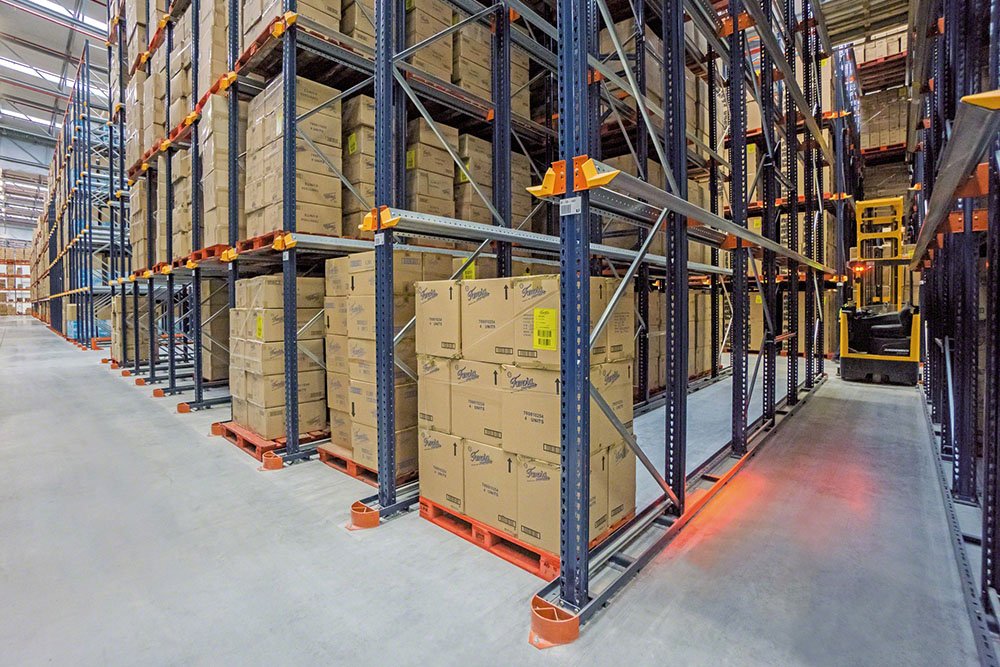
Key structural characteristics of drive-in racking include:
- Single-entry lane geometry (closed at one end)
- Pallets stored 4 to 10 positions deep per lane, typically
- 60% to 75% higher storage density than selective racking
- LIFO inventory rotation only
- Compatible with counterbalance and reach trucks
Because forklifts operate inside the rack structure, drive-in racking requires disciplined operator training and slower pallet handling speeds than selective racking. The trade-off is one of the highest storage densities achievable with static (non-automated) pallet storage.
What Is Drive-Through Racking
A drive-through racking system is a high-density pallet storage configuration with open ends on both sides, allowing forklifts to enter one aisle and exit through the opposite side. Pallets are loaded from one end and retrieved from the other, enabling First-In, First-Out (FIFO) inventory rotation when the operational flow is disciplined accordingly.
The system uses the same structural components as drive-in racking — upright frames, pallet rails, top-tie beams, base plates, and upright protectors — but with both ends of each storage lane left open. The rack rows are typically positioned as freestanding structures rather than against a wall, since access is required from both sides.
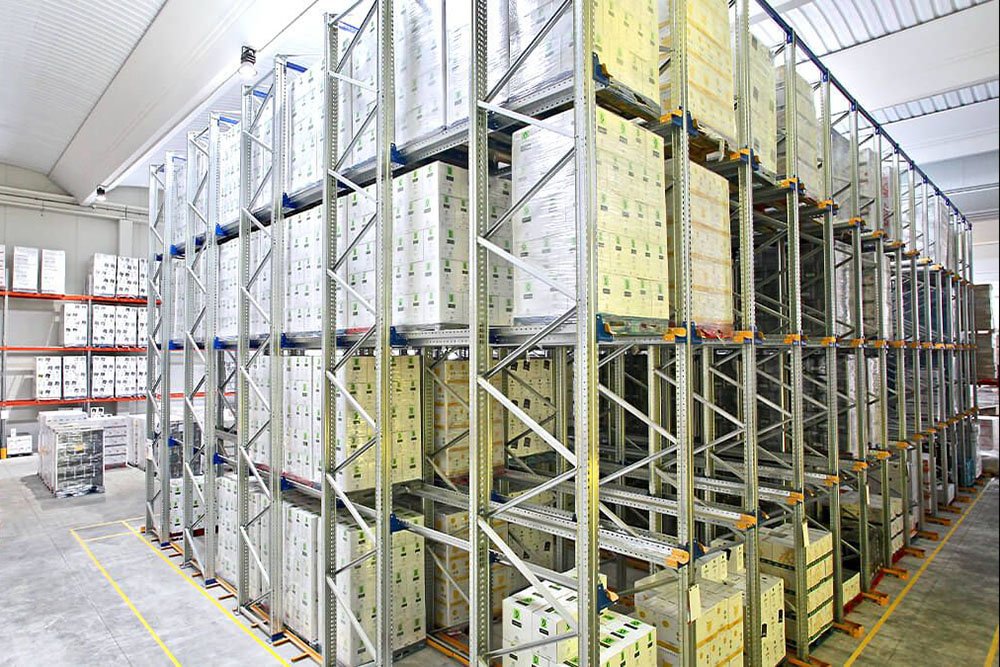
Key structural characteristics of drive-through racking include:
- Dual-entry lane geometry (open at both ends)
- Pallets stored 4 to 10 positions deep per lane, typically
- 50% to 65% higher storage density than selective racking (slightly lower than drive-in due to reduced back-wall support)
- FIFO inventory rotation
- Requires clear forklift traffic paths at both ends of the rack
Because both ends of the rack are open, drive-through racking cannot brace itself against an adjacent wall and requires additional structural bracing — usually top-tie beams and diagonal frame bracing — to maintain lateral stability under forklift entry loads.
Key Structural and Operational Differences
While drive-in and drive-through racking share the same core structural components, their geometry, operational logic, and space efficiency diverge in ways that matter for warehouse planning. The table below summarizes the principal differences between drive-in vs drive-through racking.
| Feature | Drive-In Racking | Drive-Through Racking |
|---|---|---|
| Lane entry points | 1 (single side) | 2 (both sides) |
| Inventory rotation | LIFO | FIFO |
| Storage density vs selective | 60–75% higher | 50–65% higher |
| Structural bracing requirement | Standard | Additional (no back wall) |
| Typical lane depth | 4–10 pallets | 4–10 pallets |
| Forklift traffic pattern | Enters and reverses out | Enters one side, exits the other |
| Wall placement | Can be placed against a wall | Requires clearance both sides |
| Suitable SKU count per lane | 1 SKU per lane | 1 SKU per lane |
| Initial investment | Lower | Slightly higher |
The most important operational distinction is inventory rotation. Drive-in racking cannot support FIFO because the newest pallet blocks access to older pallets on the same rail; drive-through racking can support FIFO because loading and retrieval happen on opposite sides. This single difference determines suitability for a large portion of real-world warehouse inventory profiles.
Storage Density and Floor Utilization
Both systems deliver storage density gains that are impossible with selective racking, and both concentrate the density advantage in floor area rather than vertical space. A simplified comparison illustrates typical performance across the three main pallet storage configurations.
| Layout Type | Aisles per 1,000 m² | Approximate Pallet Positions |
|---|---|---|
| Selective racking | 8–10 | 900–1,100 |
| Drive-through racking | 3–4 | 1,500–1,700 |
| Drive-in racking | 2–3 | 1,600–1,900 |
Drive-in racking edges out drive-through in raw pallet density because rack rows can be placed directly against warehouse walls, eliminating the need for clearance on the far side. Drive-through racking, requiring open access on both sides of every lane, dedicates more floor area to traffic paths and consequently stores slightly fewer pallets per square meter.
The density advantage of both systems, however, only realizes if lane utilization remains high. Because each lane holds a single SKU, warehouses with many SKUs and few pallets per SKU cannot fill lanes completely. A rule of thumb: drive-in and drive-through racking deliver strong economics when the same SKU occupies at least three-quarters of each lane, and marginal economics below that threshold.
Inventory Rotation: LIFO vs FIFO
The LIFO versus FIFO distinction is not simply a technical choice — it directly determines which inventory categories can be safely stored in each system.
Drive-in racking (LIFO) is well-suited to:
- Non-perishable finished goods with long shelf life
- Raw materials that do not degrade in storage
- Bulk buffer inventory where oldest-first retrieval is not required
- Uniform product families where individual pallet identity is interchangeable
Drive-through racking (FIFO) is required for:
- Food and beverage inventory with expiration dates
- Pharmaceutical products with regulated shelf life
- Batch-traceable manufacturing components requiring sequential consumption
- Any inventory subject to first-in-first-out regulatory compliance
Storing FIFO-required inventory in drive-in racking creates compliance and quality risk. Buyers should verify inventory rotation requirements against regulatory and internal quality standards before finalizing the system selection.
Forklift Requirements and Operator Safety
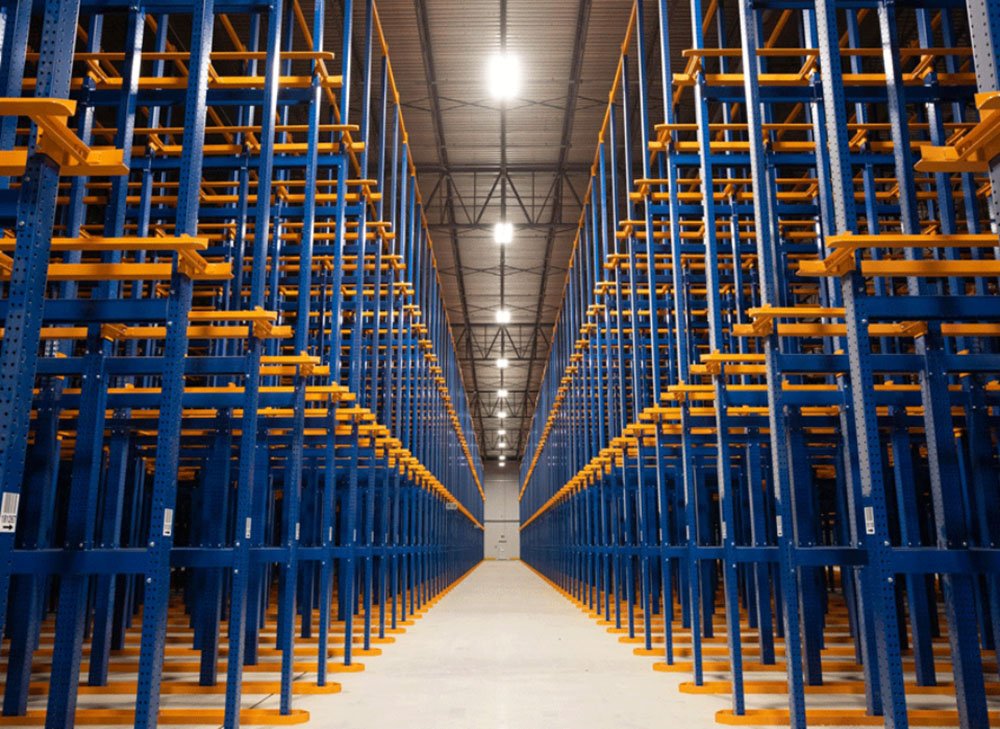
Both systems present distinctive forklift operational challenges. Because the forklift enters the rack structure, mast height, load size, and turning radius all interact with the internal rack dimensions.
Drive-in racking accommodates:
- Standard counterbalance forklifts (sit-down or stand-up)
- Reach trucks for higher vertical extension
- Specially guided forklifts in narrow-aisle drive-in configurations
Drive-through racking accommodates the same forklift range but requires additional operational discipline: because two forklifts can potentially enter opposite ends of the same lane simultaneously, warehouse management procedures must prevent collision incidents. Common controls include signal lights at lane entries, dedicated one-way traffic scheduling, and warehouse management system integration that reserves a lane during active loading.
Operator training carries additional weight in both systems. Damage to internal uprights — caused by mast contact, load overhang, or improper reverse-out procedure — is the leading cause of drive-in and drive-through rack failure. According to guidance from the Material Handling Institute, upright frame protectors, floor guide rails, and forklift speed limits inside rack lanes are standard elements of a well-designed high-density installation.
Cost, ROI, and Long-Term Considerations
Capital investment differs modestly between the two systems, and the total cost of ownership depends more on operational execution than on hardware cost.
| Cost Category | Drive-In Racking | Drive-Through Racking |
|---|---|---|
| Structural hardware (per pallet position) | Lower | Slightly higher (extra bracing) |
| Installation time | Standard | Standard |
| Operator training investment | Standard | Higher (two-side traffic control) |
| Forklift damage exposure | Moderate | Moderate to high |
| Warehouse management system integration | Optional | Recommended for lane reservation |
| Building footprint required | Smaller (wall-adjacent placement) | Larger (dual-side clearance) |
For warehouses handling LIFO-compatible inventory in stable, high-volume SKU groupings, drive-in racking typically delivers the best payback because it combines the highest density with the simplest operational model. For warehouses handling FIFO-required inventory in similar profiles, drive-through racking justifies its slightly higher cost through regulatory compliance and reduced quality loss.
Modern high-density warehousing frequently combines drive-in or drive-through racking with alternative high-density solutions — including radio shuttle racking and push-back racking — deployed in different zones according to SKU profile. This hybrid approach captures the density economics of high-density storage where inventory profiles fit, while preserving selectivity for fast-moving SKUs elsewhere.
Application Scenarios for Each System
Both systems remain widely deployed across global warehousing operations, but each excels in distinct environments determined by SKU profile, inventory rotation requirements, and operational tolerance for forklift entry.
Drive-in racking is preferred for:
- Cold storage facilities for frozen food and ice cream with long shelf life
- Beverage and canned goods warehouses with bulk SKU groupings
- Manufacturing plants storing raw material and packaging in buffer volumes
- Seasonal inventory storage during peak build-up periods
- Warehouses where rack rows can be placed directly against walls to maximize density
Drive-through racking is preferred for:
- Food and beverage warehouses with expiration-dated inventory requiring FIFO
- Dairy and fresh produce distribution centers
- Pharmaceutical distribution facilities with regulated shelf-life controls
- Batch-traceable component manufacturing requiring sequential consumption
- Warehouses with dual-side dock configurations supporting one-way flow
In hybrid warehouses, drive-in and drive-through racking are sometimes combined within the same facility — drive-in in reserve or buffer storage zones, drive-through in front-line inventory rotation zones — matching each system to the inventory it best serves.
Design Considerations and Safety Standards
Both drive-in and drive-through racking systems must comply with regional structural design codes and workplace safety regulations. In Europe, this typically means conformance with FEM 10.2.07 for drive-in and drive-through racks and EN 15512 for general steel storage racking. In North America, ANSI MH16.1, published by the Rack Manufacturers Institute, addresses drive-in and drive-through design, testing, and utilization.
Critical design parameters common to both systems include:
- Upright frame section properties verified against maximum pallet load
- Top-tie beam sizing for lateral stability under forklift entry
- Pallet rail deflection limits (typically L/180 under full load)
- Upright frame protectors at all aisle-facing columns
- Floor guide rails at lane entries to reduce forklift misalignment
- Overhead clearance for mast extension inside the lane
- Seismic bracing for installations in high-seismic zones
Drive-through racking requires additional attention to lateral bracing because the absence of a back wall reduces overall system stiffness. Reinforced top-tie beam sections, diagonal frame bracing, and closer upright frame spacing are commonly specified.
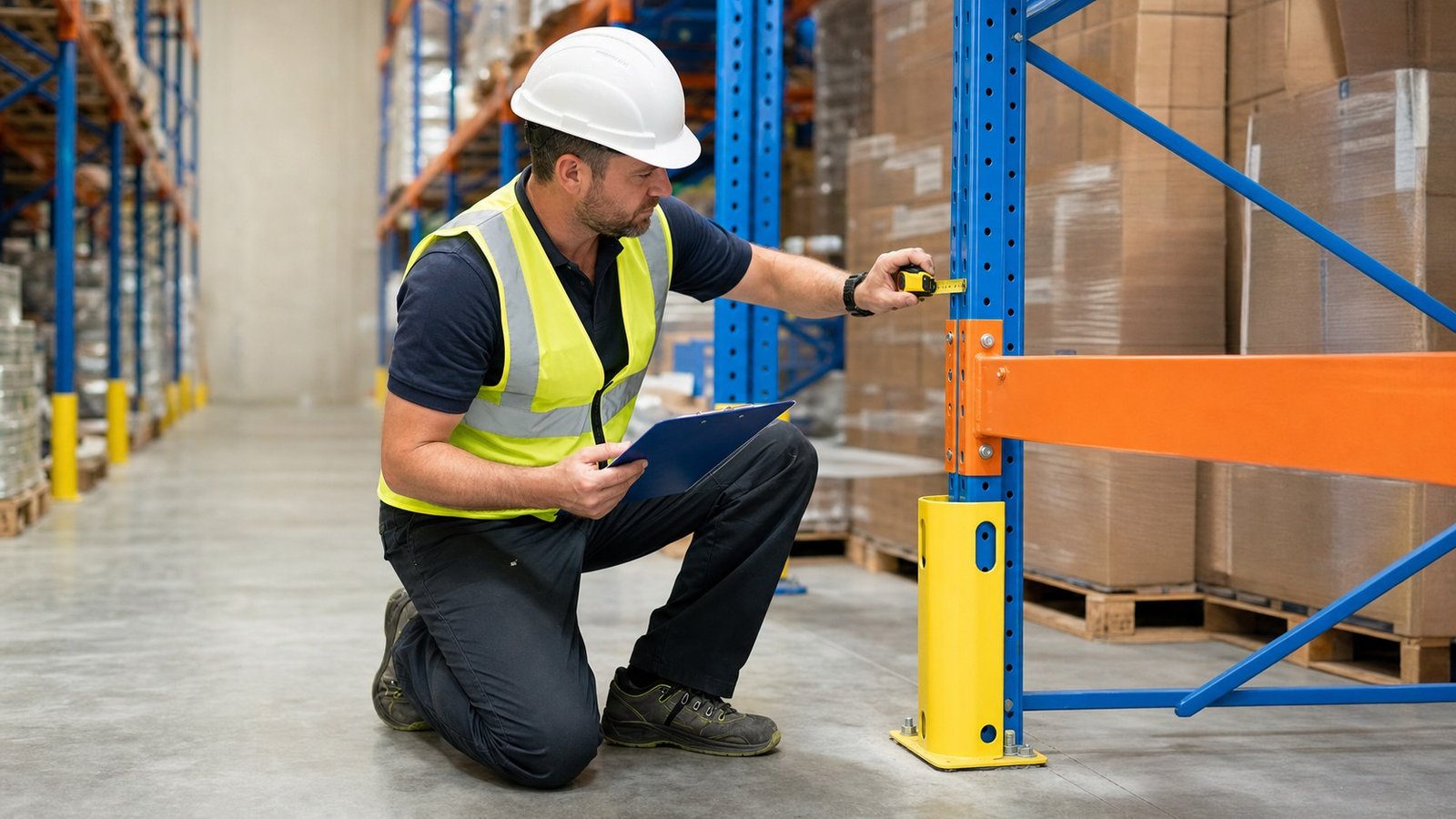
Periodic rack inspection — recommended quarterly for high-density installations due to elevated forklift contact frequency — is essential to maintain structural integrity. Damaged uprights should be replaced immediately rather than repaired in place.
Frequently Asked Questions
What is the main difference between drive-in and drive-through racking?
The main difference is access geometry. Drive-in racking is open at one end only and operates on LIFO inventory rotation. Drive-through racking is open at both ends and supports FIFO inventory rotation. Both use identical structural components — uprights, pallet rails, and top-tie beams — but drive-through requires additional lateral bracing because it cannot lean against a back wall.
Which system delivers higher storage density?
Drive-in racking delivers marginally higher density because rack rows can be placed against walls, eliminating clearance on the far side. Typical density gain versus selective racking is 60–75% for drive-in and 50–65% for drive-through. In practice, the density difference is small, and the choice is usually driven by inventory rotation requirements rather than raw density comparison.
Can drive-in racking support FIFO inventory rotation?
No. Drive-in racking is inherently LIFO because pallets are loaded and unloaded from the same side, and the newest pallet blocks access to older pallets on the same rail. Inventory requiring FIFO rotation — including most perishable food, beverage, and pharmaceutical products — should be stored in drive-through racking, pallet flow racking, or radio shuttle systems configured for FIFO flow.
How many pallets deep should a drive-in or drive-through lane be?
Optimal lane depth balances density against operational efficiency. Lanes shorter than 4 pallets deep sacrifice density benefit; lanes deeper than 10 pallets deep increase forklift travel time and damage risk. Most warehouses standardize on 5 to 7 pallets deep as the practical operating range, with adjustments based on SKU velocity and average pallets per SKU.
What forklift type is required for drive-in and drive-through racking?
Standard counterbalance forklifts and reach trucks both operate in drive-in and drive-through racking. Mast height must accommodate rack clearance, and load size must respect internal lane width tolerances. High-bay drive-in installations sometimes use dedicated guided forklifts with wire or rail guidance to reduce upright damage from operator drift.
How much rack damage should be expected in drive-in racking?
Drive-in and drive-through racking experience meaningfully higher forklift damage than selective racking because the forklift operates inside the rack structure. Well-managed installations with operator training, floor guide rails, upright frame protectors, and quarterly inspection typically limit damage to acceptable maintenance levels. Poorly managed installations experience upright replacement rates that can offset the density savings within 5 to 7 years.
When should radio shuttle racking be considered instead of drive-in or drive-through?
Radio shuttle racking is worth evaluating when lane depth exceeds 8 pallets, forklift-in-rack damage is a persistent issue, or throughput requirements exceed drive-in capacity. Shuttle systems remove the forklift from the rack interior by using a battery-powered shuttle to move pallets to the aisle face. Initial investment is significantly higher, but throughput, safety, and long-term maintenance often justify the upgrade in high-volume operations.
Conclusion
Choosing between drive-in vs drive-through racking is fundamentally a choice between LIFO simplicity and FIFO compliance. Drive-in racking offers the highest static density with the lowest hardware and training investment, while drive-through racking supports first-in-first-out inventory rotation required by food, beverage, pharmaceutical, and batch-traceable manufacturing operations.
Warehouse operators evaluating these two configurations should begin with a clear definition of inventory rotation requirements, average pallets per SKU, forklift fleet configuration, and building geometry before committing to a layout. Neither system suits highly varied SKU profiles with few pallets per SKU, where selective racking or double deep configurations typically deliver better economics. Where both systems fit the inventory profile, the decision comes down to rotation logic — FIFO points to drive-through, LIFO points to drive-in, and no amount of density calculation changes that fundamental determinant.
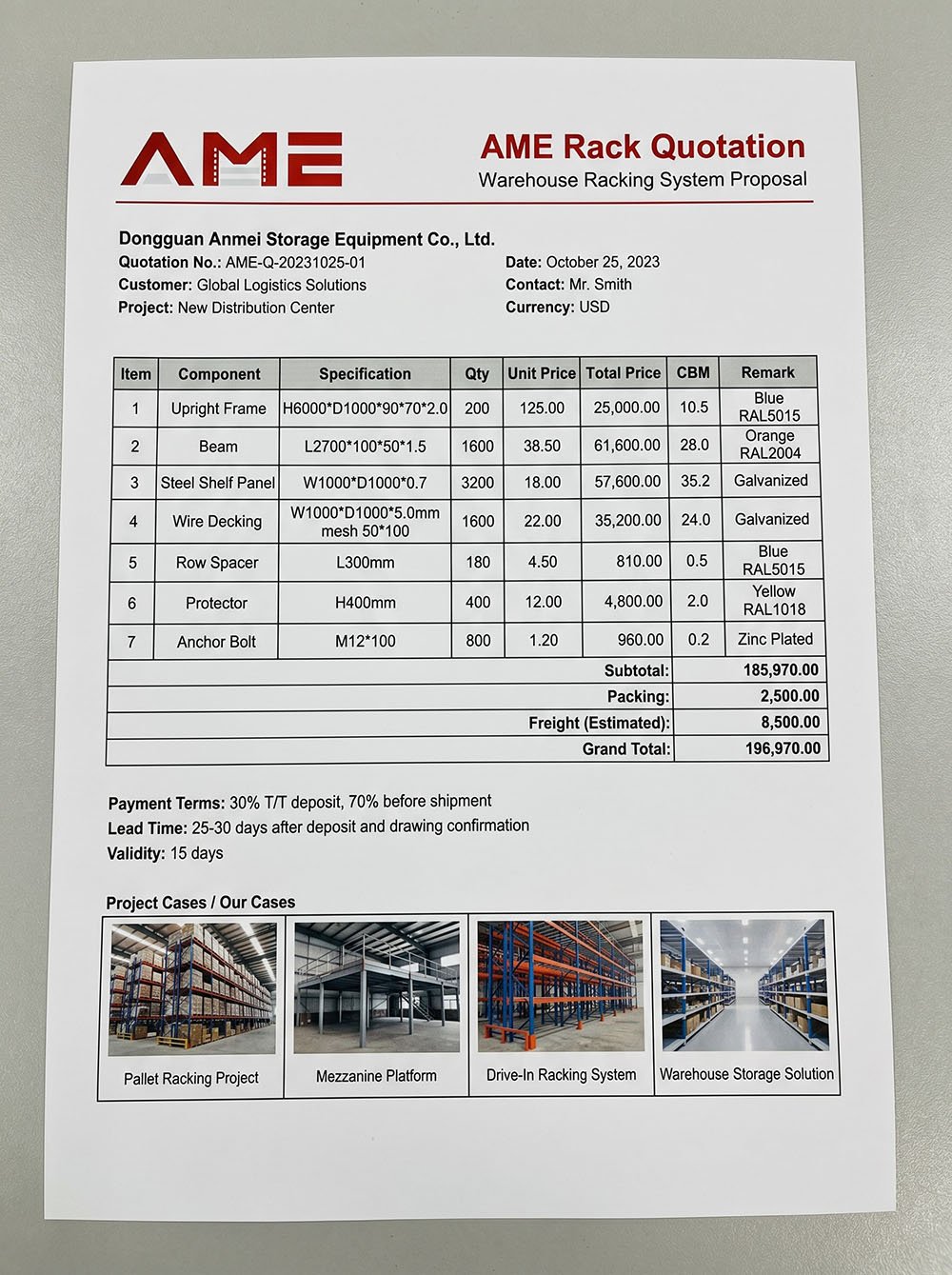
Producers manufacturing high-density pallet storage systems typically maintain distinct engineering for drive-in and drive-through configurations because of the different bracing requirements. Among such producers is AME Rack, whose Dongguan facility manufactures both configurations with standard and cold-storage variants — drive-in and drive-through pallet racking engineered for high-density warehouse deployments. Buyers comparing high-density options frequently evaluate drive-in and drive-through alongside selective pallet racking for mixed-SKU zones and radio shuttle racking for deeper-lane configurations. Related comparative analysis is available in the overview of single deep vs double deep pallet racking for warehouses balancing selectivity and density trade-offs.