AME Rack

🏗️ Push Back Pallet Racking — LIFO High Density

Push Back Pallet Racking — LIFO High-Density Storage with Single-Aisle Loading

The smart density alternative to drive-in: pallets glide on nested carts down inclined rails — load and pick from one aisle, no fork-truck entry, 2–6 deep storage. AME Rack manufactures push back pallet rack systems compliant with EN 15512 / FEM 10.2.07 / RMI MH16.1 / AS 4084 — engineered for 1,000–2,000 kg per pallet, 75–90% storage density gain vs selective, exported to 65+ countries.

Pushback RackingPush-Back Pallet RackLIFO RackingCart-Based RackingNested Cart RackingGravity Push Back SystemInclined Rail RackingPushback Storage SystemLast-In-First-Out Rack
80,000+ pallet positions delivered yearly EN 15512 / FEM 10.2.07 / RMI MH16.1 10-year structural warranty
+75–90%DENSITY VS SELECTIVE
2–6 deepSTORAGE LANE OPTIONS
1 aisleLOAD & PICK
30 daysSTANDARD LEAD TIME
📖 What Is Push Back Racking?

The Cart-on-Rail LIFO Architecture, Explained

Push back pallet racking (also called pushback racking, push-back pallet rack, LIFO racking, cart-based racking, nested cart racking, gravity push back system, inclined rail racking, pushback storage system or last-in-first-out rack) is a high-density gravity-assisted pallet storage system that stores 2–6 pallets deep per lane — loaded and retrieved from a single aisle without forklift entry into the rack.

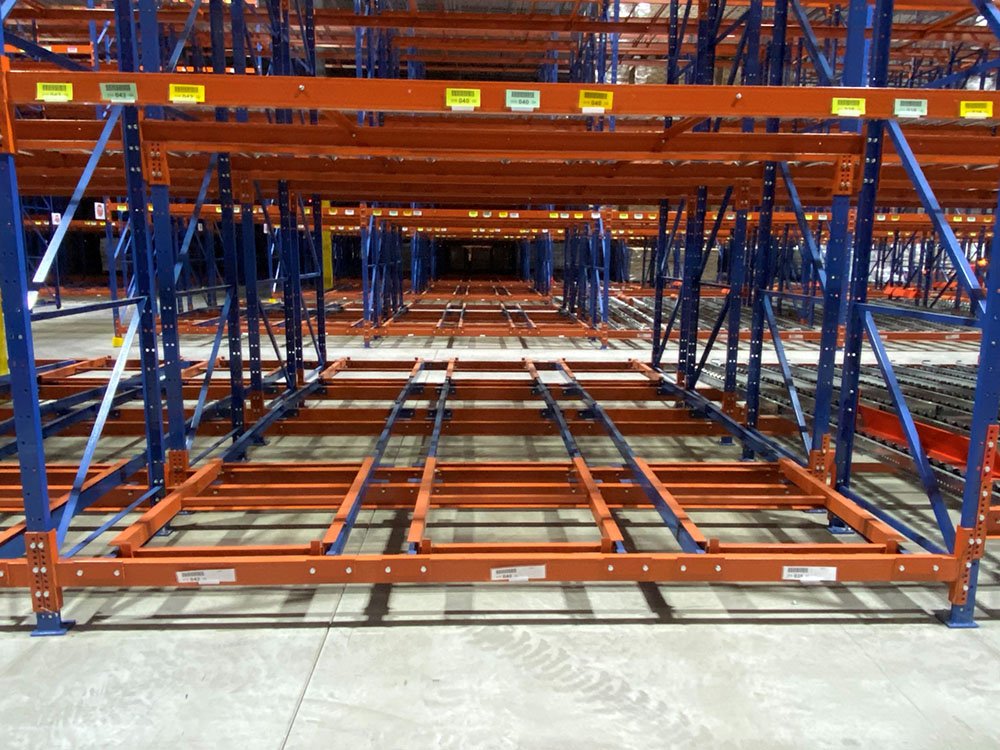
The mechanism is elegantly simple. Each lane has a set of nested telescoping carts riding on slightly inclined rails (3–4° slope). When the forklift loads pallet 1, it sits on the bottom cart. When pallet 2 is loaded, it pushes pallet 1 backward up the rail; pallet 2 now sits on the next cart. At full depth, the topmost (most recently loaded) pallet sits at the aisle face. Retrieve a pallet and the remaining stack gravity-glides forward to fill the position.

This delivers LIFO (Last-In-First-Out) rotation — the trade-off for the density gain. Push back is the right choice when your SKU per lane is consistent, batch dating isn't critical, and you want drive-in density without drive-in's safety issues (no fork-truck enters the rack, near-zero impact damage).

AME Rack manufactures push back pallet rack systems to EN 15512, FEM 10.2.07, RMI MH16.1 and AS 4084 standards — with stamped FEA reports, cart load tests and IQ/OQ commissioning protocols issued free with every project.
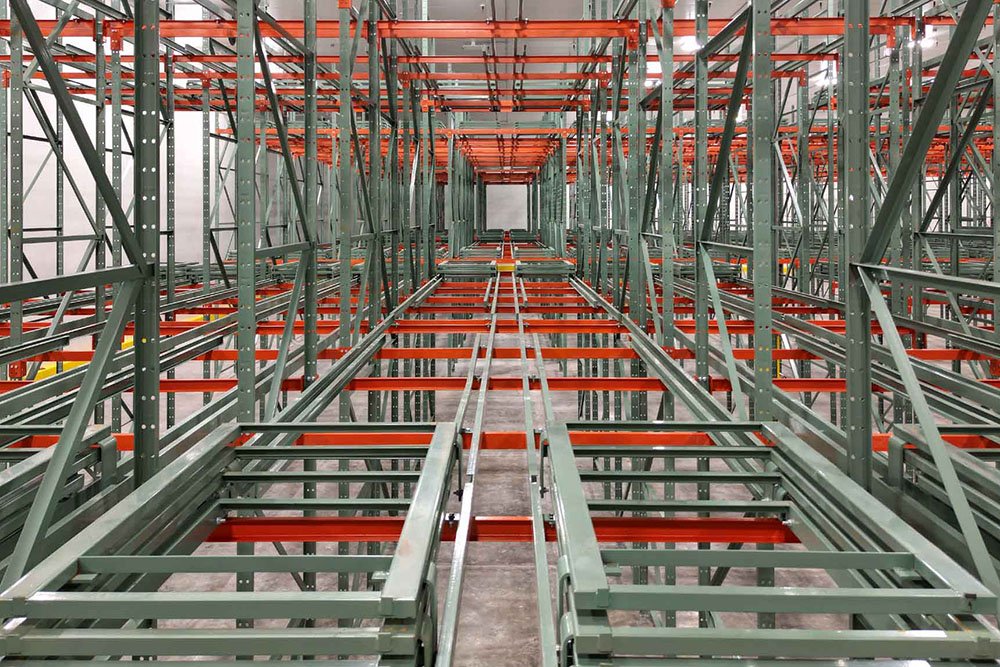
Push back pallet racking 4-deep configuration with nested telescoping carts and inclined rails Push Back Pallet Racking — 4-Deep Nested Cart
✨ Benefits

Why Push Back Racking Wins When Drive-In Doesn't

Eight reasons push back pallet racking has become the high-density alternative of choice for distributors with multi-SKU LIFO operations — wherever drive-in's safety and SKU constraints don't work.

📊

+75-90% Density vs Selective

Eliminate 60-75% of aisles by storing 2-6 pallets deep per lane. Convert wasted aisle floor into usable pallet positions.

🚪

Single-Aisle Load & Pick

Forklift operates from one aisle only — no drive-in entry, no double-aisle access. Half the forklift travel of drive-in racking.

🛡️

Zero Forklift Entry

Forklift never enters the rack — eliminates the #1 cause of rack damage. 90% lower upright impact damage vs drive-in racking.

🎯

Better SKU Variety than Drive-In

Each lane stores 1 SKU (vs drive-in which forces 1 SKU per bay). Push back gives 2-3× more SKU positions per cubic meter than drive-in.

Faster Picking than Drive-In

Pallets glide forward to the aisle face automatically — pick cycle 30-50% faster than drive-in (where forklift must drive in).

🔧

No Power, No Maintenance

Pure gravity system — no motors, no batteries, no electrical. Carts use sealed precision bearings; 10-year service life with minimal maintenance.

🌡️

Cold-Storage Friendly

Works in -30°C freezers (no battery / no electronics). HDG carts and rails available for chilled / frozen / wet zones.

🛡️

EN 15512 + FEM 10.2.07 Certified

FEA-verified to EN 15512 (structure), FEM 10.2.07 (push back specific), RMI MH16.1, AS 4084. Stamped engineering report included free.

📦 Product Types

3 Configurations of Push Back Pallet Rack

Push back racking in three standard variants — standard for mid-velocity mixed SKU, heavy-duty for high-load pallets and cold-storage HDG for frozen and chilled DCs. Pick the version that matches your pallet weight, environment and lane depth.
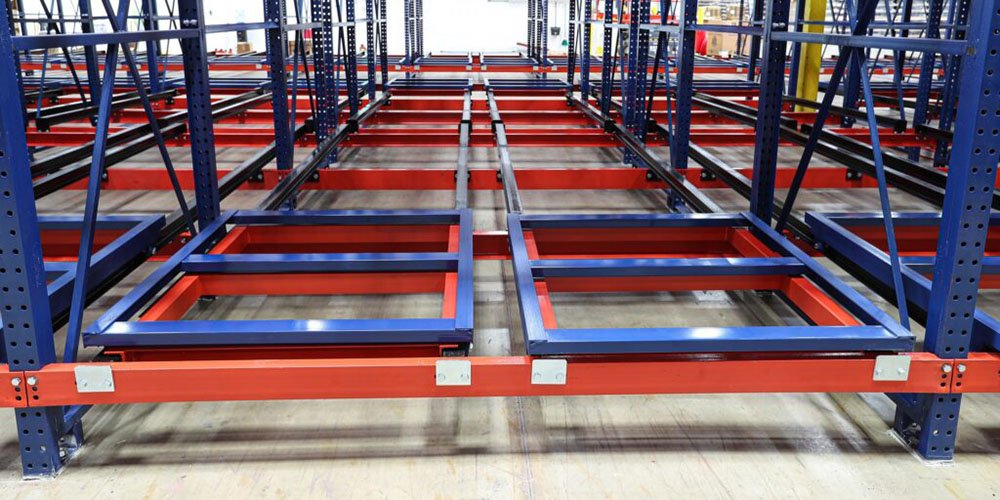
01 Volume Seller Standard push back pallet racking with nested carts by AME Rack

Standard Push Back

Nested cart system on inclined rails, 2–4 pallets deep per lane, 1,000–1,500 kg per pallet. 2.5 mm Q235B / Q345B uprights + 100×50 mm box beams + sealed-bearing steel cart wheels. The volume seller for food, beverage, FMCG and general 3PL operations.
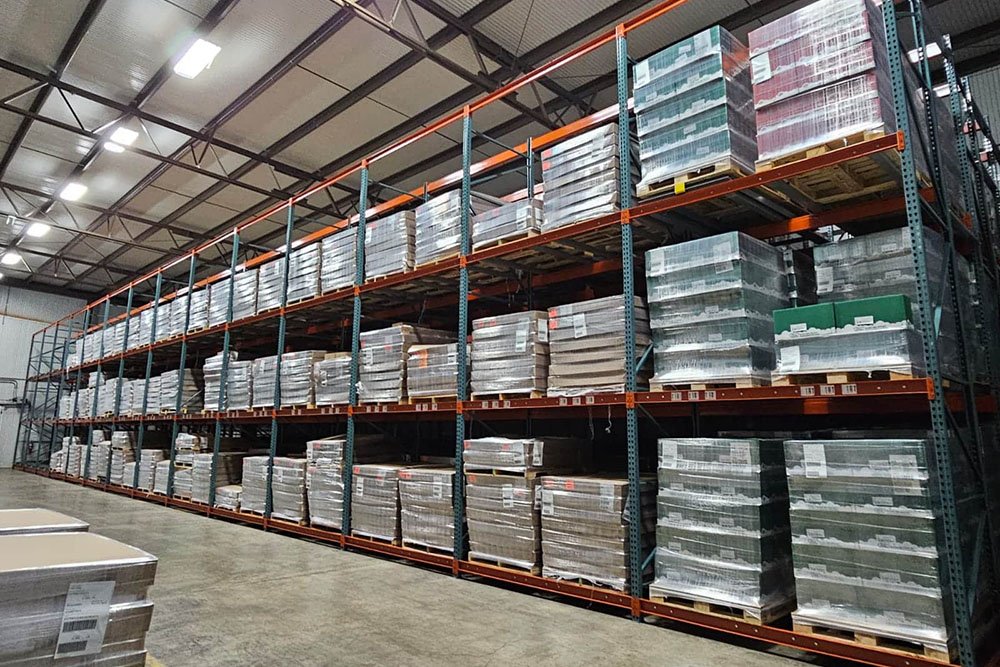
Best ForFood, beverage, FMCG, 3PL
02 High-Load Heavy-duty push back racking with reinforced rails by AME Rack

Heavy-Duty Push Back

Reinforced 3.0 mm S355JR uprights + 120×50 mm box beams + reinforced cart cascade with engineered braking. 1,500–2,000 kg per pallet, 2–6 pallets deep. For beverage, glass bottle, engine parts and manufacturing WIP buffer operations.
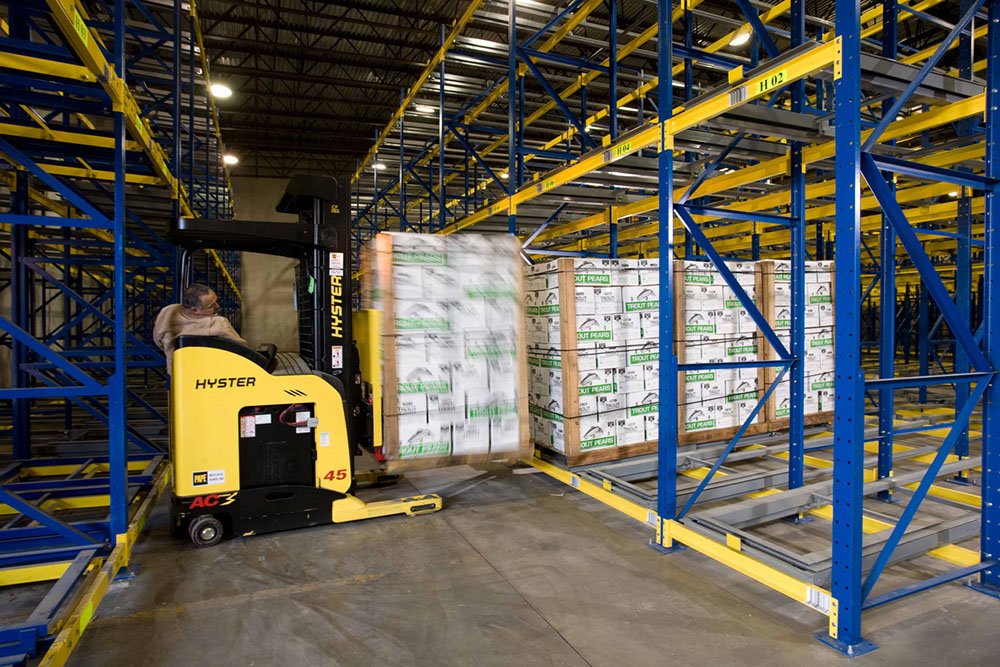
Best ForBeverage, glass, manufacturing WIP
03 Sub-Zero Rated Cold storage HDG push back racking hot-dip galvanised by AME Rack

Cold-Storage HDG Push Back

Hot-dip galvanised 80–120 μm finish per ISO 1461 on rails and carts + Q345B low-temp impact steel + sealed-bearing wheels rated to -30°C. 2–4 pallets deep, 1,000–1,500 kg per pallet. 15-year corrosion warranty for frozen DCs and cold-chain operations.

Best ForFrozen DC, cold-chain, chilled pharma
📊 Technical Specifications

Full Push Back Pallet Rack Specification Matrix

Three production configurations covering the majority of push back demand. All values verified by stamped FEA report (EN 15512 + FEM 10.2.07) — request the full PDF datasheet with your quote.

SpecificationStandardHeavy-DutyCold-Storage HDG
▎Application & Environment
Best ForFood, beverage, FMCG, 3PLBeverage, glass, manufacturing WIPFrozen DC, cold-chain, chilled pharma
Operating Temperature+5 to +40°C+5 to +40°C-30 to +5°C
RotationLIFOLIFOLIFO
▎Load & Capacity
Pallet Load (per position)1,000 – 1,500 kg1,500 – 2,000 kg1,000 – 1,500 kg
Storage Depth (pallets/lane)2 – 4 deep2 – 6 deep2 – 4 deep
Density Gain vs Selective+50 – 75%+50 – 90%+50 – 75%
Aisle Reduction50 – 67%50 – 80%50 – 67%
▎Structure & Materials
Upright Gauge2.0 – 2.5 mm2.5 – 3.0 mm2.5 mm
Upright ProfileBox 90×65 – 100×70 mmBox 100×70 – 120×70 mmBox 100×70 mm
Beam ProfileBox 100×50 mmBox 120×50 mmBox 100×50 mm
Steel GradeQ235B / Q345BQ345B / S355JRQ345B (Charpy -40°C)
Base Plate Thickness10 – 12 mm12 – 16 mm10 – 14 mm
Anchor SpecM12 – M16 chemical anchorM16 – M20 chemical anchorM16 HDG chemical anchor
▎Cart & Rail System
Cart TypeNested steel cartReinforced nested cart with brakeHDG nested cart, sealed-bearing
Cart Wheels4 – 6 × Ø80 mm steel6 – 8 × Ø100 mm steel6 × Ø100 mm sealed-bearing
Rail ProfileCold-rolled C-channelHot-rolled angle steelHot-rolled HDG
Rail Slope3.5°4.0°4.0°
Cart BrakingStandard friction brakeEngineered cascade brakeSealed engineered brake
▎Dimensions
Frame Height4 – 10 m4 – 12 m4 – 9 m
Lane Width (beam length)2.4 – 2.7 m2.4 – 2.7 m2.4 – 2.7 m
▎Finish & Compliance
Surface FinishPowder coat 60 – 80 μmPowder coat 80 – 100 μmHDG 80 – 120 μm per ISO 1461
Salt-Spray Test500 h1,000 h1,500 h (HDG)
Corrosion Warranty3 years5 years15 years
Standard ComplianceEN 15512 · FEM 10.2.07EN 15512 · FEM 10.2.07 · RMI MH16.1EN 15512 · FEM 10.2.07 · ISO 1461
Standard Lead Time25 – 32 days28 – 35 days32 – 42 days
Engineering note: Push back depth selection should match SKU consistency. Going from 3-deep to 6-deep doubles density but requires that the same SKU fills the entire lane — otherwise you create "honeycomb" loss (empty positions you can't access). For mixed-SKU operations, 2–3 deep is the sweet spot; 5–6 deep is reserved for single-SKU bulk lanes in the Heavy-Duty configuration.
🧱 Components Breakdown

10 Engineered Parts of a Push Back Pallet Rack

Every push back system we ship is built from the same 10-part architecture — designed for safety, smooth pallet cascade and 10+ year service life in high-cycle distribution operations.

🏛️

Upright Frames

2.0–2.5mm Q235B / Q345B steel uprights with diagonal & horizontal bracing. Slot pitch 50mm for beam adjustment. FEA-verified to EN 15512.

Front & Rear Cross Beams

Box-section beams span the rack opening — front beam supports the aisle-face pallet, rear beam ties the structure. Locked with safety pins.

📐

Inclined Rails (3.5–4° slope)

Cold-rolled or hot-rolled steel rails set at 3.5–4° gravity slope. Precision-cut rail track lets carts glide smoothly under load.

🛒

Nested Telescoping Carts

2–6 nested carts per lane (one less than pallet depth — bottom pallet sits on rails). Each cart slides into the one above when retracted.

⚙️

Cart Wheels (Sealed Bearing)

Ø80–100mm steel wheels with sealed precision bearings (-30°C rated for cold-storage variant). 4–6 wheels per cart depending on load.

🛑

Cart Stops & Guards

End stops at the aisle face prevent cart over-run; rear stops contain the cart cascade. Pallet centering guides on every cart prevent skew.

🪝

Cart Recovery Hooks

Engineered hook prevents cart separation during cascade. Critical safety feature — eliminates the runaway-cart failure mode of cheap copies.

🧲

Pallet Locator Pins

Stamped sheet-metal pallet locators on each cart — center the pallet on the cart deck, prevent skew and stringer slip during gravity glide.

🛡️

Column Protectors & Base Plates

1500mm-high column guards (HDG or yellow powder coat) on every aisle-face upright. Anchor base plates with chemical bolts on 4 corners.

🎨

Surface Finish

Standard: powder coat 60–80 μm electrostatic over zinc primer. Cold/wet zones: hot-dip galvanize 80–120 μm per ISO 1461. 15-year corrosion warranty.

🎯 Industry Applications

8 Industries Running on Push Back Pallet Racking

Eight industries where push back racking delivers density without the SKU and safety constraints of drive-in — wherever LIFO is acceptable and the SKU-per-lane is reasonably consistent.

🥤

Beverage Distribution

Beer, soft drink, bottled water DCs — high-velocity case-pallet LIFO with consistent SKU per lane. Push back's sweet spot.

🥫

Food & FMCG Distribution

Canned food, snacks, packaged goods — date code typically not critical at distribution stage. 75% density gain over selective.

❄️

Cold & Frozen Storage

Frozen meat, ice cream, frozen vegetable — push back beats drive-in safety (no driver in -25°C lane) + handles freezer-grade pallets.

🧴

Personal Care & Cosmetics

Shampoo, detergent, household chemicals — typically not date-critical at DC level. Multi-SKU push back fits the SKU profile well.

🏭

Manufacturing Buffer

Raw material / WIP buffer storage between production stages — push back delivers density without the SKU constraints of drive-in.

📦

3PL High-Density Storage

Third-party logistics operators serving FMCG / beverage / food customers — push back maximises customer SKU positions per cubic meter.

🏪

Retail Backroom DC

Supermarket / hypermarket regional DC for fast-moving SKUs — push back triples backroom storage density vs selective racking.

🚛

Cross-Dock & Consolidation

24–72 hour pallet hold zones — LIFO is fine when the dwell time is short. Push back streamlines load consolidation for outbound trucks.

🧭 Design Decision Guide

How to Spec a Push Back Pallet Rack in 3 Decisions

Three decisions determine whether your push back system delivers the promised density gain — or creates expensive honeycomb loss. Work through them before requesting your quote.

DECISION 1

Depth: 2, 3, 4 or 6 Deep?

Depth selection depends on SKU consistency, not warehouse height. Deeper lanes = more honeycomb loss when SKUs run out mid-lane.

  • 2 deep — Mixed SKU, low velocity; safest spec
  • 3 deep — Most popular; FMCG / food / beverage
  • 4 deep — Cold storage; consistent SKU per lane
  • 5–6 deep — Single-SKU bulk only; reorder under risk
DECISION 2

LIFO Acceptance: Date-Critical?

Push back is LIFO by physics. Don't fight it — pick a different rack type if FIFO matters.

  • Date-tolerant SKU (FMCG/CPG) → push back ✅
  • Short dwell time (24–72 h) → push back ✅ (LIFO doesn't matter)
  • Pharma / fresh food → use pallet flow (FIFO) ❌
  • Vaccine / API cold-chain → use radio shuttle (FIFO option) ❌
DECISION 3

Cart Type: Telescoping vs Carriage?

Two design schools — nested telescoping cart (cleaner, higher cycle life) vs bumper carriage (cheaper, more pallet tolerance). Match to your pallet quality.

  • Telescoping cart — Standard pallet; max smoothness
  • Bumper carriage — Mixed pallet sizes; lower CapEx
  • Sealed bearing — Required for cold-storage
  • Steel wheel — Standard for indoor +5°C
Selection Criteria2-Deep Mixed3-Deep FMCG4-Deep Cold6-Deep Single-SKU
SKU per lane requiredSame or compatibleSame SKU (preferred)Same SKU (required)Same SKU only
Honeycomb loss riskLowMediumHighVery high
Density gain vs selective+50%+65%+75%+90%
Aisle reduction50%60%67%75%
Forklift cycle timeFastFastMediumSlower (deep cart)
Cold-storage suitableYesYesYes (HDG req.)Yes (HDG req.)
Cost per pallet position1.0× (baseline)1.1×1.3×1.6×
Best for SKU countHigh SKU varietyMid SKU varietyLow SKU varietySingle SKU bulk
⚖️ Apples-to-Apples Comparison

Push Back vs. Selective · Drive-In · Pallet Flow · Radio Shuttle

Where push back wins, where alternatives win. Use this matrix to defend your spec internally — every row reflects what a real warehouse design engineer evaluates.

CriteriaPush BackSelective PalletDrive-InPallet FlowRadio Shuttle
Storage density (vs selective)+50 to +90%Baseline (1.0×)+80%+50%+80% (+ FIFO)
Rotation methodLIFODirect (any)LIFOFIFO (gravity)FIFO or LIFO
Forklift entry into rackNo (single aisle)NoYES (high risk)NoNo (shuttle)
SKU per lane1 SKU per lane1 per position1 SKU per bay1 SKU per lane1 SKU per lane
Rack damage risk★★★★ (low)★★★★★★★★★ (highest)★★★★★★★★★
Forklift cycle / pick speed★★★★★★★★★★★★★★★★★★★★★★★
Best depth range2–6 deep1 deep4–10 deep4–20 deep4–30 deep
Power requiredNone (gravity)NoneNoneNone (gravity)Battery shuttle
Cold-storage suitableYesYesMarginal (driver in cold)YesYes
CapEx per pallet position$$ (medium)$ (lowest)$$ (medium)$$$ (high)$$$$$ (highest)
Best use caseLIFO multi-SKU densityHigh SKU varietyBulk single-SKUFIFO date-criticalPremium FIFO + density

⭐ AME Rack's Honest Verdict

Pick push back racking when you need 50–90% density gain over selective, your SKU rotation tolerates LIFO (FMCG / beverage / cold-storage / consumer goods), and you want drive-in density without drive-in's forklift-damage risk. Stay with selective when SKU variety is high and direct pallet access matters more than cube. Drive-in beats push back on single-SKU bulk storage with very deep lanes (8+ deep) where the deepest cart cascade becomes impractical. Pallet flow beats push back when FIFO is required (dated food, pharma, biologics). Radio shuttle beats push back when you can pay 3–4× the CapEx for FIFO option + automated cycle.

🌍 Real Project Cases

3 International Push Back Racking Projects by AME Rack

Real customers, real KPIs. From Mexican beverage distribution to Czech frozen food cold-storage to Australian 3PL FMCG contract warehouse — push back racking delivers density without the SKU and safety constraints of drive-in.
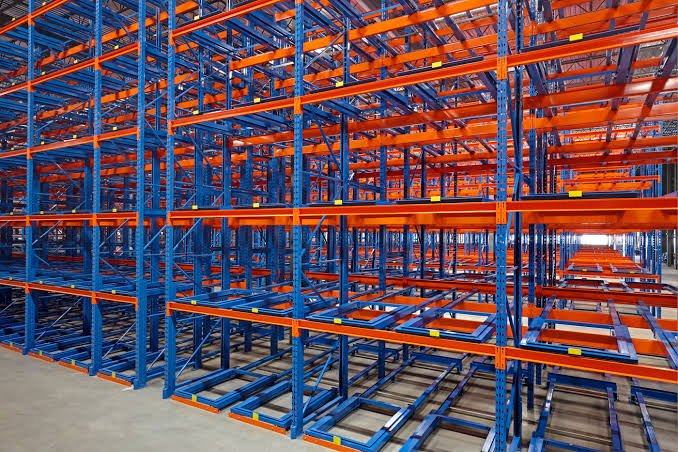
🇲🇽 Mexico CASE 01 Beverage / Soft Drink Distribution push back racking case study in 🇲🇽 Mexico
Beverage / Soft Drink DistributionMonterrey regional bottler — soft drink & bottled water distribution
🎯 Challenge

Bottler ran a 12,000 m² DC for 24 SKUs of bottled beverages. Existing selective pallet racking used 62% of floor for aisles, leaving only 2,800 pallet positions. Demand spike during summer forced rental of overflow warehouse at USD 18K/month.

🔧 AME Solution

1,600 pallet position push back racking, 3-deep, 1,200 kg/position, 6m height, powder coat finish. Replaced 60% of the selective area with push back (kept selective for 200 slow SKUs). Engineered nested telescoping carts with sealed bearings.

✅ Result

Pallet positions increased from 2,800 → 4,600 (+45%) in the same building footprint. Overflow warehouse rental terminated (USD 160K/yr saved). Forklift travel distance dropped 35%. Bottler reordered Year-2 expansion of another 1,800 positions.
2,800positions
+45%density
$160K/yrrent saved
-35%forklift travel
🇨🇿 Czech Republic CASE 02 Frozen Food Cold-Storage DC push back racking case study in 🇨🇿 Czech Republic
Frozen Food Cold-Storage DCPrague regional frozen food distribution centre (-25°C)
🎯 Challenge

Cold-storage DC at -25°C wasted 70% of expensive freezer cube on aisles. Existing drive-in racking had 24 forklift-impact incidents/year (drivers operating in -25°C make errors); 8% of cold-storage pallet positions were damaged at any given time.

🔧 AME Solution

800 pallet position push back, 2-deep, 1,500 kg/position, 7m height, HDG 100 μm finish + Q345B low-temp impact steel, sealed-bearing carts rated -30°C. Driver never enters the rack — eliminates the cold-storage forklift-injury and impact-damage risk.

✅ Result

Forklift impact incidents dropped from 24/yr → 1/yr (96% reduction). Damaged pallet positions dropped 8% → 0.3%. Cold-storage usable cube increased +75%. Operator passed BRCGS Storage & Distribution audit with zero findings.
800positions
-96%impact incidents
+75%cube utilisation
BRCGSaudit passed
🇦🇺 Australia CASE 03 3PL FMCG Contract Warehouse push back racking case study in 🇦🇺 Australia
3PL FMCG Contract WarehouseMelbourne 3PL operator serving 3 FMCG brand customers
🎯 Challenge

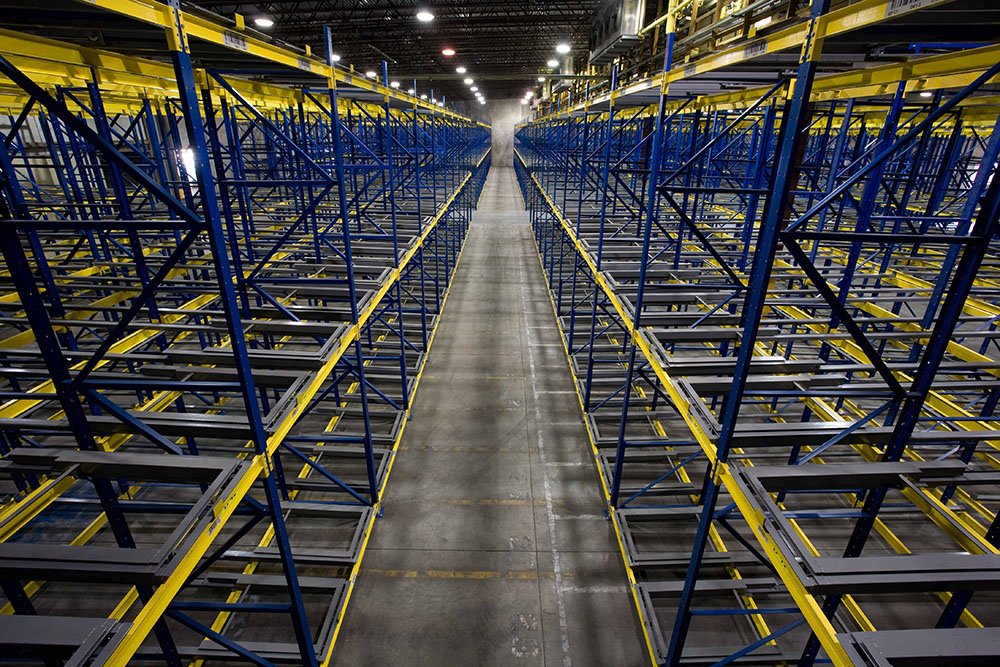
3PL operated a 25,000 m² contract warehouse with selective racking for 18,000 pallet positions across 3 customers. Customer demand grew 22% over 18 months — 3PL faced either rejecting growth or building a second warehouse (AU$ 5M capex).

🔧 AME Solution

8,000 pallet positions converted to 3-deep push back (for the 2 customers with FMCG / beverage SKU mix). Phased over 4 months without operations interruption. Selective retained for the 3rd customer (pharma — needs FIFO).

✅ Result

Pallet capacity within same building: 18,000 → 32,000 positions (+47%). Second-warehouse capex eliminated (AU$ 5M saved). Contract terms renegotiated with 12% rate uplift on densified zone (storage-per-cube basis). ROI achieved in 7 months.
8,000converted
+47%capacity
AU$5Mcapex avoided
7 mopayback
🏭 Inside the AME Rack Factory

7-Stage Manufacturing & Quality Pipeline for Push Back Racking

Every push back system leaves our Dongguan factory through a 7-stage production line built around mill-certified steel, robotic welding, in-factory cart cascade testing and full-container loading verification.

01

Material Inbound

Q235B / Q345B steel sheet & tubing from Baosteel & Shagang. Mill test certificate (yield strength, elongation, chemistry) on every coil; AME QC re-tests random samples per ISO 6892.

02

CNC Cutting & Roll-Forming

Laser cutter (±0.2mm) prepares uprights, beams and rail profiles. Roll-forming line produces cold-rolled rail sections with the precise C-channel geometry needed for smooth cart glide.

03

Robotic Frame Welding

4-station Panasonic robotic MIG welder forms uprights, beams and cart bodies. Full-penetration welds at every joint, verified by ultrasonic spot-check per EN 1090 Class EXC2.

04

Cart Assembly & Bearing Fitting

Carts assembled with sealed precision bearings (cold-storage variant: -30°C rated). Each cart cycle-tested 500× under load to verify smooth glide and bearing seal integrity.

05

Surface Treatment

7-stage pre-treatment (degrease → rinse → phosphate → rinse → passivate → rinse → dry). Standard: powder coat 60–80 μm Akzo Nobel + 200°C oven cure. Cold/wet: HDG 80–120 μm per ISO 1461.

06

System Pre-Assembly & Glide Test

Each lane pre-assembled in factory test bay — load 2–6 pallets, verify cart cascade, glide speed (target 0.3–0.5 m/s) and stop engagement. No failure tolerance.

07

Packaging & Container Loading

IPPC ISPM-15 wood pallets, PE film, edge guards. Carts packed pre-nested for max density. Photo + video proof-of-loading sent before vessel sails.

🛒 B2B Procurement Checklist

How to Buy Push Back Pallet Racking — A 6-Point Importer Checklist

Six things every warehouse manager, importer and DC project lead should validate before placing a push back racking PO. These are the questions our top customers always ask.

📋 1. Specification Confirmation

  • Storage depth (2 / 3 / 4 / 5 / 6 deep) — confirm SKU consistency
  • Pallet load per position (kg) and stack height (m)
  • Pallet type (Euro / GMA / custom) and dimensions (L × W × H)
  • Cart type: telescoping nested or bumper carriage
  • Rail slope (3.5–4°) and wheel material (steel / sealed)
  • Surface finish: powder coat μm or HDG μm per ISO 1461

🛡️ 2. Compliance & Test Reports

  • EN 15512 structural calculation report (stamped by chartered engineer)
  • FEM 10.2.07 push back specific design verification
  • RMI MH16.1 (Americas) / AS 4084 (Australia)
  • Cart load test report (1.5× rated payload, 24 h hold)
  • Cart cycle test report (500+ cascade cycles)
  • ISO 1461 HDG coating certificate (cold-storage variant)

📐 3. Layout & Engineering Review

  • Submit CAD drawing of warehouse (with column grid) for free layout
  • Specify forklift fleet (mast height, reach truck or counterbalance)
  • Confirm floor flatness FF/FL spec (≥ FF35 for >6m height)
  • Seismic zone confirmation (push back requires extra bracing in zone 3+)
  • Aisle width and turn radius for forklift fleet

💰 4. Payment & Incoterms

  • T/T 30% deposit + 70% before B/L (standard)
  • L/C at sight accepted for orders ≥ USD 50,000
  • Incoterms: FOB Shenzhen (default), CIF, DDP available
  • Installation supervision USD 280/day + travel (engineer optional)
  • Performance bond 5% (held 12 months for major projects)

🚢 5. Logistics & Container Loading

  • 40HQ holds ~600 pallet positions of 3-deep push back components
  • Carts packed pre-nested (5 carts per crate)
  • IPPC ISPM-15 heat-treated wood pallets included
  • Container loading photo + video sent before sailing
  • Lead time: 30 days standard, 35 days HDG cold-storage

🤝 6. After-Sales & Warranty

  • 10-year structural warranty (15 years on HDG cold-storage)
  • 5-year cart and bearing warranty (sealed-bearing variant)
  • Spare parts (carts / wheels / pins) available 10+ years
  • Engineer site visit available for major modifications
  • Dedicated project manager from order through installation
❓ FAQ — 15 B2B Procurement Questions

Everything Warehouse Managers, DC Engineers & Importers Ask About Push Back Racking

Real questions from warehouse managers, distribution centre design engineers and importers during 36 months of push back racking export quotes. Bookmark this — it answers ~95% of pre-order objections.

Q01. What is push back pallet racking and how does it work?+

Push back pallet racking is a high-density LIFO storage system where 2–6 pallets are stored per lane on nested telescoping carts riding on inclined rails (3.5–4°). When a pallet is loaded, it pushes the previous pallets backward up the slope. Retrieve a pallet and the remaining stack gravity-glides forward to the aisle face. Loaded and picked from one aisle — forklift never enters the rack.

Q02. How is push back different from drive-in racking?+

Drive-in requires the forklift to drive into the rack — high impact-damage risk. Push back uses gravity carts so the forklift stays in the aisle — 90% lower upright damage. Drive-in works best 8–12 deep with 1 SKU per bay; push back works best 2–6 deep with 1 SKU per lane.

Q03. What is the typical lead time?+

30 days for standard powder-coat configurations; 35 days for HDG cold-storage variants. Engineering review and layout drawing take 5–7 days before production starts. Express 20-day production possible for repeat customers with stock components.

Q04. How deep can push back racking go?+

Standard depths: 2, 3, 4, 5, 6 pallets deep. 3-deep is the most popular (FMCG / food / beverage). 4-deep is common in cold storage. 5–6 deep requires consistent SKU-per-lane (otherwise honeycomb loss eats the density gain).

Q05. What is LIFO and is it a problem?+

LIFO = Last-In-First-Out. The last pallet loaded is the first picked. It is fine for FMCG, beverage, consumer goods, dry food, cosmetics, household chemicals — any SKU where date code is not picked at distribution stage. It is wrong for fresh food, pharma, biologics, dated dairy, vaccines — use pallet flow or radio shuttle instead.

Q06. What is honeycomb loss?+

When a lane has a mix of SKUs (or runs partially empty), some pallet positions become inaccessible — they sit behind another SKU you can't move. This is "honeycomb" loss. To minimise it: keep 1 SKU per lane, replenish before empty, prefer 2–3 deep over 5–6 deep for mixed SKU operations.

Q07. What pallet load can push back handle?+

Standard ratings: 1,200 kg/position (2-3 deep) and 1,500 kg/position (4 deep). Heavy-duty 2,000 kg available with reinforced uprights and 6-wheel carts. Always specify pallet quality at quote stage — push back works best with consistent, undamaged Euro / GMA pallets.

Q08. Is push back racking suitable for cold storage?+

Yes — and it is the recommended density solution for freezers. Order the HDG variant (80–120 μm per ISO 1461) + Q345B low-temp impact steel + sealed-bearing carts rated -30°C. Forklift driver never enters the cold lane (driving inside -25°C causes errors); cart bearings don't fail in cold cycle.

Q09. What is the density gain vs selective racking?+

+50% to +90% depending on depth: 2-deep = +50%, 3-deep = +65%, 4-deep = +75%, 6-deep = +90%. The gain comes from eliminating 50–75% of aisles. Always compare apples-to-apples — count pallet positions in the same warehouse footprint, not just shelf positions.

Q10. Do push back carts need maintenance?+

Minimal — sealed-bearing wheels need no lubrication. Annual inspection covers: cart cascade smoothness, end-stop engagement, hook integrity, rail alignment. Replace bearings every 7–10 years under heavy use; otherwise carts last the full 10+ year rack life.

Q11. Can push back racking be retrofitted into existing buildings?+

Yes — push back is ideal for warehouse densification projects. Phased installation possible without total operations interruption (we install bay-by-bay). Requires: stable concrete floor (FF35+ for >6m height), adequate ceiling height (4m minimum), and a forklift with clear aisle access.

Q12. What standards do AME Rack push back systems comply with?+

EN 15512 (European racking structure), FEM 10.2.07 (push back specific), RMI MH16.1 (Americas), AS 4084 (Australia), FEM 9.831 (rack design), ISO 1461 (HDG coating), ISO 9001 / 14001 factory certs. Stamped FEA load report from chartered engineer issued free.

Q13. How much does push back racking cost vs alternatives?+

Per pallet position FOB Shenzhen: Selective $50–80, Push back $90–130, Drive-In $80–120, Pallet flow $150–200, Radio shuttle $400–700. Push back's CapEx premium over selective is typically paid back in 2–4 years by floor-space savings + lease-rent avoided.

Q14. What is the warranty?+

10-year structural warranty on standard powder-coat configurations; 15-year warranty on HDG cold-storage. 5-year warranty on carts and sealed bearings. Covers manufacturing defects, weld failure, paint corrosion-through. Excludes user damage (forklift impact, overload, out-of-spec pallets).

Q15. What payment terms do you accept?+

Standard: 30% T/T deposit + 70% before B/L. L/C at sight for orders ≥ USD 50,000. Performance bond 5% for major projects (held 12 months). After 3 successful POs, repeat customers can negotiate OA 30–60 days subject to credit check.

🚀 Ready to Densify?

Get a Push Back Layout in 48 Hours — From the Factory That Ships 65+ Countries

Send your warehouse CAD + SKU profile (depth, pallet size, weight, forklift fleet, ceiling height) — we reply within 48 hours with FOB pricing, optimised layout drawing, FEA load report and lead time. Free engineering review. Free density-gain analysis. Free installation drawing pack.

30-day standard lead time EN 15512 / FEM 10.2.07 compliant 10-year structural warranty 600 positions / 40HQ

📩 3 Ways to Start the Conversation

AME Rack Sales · Lily
📧 Lily@amerack.com
💬 WhatsApp / Phone: +86 188 2453 7792
🏭 Dongguan, Guangdong, China · MON–SAT 09:00–18:00 (GMT+8)

Get a free quote quickly

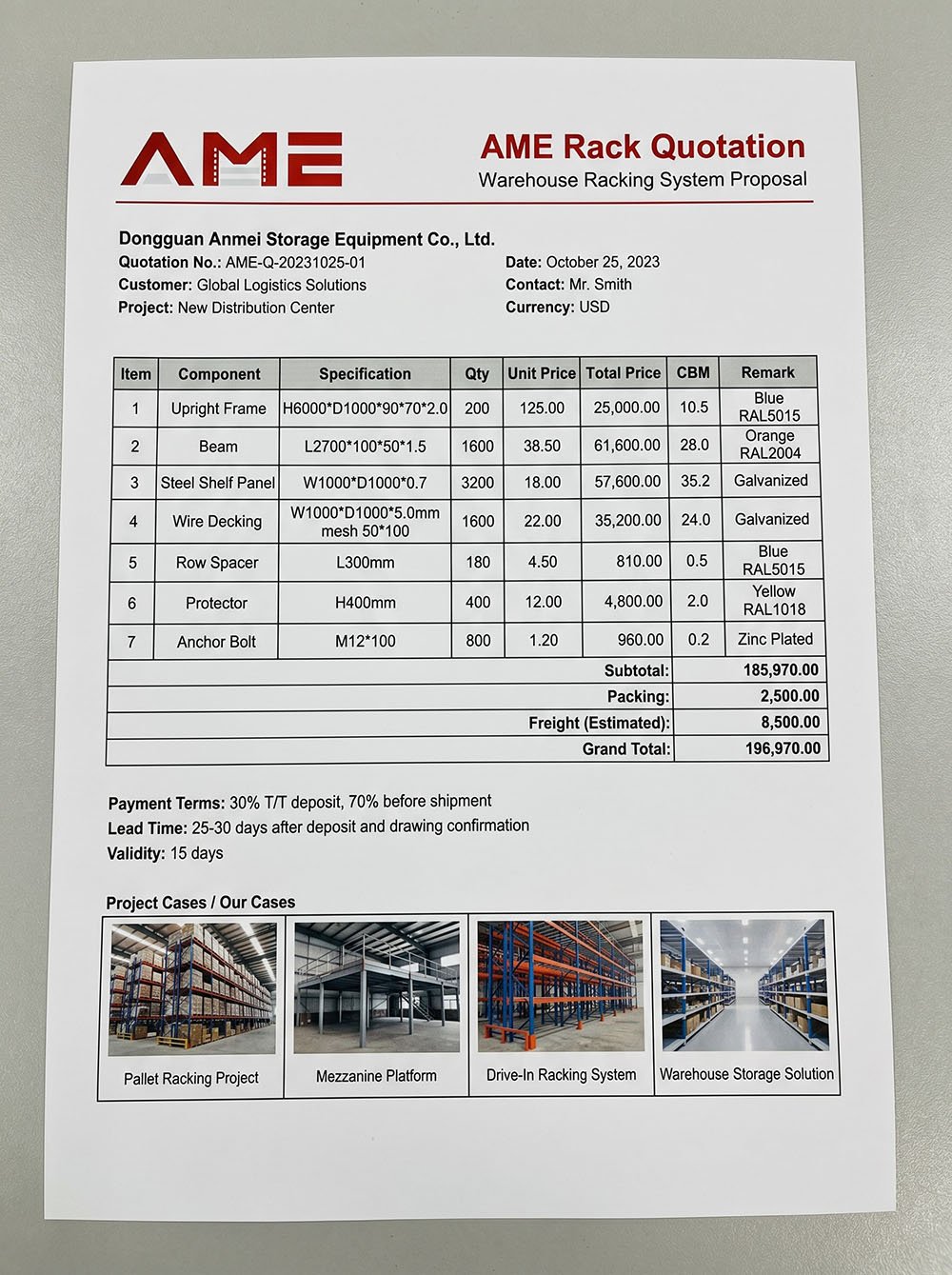
AME Rack quotation