Gravity Pallet Flow Racking — Zero-Energy FIFO with No Forklift In-Lane
Inclined gravity-roller lanes carry pallets autonomously from load end to pick end — no power, no shuttle, no forklift in the lane. Pure FIFO rotation perfect for dairy, fresh produce, dated pharma and food production WIP. Achieves +50–65% density vs selective rack with mechanical reliability that beats motorised alternatives. AME Rack delivers EN 15512 / FEM 9.831 / RMI MH16.4 compliant pallet flow systems exported to 65+ countries.
Pallet Flow Rack — Gravity Does the Work
Gravity pallet flow racking (also called pallet flow rack, gravity flow rack, flow rail pallet storage, dynamic pallet rack or roller-track pallet rack) uses inclined gravity-roller or wheel-track lanes to carry pallets from a higher load end down to a lower pick end. No motors, no shuttle carts, no forklift in the lane — pallet weight + 3–4° slope = autonomous FIFO flow.
Forklift drops a pallet at the elevated load end; rotation brakes regulate descent speed to a safe 0.3 m/s; the lead pallet stops at the pick end against a separator brake. Removing the front pallet releases the next pallet to slide forward. Pure first-in-first-out, mechanically reliable, zero energy cost. Standard architecture for dairy, fresh produce, dated pharma, beverage and food-production WIP buffer.
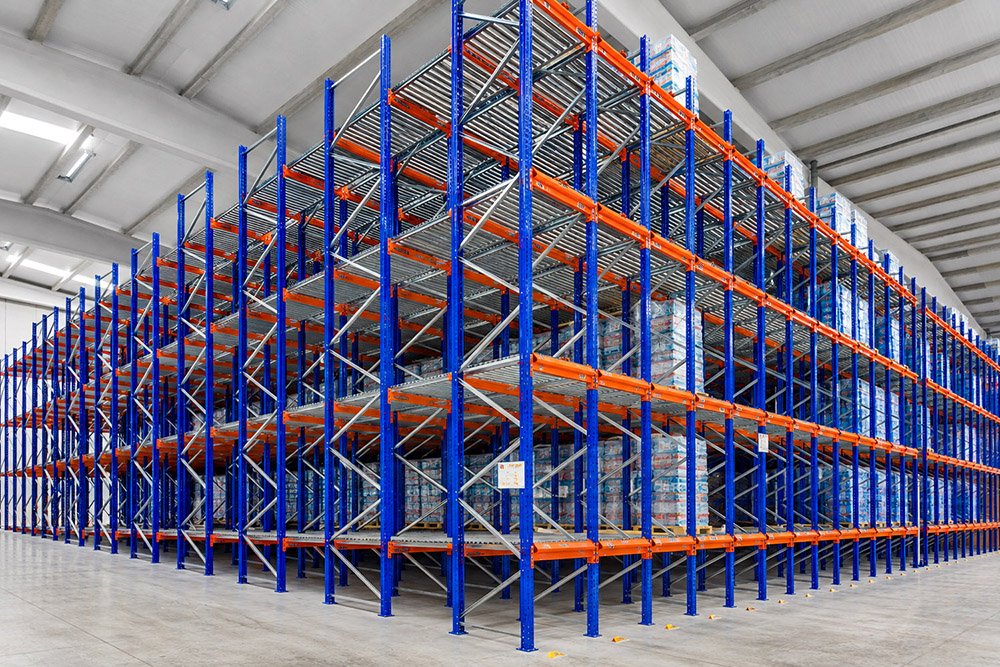
Why Pallet Flow Rack Beats All Other FIFO Dense Storage
Eight engineering and operational advantages that explain why gravity pallet flow is the standard FIFO architecture for dairy, fresh produce, dated pharma and food-production WIP — beating drive-through, push-back and even radio shuttle on capex / kg of stored product.
Zero Energy Cost
Pure mechanical gravity flow — no motors, no batteries, no electricity, no compressed air. Zero ongoing operating cost over 20-year service life.
True FIFO Rotation
First pallet loaded is first pallet picked — perfect for dated stock (dairy, fresh produce, pharma batch). Eliminates expiry write-offs from poor rotation.
Forklift Stays Outside
Forklift never enters the lane — eliminates in-lane collision damage that costs 8–12% of drive-in rack steel over 5 years. Lower insurance premium too.
+50–65% Density
Deep lanes (4–20 pallets) eliminate cross aisles for the majority of storage rows. Typical 30% denser than selective rack at base spec, 65% at maximum lane depth.
Auto Replenish Pick Face
Picker takes front pallet → next pallet auto-slides forward. Pick face is always full, never empty during shift. Cuts pick-cycle time 20–30% vs static rack.
Quiet, Reliable Mechanical
No moving electronics, no software, no firmware updates. Rotation brakes service life 1M+ pallet cycles. Mechanical reliability that beats all motorised dense storage.
Cold-Storage Friendly
Brake/roller technology works reliably at -25°C frozen and 2–8°C chilled. Cold-rated greaseless bearings standard. HDG finish for refrigerated cells.
EN 15512 + FEM 9.831
Engineered to EN 15512 (rack) + FEM 9.831 (flow lane brake design) + RMI MH16.4. Stamped FEA report covers both static rack and dynamic flow loading.
Three Pallet Flow Configurations for Every Operation
From standard roller lane for dairy to wheel-track skate for cartons and HDG cold-storage flow for frozen DCs — match track technology, brake system and finish to your pallet profile and operating environment.
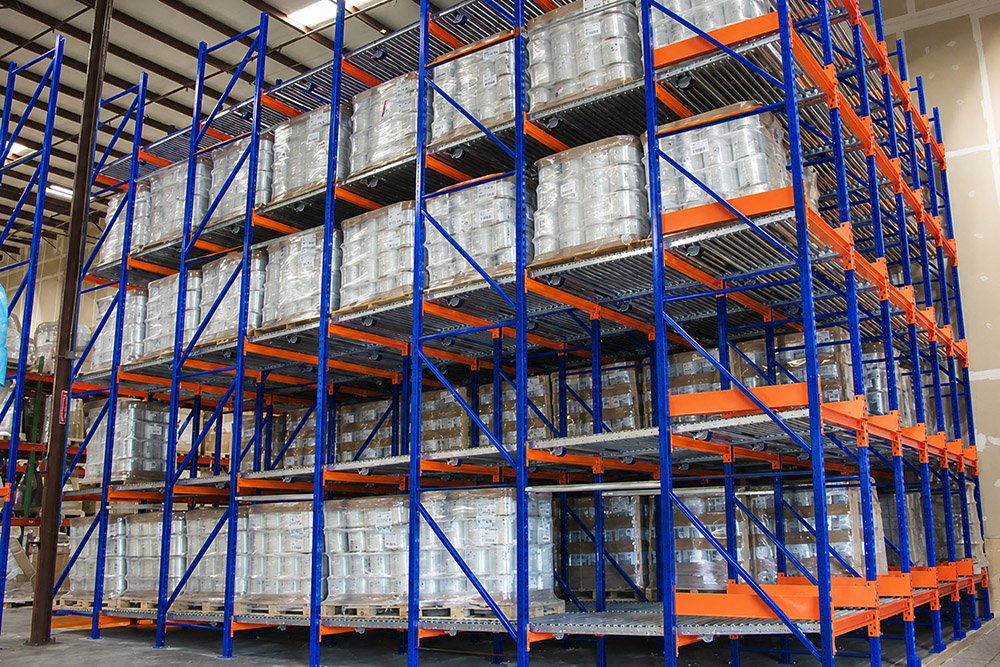
Standard Roller Lane
Steel-roller lane with rotation brakes. 1.0–1.5 T pallets, 4–12 pallet lane depth. The volume seller — fits 70% of dairy, beverage and FMCG projects with reliable FIFO rotation at zero power.
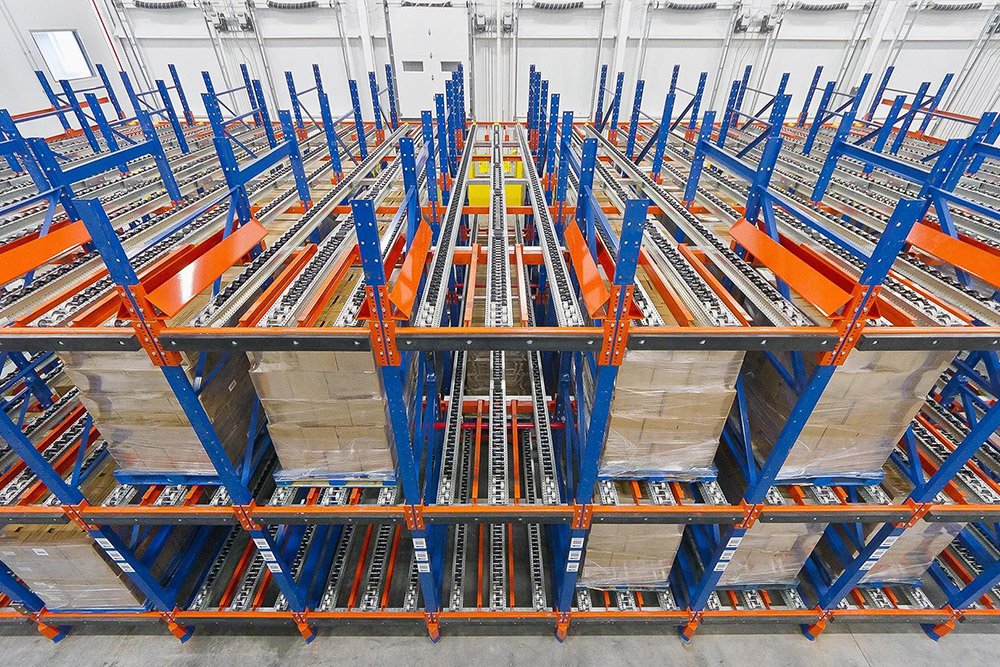
Wheel-Track Lane (Skate)
Polymer or steel skate-wheel track. Lower cost than full roller, lighter pallets only (≤ 800 kg). Best for carton-on-pallet and tray-on-pallet FIFO in pick-face zones and replenishment buffers.
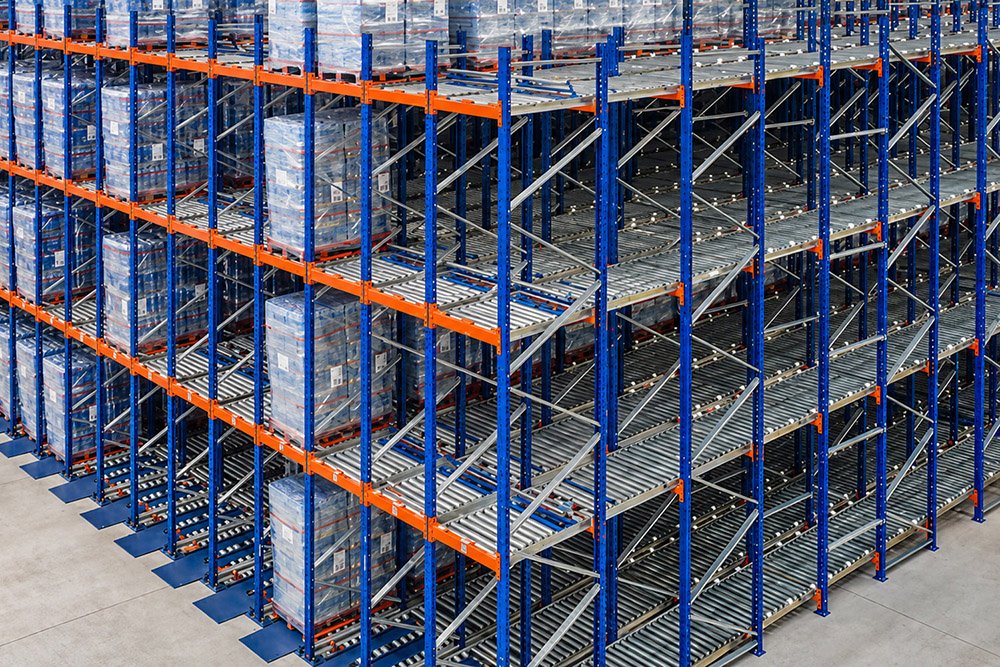
Cold-Storage HDG Flow
Greaseless cold-rated bearings + HDG 80–120 μm rack finish. Operates -25°C to +5°C reliably. The standard for dairy, frozen-meat 3PL and chilled pharma operations requiring true FIFO date control.
Engineered Technical Parameters — 4 Standard Configurations
Standard catalogue spec range. All parameters fully customisable — send pallet weight, pallet type, lane depth target, ambient/cold environment and daily throughput for stamped engineering.
| Parameter | Standard Roller | Wheel-Track Skate | Heavy-Duty 2T Roller | Cold-Storage HDG |
|---|---|---|---|---|
| Pallet Load Capacity | 1,000 – 1,500 kg | ≤ 800 kg | 1,500 – 2,000 kg | 1,000 – 1,500 kg |
| Lane Depth (pallets) | 4 – 12 | 3 – 8 | 4 – 10 | 4 – 12 |
| Lane Slope | 3° – 4° | 3° | 3.5° – 4° | 3° – 4° |
| Flow Speed (loaded) | 0.3 m/s (braked) | 0.3 m/s | 0.3 m/s (double brake) | 0.3 m/s |
| Roller Diameter | Ø 42 mm zinc plate | Skate wheel Ø 50 mm | Ø 50 mm zinc plate | Ø 42 mm HDG steel |
| Roller Pitch | 75 – 100 mm | 100 mm wheel pitch | 50 – 75 mm | 75 – 100 mm |
| Rotation Brake | Centrifugal, every 5th roller | Magnetic, every 3rd | Centrifugal, every 3rd | Cold-rated centrifugal |
| Separator Brake (pick end) | Standard hydraulic | Standard mechanical | Heavy hydraulic | Cold-rated hydraulic |
| Upright Profile | 100 × 80 × 2.0 mm | 90 × 70 × 2.0 mm | 120 × 95 × 2.5 mm | 100 × 80 × 2.5 mm |
| Max Height | 8 m | 6 m | 9 m | 10 m |
| Steel Grade | Q235B / Q345B | Q235B | Q345B | Q345B (-40°C Charpy) |
| Finish | Powder coat 80 μm | Powder coat 60 μm | Powder coat 80–100 μm | Hot-dip galv 80–120 μm |
| Operating Temp | +5 to +45°C | +5 to +45°C | +5 to +45°C | -30 to +20°C |
| Bearing Life | 1M+ pallet cycles | 500K+ pallet cycles | 1M+ pallet cycles | 800K+ pallet cycles cold |
| Anchor Spec | M16 × 110 mm | M16 × 110 mm | M20 × 150 mm | M16 × 110 mm HDG |
| Compliance | EN 15512 + FEM 9.831 | EN 15512 + FEM 9.831 | EN 15512 + AS 4084 + RMI MH16.4 | EN 15512 + cold-rated |
| Lead Time | 30 days | 28 days | 35 days | 40 days |
| FOB Price (USD/pos) | $ 145 – 225 | $ 95 – 165 | $ 215 – 320 | $ 195 – 295 |
Every Roller, Brake and Guide — In-House Manufactured
Ten core components engineered, machined, welded and coated under one roof at AME Rack's 15,500 m² Dongguan plant. Greaseless sealed roller bearings sourced from certified bearing supplier — never bulk-import generic rollers.
Rack Upright Frame
Double-leg upright at 100 × 80 mm to 120 × 95 mm box section, slotted at 50 mm pitch. Engineered for dynamic flow loading per EN 15512.
Lane Frame (Inclined)
Steel side frame bolted to upright at calculated 3°–4° slope. Holds two roller-track rails per lane. Slope-adjustable in 0.5° increments.
Roller Track
Zinc-plated or HDG steel roller Ø 42 mm or Ø 50 mm with sealed greaseless bearings. Pitch 75–100 mm. Quick-replace clip without lane dismantling.
Rotation Brake (Speed Controller)
Centrifugal brake fitted to every 3rd or 5th roller — regulates pallet descent to safe 0.3 m/s regardless of pallet weight. Mechanical, no power needed.
Separator Brake (Pick End)
Hydraulic or mechanical separator at front of lane — releases lead pallet on pickup, holds next pallet 50 mm back to prevent pinch hazard.
Load End Guide
Flared steel guide at the elevated load end — centres pallet onto roller track during forklift drop. Prevents fork-tine snag with rollers.
Pick End Stop
Final rest position barrier — heavy steel angle absorbs pallet impact, prevents pallet over-travel beyond pick face during separator release.
Lane Skirt / Side Guard
Solid steel sheet skirt along both sides of lane — prevents pallet skew, contains broken pallet boards from falling on operators below.
Column Protector
Yellow HDPE + steel hybrid guard at every aisle-side upright base, 400 mm tall. Standard equipment for all aisle-facing uprights.
Pallet Quality Inspection Plate
Light-table at load aisle entry — visual check for broken bottom skids and damaged stringers before pallet enters flow lane. Mandatory operator training.
Where Pallet Flow Rack Is the FIFO Standard
Eight industries where gravity pallet flow is the standard architecture for time-sensitive batch-rotation pallet storage.
Dairy / Yogurt
Short-shelf-life chilled dairy with strict FIFO batch rotation — pallet flow standard.
Fresh Produce
Fruit, vegetable, leafy green — 7-day shelf life forces FIFO at the rack level.
Pharmaceutical
Batch-traceable FIFO for dated pharma per GMP / FDA, FEFO option per lane.
Beverage / Beer
High-throughput line-end buffer with FIFO rotation, glass-bottle compatible.
Canned / Packaged Food
Date-coded packaged food production WIP buffer between filler and despatch.
Frozen Meat / Seafood
-25°C HDG pallet flow for frozen protein with batch-date traceability.
Production Line WIP
Live buffer between filling / packing line and outbound despatch.
3PL FIFO Service
Multi-client 3PL offering FIFO premium service for time-sensitive SKUs.
How to Specify a Pallet Flow System in 3 Decisions
Pallet quality, lane depth and slope drive 85% of pallet flow project success. Get these three right BEFORE quoting — pallet flow is the most pallet-quality-sensitive rack type.
Pallet Quality — Foundation of Flow
The single biggest project-failure mode. Bad pallets stick mid-lane, jam the system, force operator intervention.
- EUR / CHEP / IPP / US-GMA — preferred
- Inspect bottom skids before every load
- Plastic pallets (HDPE) ideal — no broken boards
- Reject pallets with missing / split skids
Lane Depth — Density vs Cost
Deeper lanes = more density but longer lanes need more rotation brakes and tighter slope tolerance.
- 4–6 pallets — moderate FIFO, lowest cost
- 8–12 pallets — sweet spot for FMCG dairy
- 14–18 pallets — high density, frozen meat
- 20 pallets — extreme; needs precise slope
Slope Angle — 3° or 4°?
Slope is calculated by pallet weight + lane depth + roller friction. Wrong slope = stalled or runaway pallets.
- Light 800 kg pallets — 4° steeper needed
- Standard 1.2 T — 3°–3.5° optimal
- Heavy 2 T — 3° plenty, double brake mandatory
- Frozen lanes — add 0.5° (cold friction)
| Lane Depth | Light 800 kg | Standard 1.2 T | Heavy 1.5 T | Heavy 2 T |
|---|---|---|---|---|
| 4 pallets | 4° / brake @ 5 | 3.5° / brake @ 5 | 3° / brake @ 5 | 3° / double brake @ 3 |
| 8 pallets | 4° / brake @ 5 | 3.5° / brake @ 5 | 3.5° / brake @ 3 | 3° / double brake @ 3 |
| 12 pallets | 4° / brake @ 3 | 3.5° / brake @ 3 | 3.5° / brake @ 3 | 3° / double brake @ 3 |
| 16 pallets | 4° / brake @ 3 | 4° / brake @ 3 | 3.5° / double brake @ 3 | Heavy-duty system only |
| 20 pallets | Tight spec needed | 4° / double brake @ 3 | 4° / double brake @ 3 | Custom engineered |
Pallet Flow vs Drive-Through / Push-Back / Shuttle / Selective — Honest Pros & Cons
Which dense FIFO storage system is right for your warehouse? Compare on FIFO purity, density, capex, energy cost, pallet-quality tolerance and best-fit operation.
| Factor | Pallet Flow Rack | Drive-Through | Push-Back | Radio Shuttle | Selective |
|---|---|---|---|---|---|
| FIFO Capability | ★★★★★ Pure | ★★★★★ | ★★★★★ LIFO | ★★★★★ | ★★★★★ |
| Density vs Selective | +50–65% | +60–70% | +50% | +80% | Baseline |
| Energy Required | 0 kW | 0 kW | 0 kW | Battery shuttle | 0 kW |
| Forklift in Lane? | No | Yes (damage) | No | No | No |
| Capex per Position | $$$ Mid-high | $$ Low-mid | $$$$ High | $$$$$ Highest | $ Lowest |
| Throughput per Lane | Auto-replenish fast | 10–20 pal/hr | 15–30 pal/hr | 30–60 pal/hr | 20–35 pal/hr |
| Pallet Quality Tolerance | ★★★★★ Strict | ★★★★★ | ★★★★★ | ★★★★★ | ★★★★★ |
| Maintenance | Minimal mechanical | Forklift damage repair | Cart maintenance | Battery + PLC | Minimal |
| Best For | Dated SKUs, FIFO, low SKU | Cheap FIFO bulk | 4–6 pal LIFO mix | FIFO + max density | Mixed SKU access |
Strict FIFO + good pallets + zero-energy
Dated stock (dairy, fresh produce, dated pharma), 5+ pallets per SKU, EUR/CHEP/IPP/GMA quality pallets, want zero-energy reliable operation. Standard for cold-chain dairy DCs.
Poor pallet quality or low throughput
If your inbound pallets are damaged-board mix (broken stringers, missing skids), pallet flow will jam. Use drive-in or selective instead. Below 50 pallets/day, capex doesn't justify.
FIFO needed but capex tight
Drive-through gives similar density at 40% lower capex — but forklift damage in-lane adds 8–12% steel cost over 5 years. Long-run TCO favours pallet flow.
Dairy / fresh produce DC standard
Pallet flow for top-volume dated SKUs (FIFO critical); selective for the long tail. Single supplier, integrated layout, 35–50% blended density gain across building.
Real Pallet Flow Installations Around the World
Three recent projects across three continents — dairy chilled DC, fresh produce hub and pharma batch FIFO. Each shows lane configuration, brake spec, lead time and verified FIFO compliance.
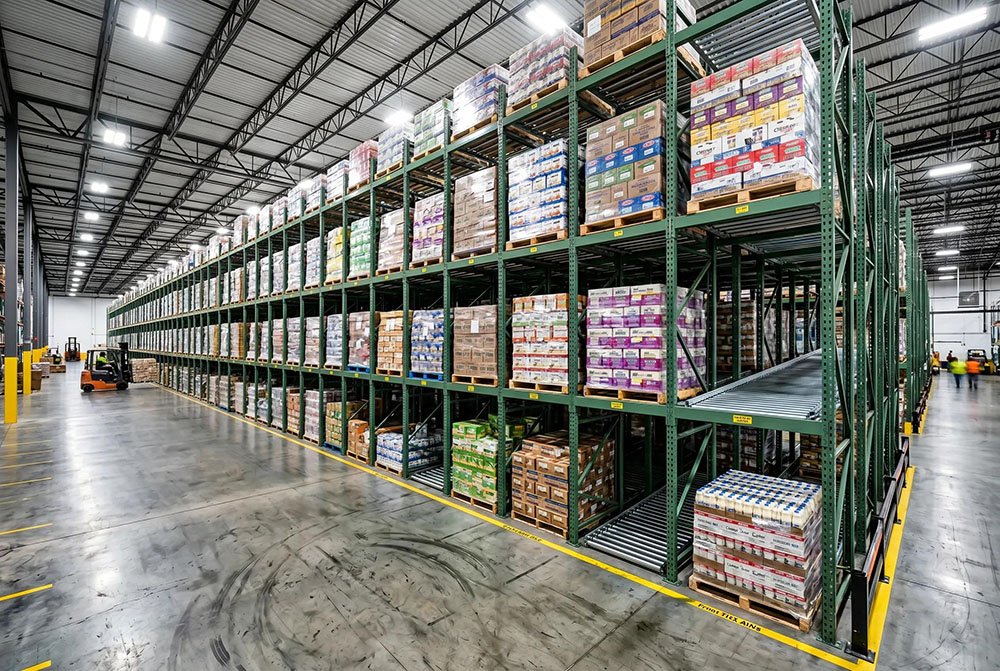
Paris Dairy DC — Chilled FIFO Pallet Flow
Major French dairy producer needed pure FIFO for 480 SKU short-shelf-life chilled yoghurt. 10-pallet-deep gravity flow lanes with cold-rated centrifugal brakes every 3rd roller, HDG 100 μm finish. Pallet expiry write-off cut from 1.8% to 0.07% — annual saving EUR 420,000 vs incumbent drive-in.
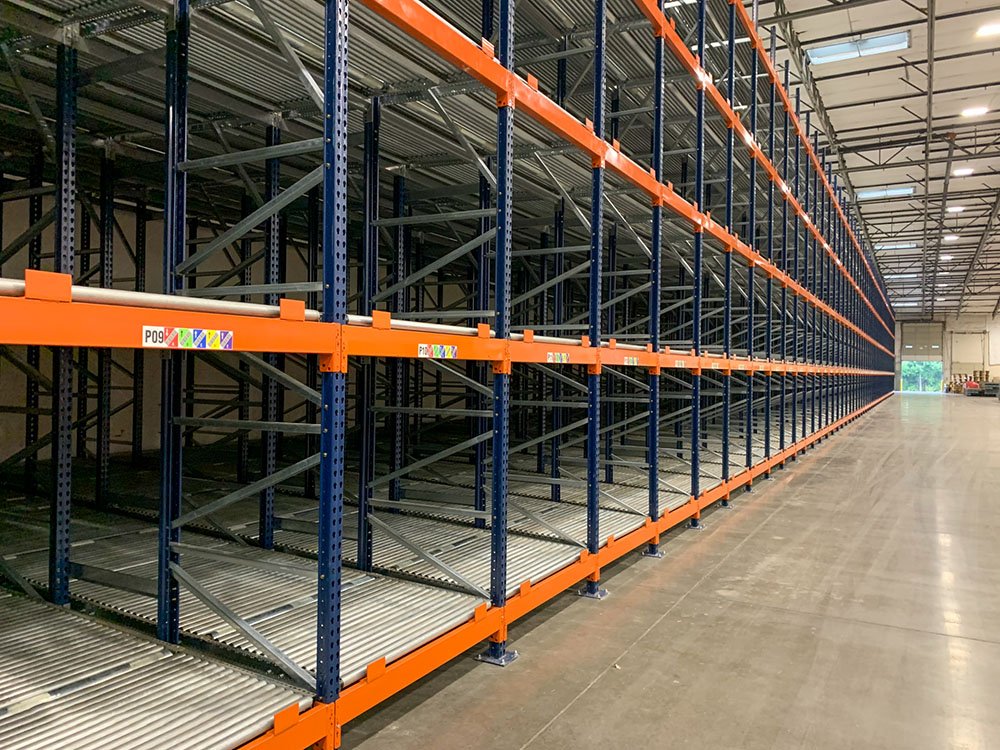
Almería Fresh Produce Hub — 5-Pallet Flow Lanes
Spanish fresh produce exporter handling 200+ truckloads/day of fruit and vegetable pallets to EU supermarkets. Standard roller flow lanes 5-pallet deep, EUR-pallet quality inspection at every load station. Picker productivity 2.1× vs incumbent selective layout — pallets always present at pick face.
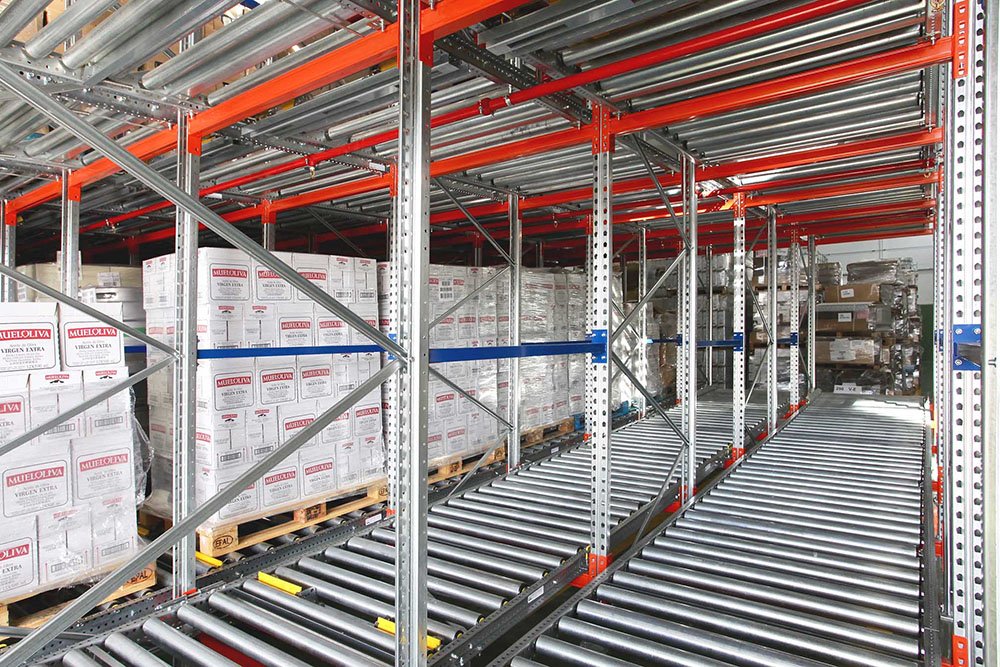
Singapore Pharma DC — GMP FEFO Pallet Flow
Multinational pharma DC needed strict FEFO (first-expiry-first-out) per HSA GMP Annex 15. 6-pallet-deep flow lanes with batch-coded pallets, mechanical separator brake holds lead pallet for batch verification scan before release. Passed first Singapore HSA audit at month-2 post-commissioning.
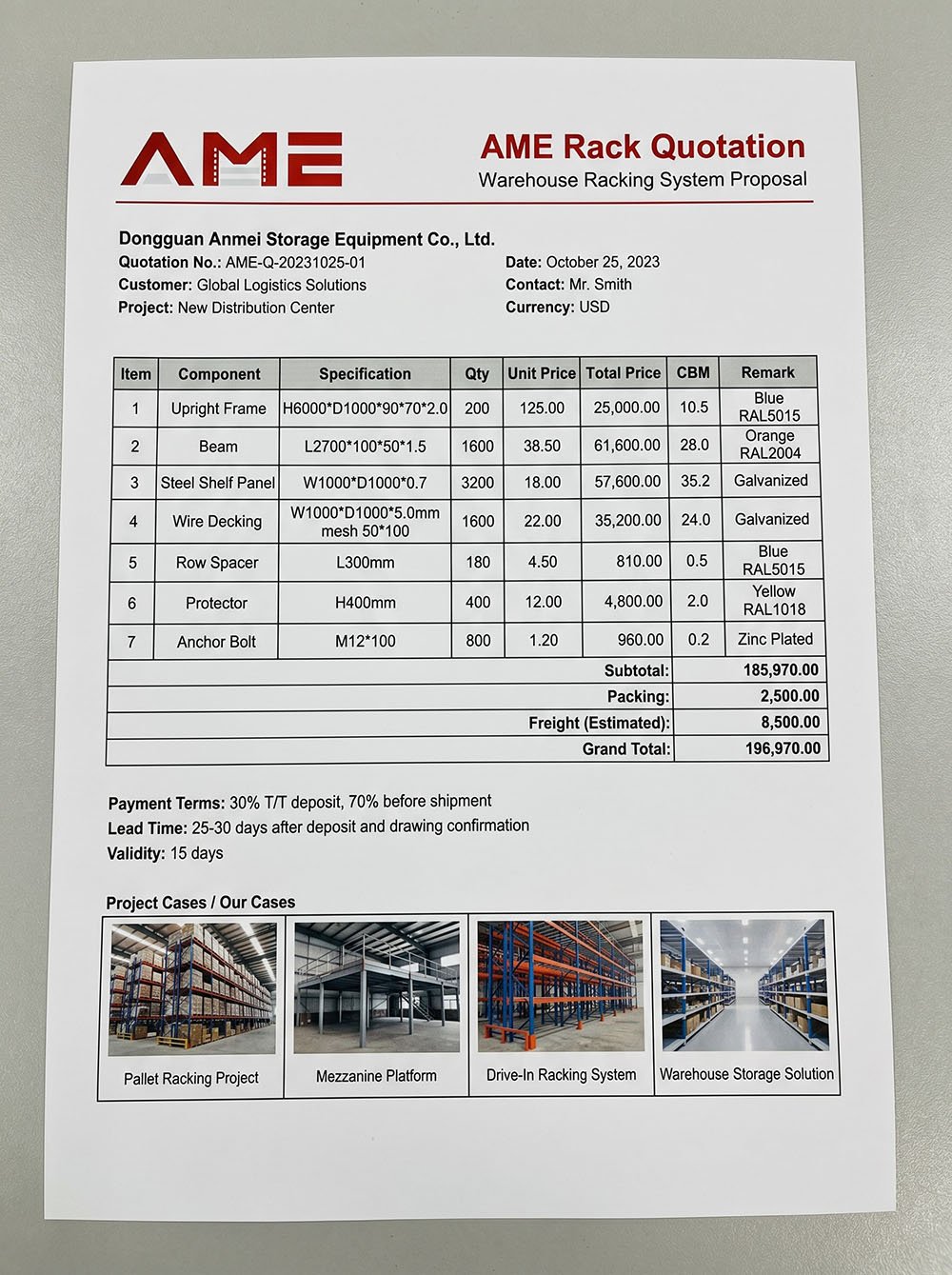
How AME Rack Builds Pallet Flow — 6-Step Production Flow
Owned 15,500 m² Dongguan factory. Rack frame + roller track + rotation brake + separator brake all engineered as one integrated system. NSK / NTN sealed bearings, dyno-calibrated brakes — premium-grade mechanical specification.
Rack CNC Punching & Cutting
4 CNC lines cut and perforate uprights from 2.0–2.5 mm Q345B coil. EN 15512 slot pattern at 50 mm pitch, tolerance ±0.15 mm. Flow lane frames cut to project-specific slope tolerance ±0.1°.
Roller Machining & Bearing Assembly
Steel rollers Ø 42 mm or Ø 50 mm machined to ±0.05 mm runout. Sealed greaseless bearings sourced from NSK / NTN certified suppliers — never bulk imports. Each roller hand-rotated for free-spin QC.
Brake Calibration
Centrifugal rotation brakes individually calibrated per project pallet weight on a dynamometer. Tested at 1.2× rated load — pallet must descend at ≤ 0.3 m/s. 100% sample retention for traceability.
Robotic Welding
Panasonic / Yaskawa robots weld upright frame, lane side rails, roller mount brackets. ISO 5817 Class B weld inspection. Critical brake-bracket welds 100% NDT-tested per FEM 9.831.
Powder Coat or HDG
7-stage pre-treatment + powder coat 80–100 μm DFT in AME Rack orange (warm climate) or HDG 80–120 μm for cold-storage / outdoor. Hardware (bolts, brake parts) zinc-electroplated.
Lane Test, Bundle & Container Loading
Each lane assembled and gravity-tested with sample pallets before disassembly for shipment — verifies flow performance at full speed. Rollers + brakes + side rails ship in zone-coded crates. 1,200–1,800 pallet positions per 40HQ.
What to Send Us for a Same-Day Quote — B2B Procurement Checklist
Six inputs are all we need to engineer a complete pallet flow system. The pallet condition photo / report is the most critical — flow rack is the most pallet-quality-sensitive rack type.
Pallet Specification & Quality
Pallet type (EUR/CHEP/IPP/US-GMA/custom), dimensions, gross weight range, condition (new / refurbished / mixed). For flow rack we need pallet condition more than any other rack type.
SKU & Throughput Profile
Active SKU count, pallets per SKU per week, daily throughput at peak hour, batch / lot rotation discipline (FIFO / FEFO / strict batch).
Building & Temperature Zone
Floor plan with columns, clear height under steel/roof, slab spec, temperature zone (ambient / +5°C chilled / -25°C frozen). Cold zones need cold-rated bearings.
Lane Configuration Preference
Target lane depth (4 / 6 / 8 / 10 / 12 / 16 / 20 pallets), number of lanes per upright, total lanes needed. Affects cross-aisle width and dock door positioning.
Forklift & Handling Equipment
Standard CB or reach truck for load end; reach truck for pick end. Dock door alignment with load aisle. Pick aisle width clearance.
Compliance Code
EN 15512 + FEM 9.831 (EU rack + flow lane), AS 4084 (AU/NZ), RMI MH16.4 (US/Canada flow rack specific), local food-safety or pharma GMP standards.
15 Procurement Questions Buyers Ask Before Placing a Pallet Flow Order
Answered for cold-chain managers, food / pharma operations heads and procurement officers comparing 3–5 pallet flow suppliers. If your question is not covered, WhatsApp Lily at +86 188 2453 7792.
01What is gravity pallet flow racking and how does it work?
02Does pallet flow need electricity or batteries?
03How deep can a pallet flow lane be?
04What density gain vs selective rack?
05What pallet types are compatible with pallet flow?
06Does pallet flow work in cold storage?
07What is the MOQ for a pallet flow project?
08How long is the lead time from PO?
09What payment terms do you accept?
10Is your pallet flow compliant with EN 15512 / FEM 9.831 / RMI MH16.4?
11How much maintenance does pallet flow require?
12What if a pallet jams mid-lane?
13Can pallet flow integrate with WMS for batch tracking?
14How much cheaper are you than European brands?
15Do you provide on-site commissioning?
Ready to Spec Your Pallet Flow Project?
Send pallet spec + condition photo, SKU profile, building drawings, temperature zone and target lane depth — receive a 3D AutoCAD layout, EN 15512 + FEM 9.831 stamped FEA, slope-and-brake calculation report, full BOM (rack + lanes + rollers + brakes) and FOB quotation within 4 working hours. Zero commitment, English / Spanish / French / Arabic available.