AME Rack

🏗️ Drive-In / Drive-Through Racking

Drive-In & Drive-Through Pallet Racking — Maximum Density for Bulk Single-SKU Storage

Up to 75% denser than selective pallet rack. Forklifts drive directly into the lane to deposit or retrieve pallets — perfect for cold storage, beverage, dairy, frozen food and FMCG buffer stock. AME Rack manufactures EN 15512 / FEM 10.2.07 / RMI MH16.3 compliant systems exported to 65+ countries.

Drive-in RackingDrive-through RackingDriveinto Pallet RackDIR SystemHigh Density RackingBulk Storage RackLIFO Pallet Rack
75% denser than selective rack EN 15512 / RMI MH16.3 compliant 10-year structural warranty
+75%DENSITY VS SELECTIVE
1–2 TPER PALLET
3–12 mHEIGHT RANGE
25 daysSTANDARD LEAD TIME
📦 What Is This Product

Drive-In Racking — The Densest Forklift-Accessible Pallet Storage

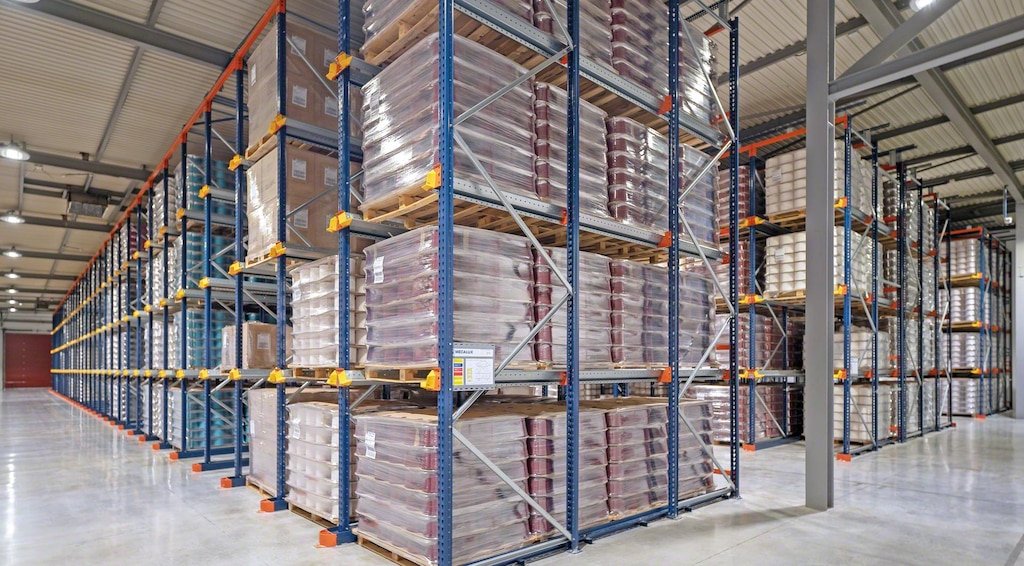
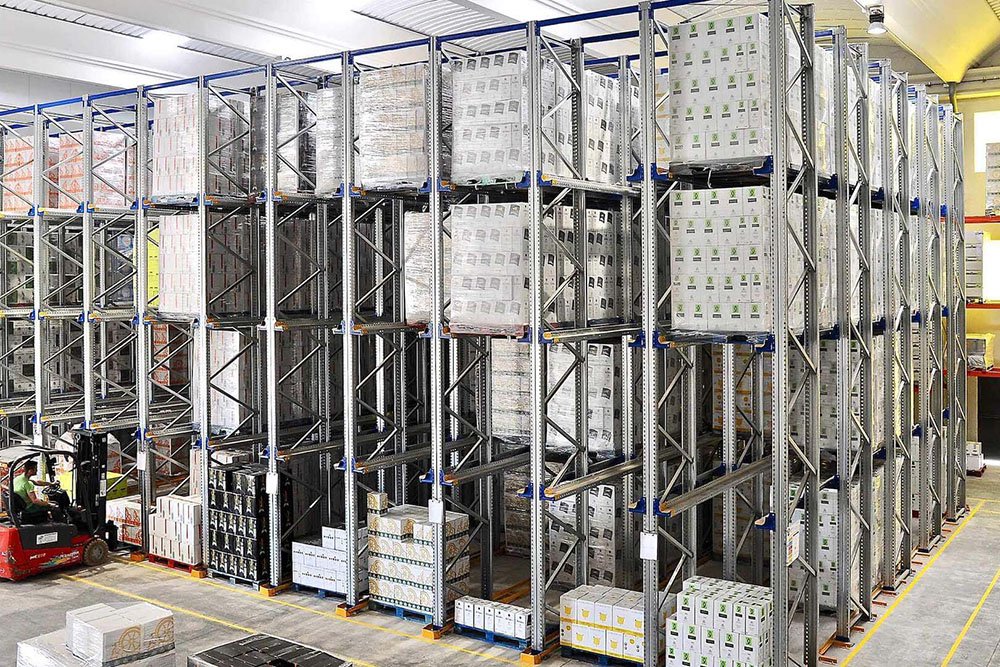
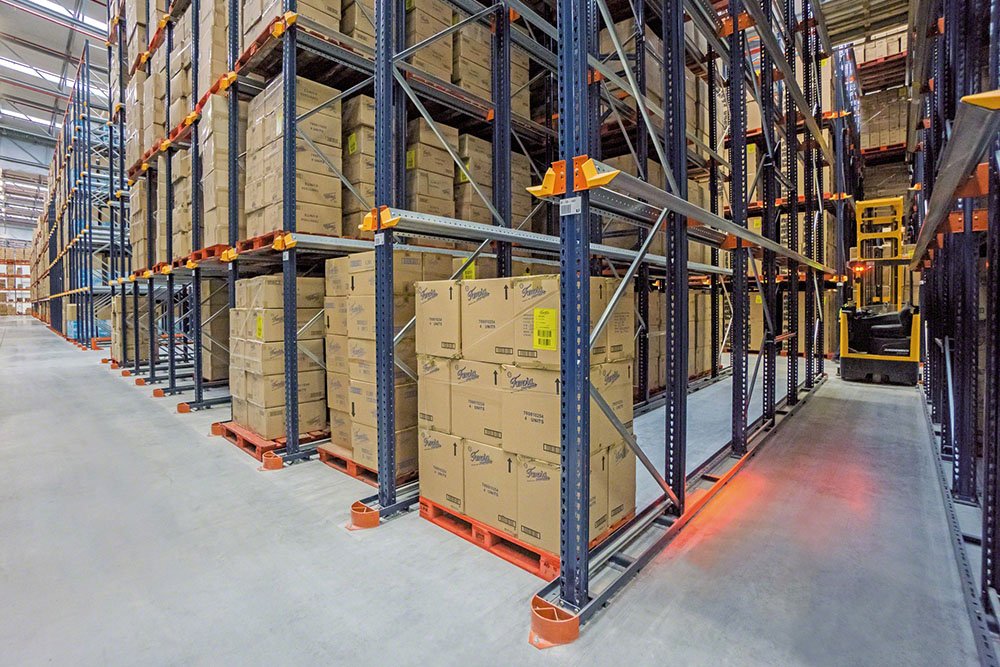
Drive-in pallet racking eliminates picking aisles. Forklifts drive directly inside the rack lane on continuous support rails to deposit pallets onto cantilever arms — LIFO (last-in, first-out) operation. Drive-through racking opens both ends of the lane, allowing FIFO operation when paired with separate load and unload aisles.

Best deployed when one SKU fills an entire lane and pick-face selectivity is not required: typically frozen food, dairy, beverage, paint, tyre and dry-bulk FMCG with high inventory turnover but low SKU count (under 50 SKUs in the racking zone).

LIFO / FIFODrive-in = LIFO · Drive-through = FIFO
Density Gain+60–75% vs selective rack
Lane Depth4 – 12 pallets deep typical
Best For≤50 SKUs, >10 pallets per SKU
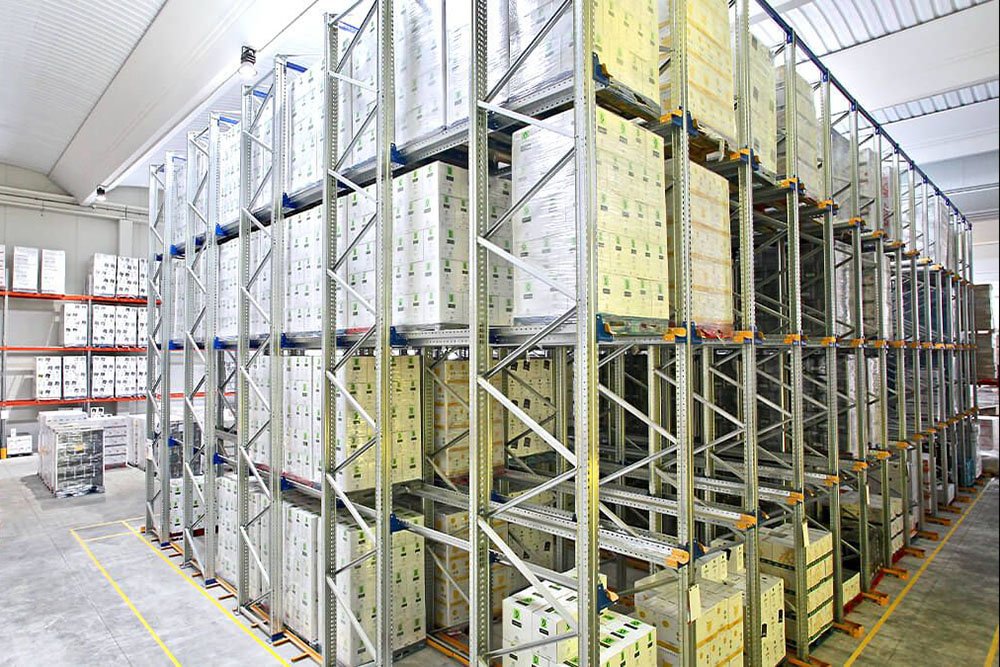
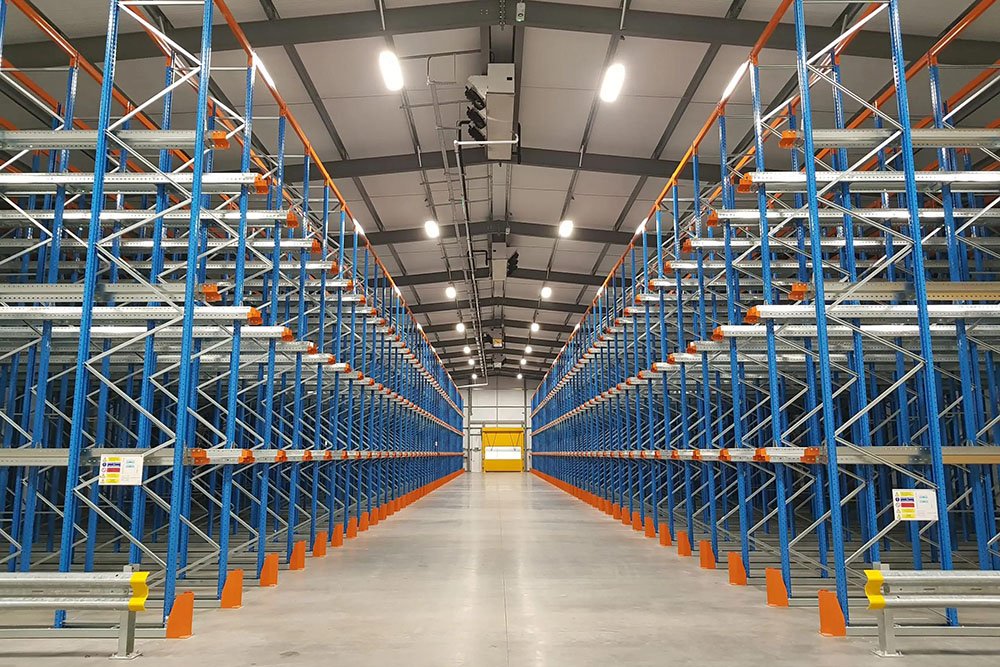
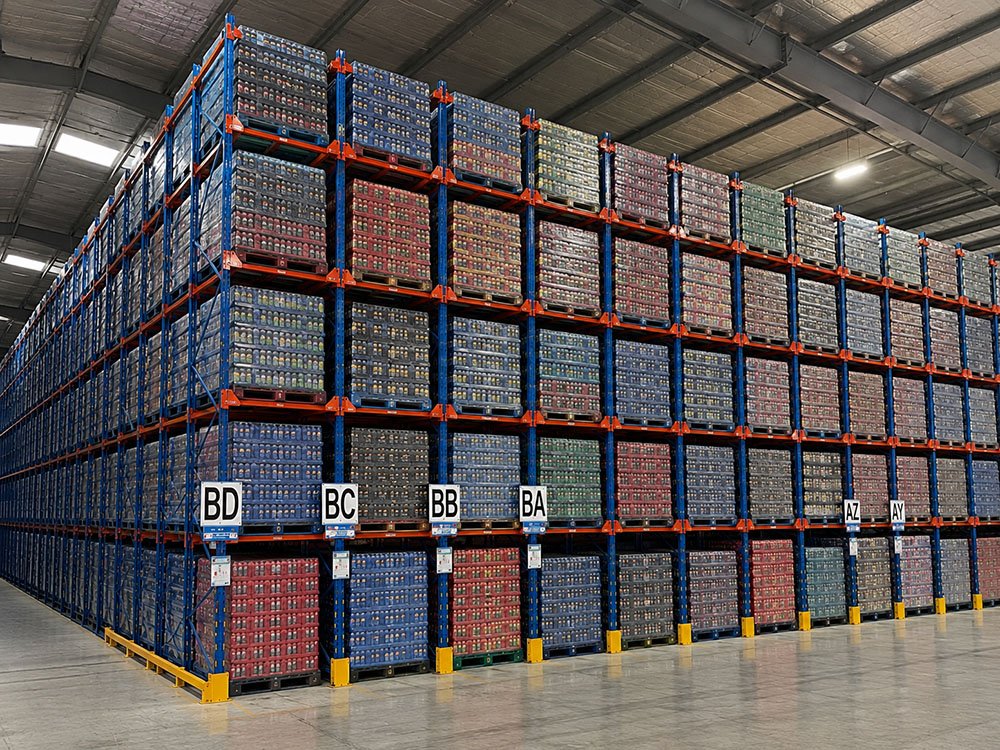
Drive-in pallet racking inside a cold storage warehouse
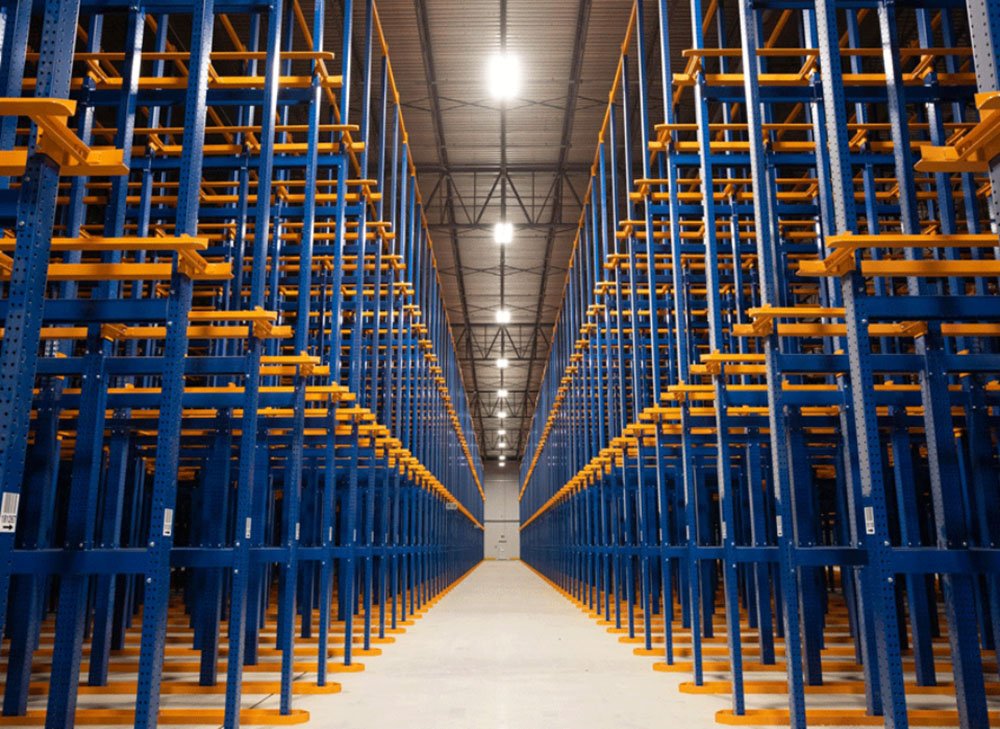
Drive-in rack inside -25°C frozen DC, HDG finish
⭐ Benefits

Why Drive-In Racking Wins for Bulk Single-SKU Storage

Eight engineering and operational advantages that explain why drive-in / drive-through racking is the standard solution in cold-chain, beverage and FMCG distribution centres worldwide.

📦

Maximum Density

Up to 75% more pallet positions on the same floor area vs selective racking. Best $/pallet position economy.

❄️

Cold-Storage Optimised

Smaller chilled / frozen volume to refrigerate — typical 30–45% energy saving vs selective layout in -25°C rooms.

🚛

Standard Forklifts

Works with any counterbalance or reach truck — no specialised VNA or shuttle equipment needed.

🔁

LIFO Buffer Storage

Perfect for raw-material buffers, seasonal stock, and beverage / FMCG bulk SKUs where rotation order is not critical.

➡️

FIFO Drive-Through

Open both ends of the lane to convert LIFO into FIFO — required for dairy, fresh produce and pharma batch traceability.

🛡️

Heavy Frame Design

Reinforced uprights, double-leg upright frames, full-length guide rails and column protectors withstand daily forklift impact.

📐

EN 15512 / MH16.3

Engineered to EN 15512, FEM 10.2.07, AS 4084 and RMI MH16.3 — stamped FEA calculation provided on every order.

🌍

Global Shipping

Compact disassembled bundling — average 1,500–1,800 pallet positions per 40HQ container.

🏷️ Product Types

Three Drive-In Racking Configurations for Every Application

From standard LIFO drive-in for beverage warehouses to drive-through FIFO for dairy and HDG cold-storage rooms — all three variants share the same engineered upright/rail system, differing in access mode and finish to match your operation.

Standard drive-in pallet racking LIFO single entry

Standard Drive-In (LIFO)

Single entry/exit per lane. Forklift loads and retrieves from the same aisle. 4–10 pallets deep, 3–8 m height. Lowest cost per position — ideal for single-SKU bulk storage in beverage, FMCG and dry-goods warehouses.

Drive-through pallet racking FIFO both ends open

Drive-Through (FIFO)

Both lane ends open. Load on one aisle, retrieve from the opposite aisle. Used for dairy, fresh produce, dated pharma — true FIFO batch rotation with first-in-first-out date control.

Cold storage hot-dip galvanised drive-in racking for frozen warehouse

Cold-Storage HDG

Hot-dip galvanised 80–120 μm finish — full corrosion protection in 2–8°C chilled, -25°C frozen and -70°C ultra-low-temperature rooms. Q345B seismic steel withstands freeze-thaw cycles and forklift impact.

📊 Specifications

Engineered Technical Parameters — 4 Standard Configurations

Standard catalogue spec range. All parameters are fully customisable — send pallet weight, building dimensions and forklift class for project-specific engineering.

ParameterLight-Duty DIStandard DIHeavy-Duty DICold-Storage HDG
Pallet Load≤ 800 kg800 – 1,200 kg1,200 – 2,000 kg800 – 1,500 kg
Lane Depth (pallets)3 – 54 – 85 – 104 – 8
Max Height5.5 m8.0 m10.5 m12.0 m
Upright Profile75 × 75 × 2.0 mm100 × 80 × 2.0 mm120 × 95 × 2.5 mm100 × 80 × 2.5 mm
Steel GradeQ235BQ235B / Q345BQ345BQ345B (-40°C Charpy)
Rail ProfileC 80×40×4C 100×50×5C 120×60×6C 100×50×5 (HDG)
FinishPowder coat 60 μmPowder coat 80 μmPowder coat 80–100 μmHot-dip galv 80–120 μm
Backstop BarOptionalStandardStandard (heavy)Standard
Guide RailOptionalStandardStandard (full-length)Standard
Column ProtectorOptionalStandardStandard (HDPE + steel)Standard (HDG)
Anchor SpecM12 × 95 mmM16 × 110 mmM20 × 150 mmM16 × 110 mm HDG
ComplianceEN 15512EN 15512 / RMI MH16.3EN 15512 / AS 4084 / RMIEN 15512 / FEM 10.2.07
Seismic ZoneZone 1–2Zone 1–3Zone 1–4Zone 1–4 + IBC
Service Life10 years15 years20 years20 years
Lead Time20 days25 days30 days35 days
FOB Price (USD/pos)$ 65 – 95$ 85 – 135$ 145 – 220$ 175 – 280
📌 Engineering Note: Lane depth selection drives 60% of total cost — deeper lanes mean higher density but slower pallet retrieval (last pallet in 10-deep lane requires 18+ forklift moves). Most cold-storage projects optimise at 6–8 pallets deep.
🔩 Components

Every Bolt, Beam and Bracing — In-House Manufactured

Ten core components engineered, rolled, welded and coated under one roof at AME Rack's 15,500 m² Dongguan plant. Full bill of materials and replacement-part price list shipped with every order.

01

Upright Frame

Double-leg reinforced frame — 100×80 mm to 120×95 mm box section, 2.0–2.5 mm Q345B steel, EN 15512 slot pattern at 50 mm pitch.

02

Cantilever Arm

L-shaped arm bolted to upright, supports continuous pallet rail. 6 mm thick plate, powder-coated red for visibility.

03

Pallet Support Rail

C-channel rail running the full length of the lane on which pallet skids slide forward. Standard C100×50×5 mm Q235B steel.

04

Top Bracing

Horizontal & diagonal bracing across the top of the rack, ties uprights together for lateral seismic stability per EN 15512 §9.

05

Back Stop

Rear-end barrier bar prevents pallets from over-pushing in LIFO drive-in. Removable for drive-through FIFO configuration.

06

Guide Rail

Floor-mounted U-channel rail along both sides of the lane — protects upright legs from forklift wheel impact, full lane length.

07

Column Protector

Yellow HDPE + steel hybrid guard at every lane entrance upright. 400 mm tall, replaceable. Mandatory in EU forklift safety codes.

08

Baseplate

200×150×8 mm hot-rolled plate, 4-hole pattern, fully welded to upright base. Anchored with M16/M20 × 110/150 mm chemical bolts.

09

Safety Pin / Lock

Drop-in safety pin secures cantilever arm to upright slot — prevents lift-out under forklift impact. ISO 5817 Class B weld.

10

Identification Sign

Aluminium load notice sign — lane number, max pallet weight, max pallet count per level, contact for damage report.

🏢 Applications

Where Drive-In Pallet Racking Delivers Maximum ROI

Eight industries where drive-in / drive-through racking is the standard storage architecture.

❄️

Cold Storage

-25°C frozen rooms, 2–8°C chilled, dense pallet storage with HDG finish.

🥤

Beverage & FMCG

Bulk SKU buffer for soft drinks, beer, water, dairy — high turnover.

💊

Pharmaceutical

Drive-through FIFO for batch traceability — 304SS variant for cleanroom.

🛞

Tyre Storage

Bulk tyre stacks per SKU, drive-in lanes with reinforced rails.

🛢️

Oil Drum & Chemical

IBC and 200 L drums, hazmat-zone spill containment available.

🛒

3PL Logistics

Buffer storage for client overflow — fast reconfigurable lane setup.

🏭

Raw Material

Coil, sheet, ingot, granular feedstock buffer pre-production line.

📦

E-commerce Reserve

Slow-mover replenishment buffer feeding selective pick faces upstream.

📐 Design Guide

How to Specify a Drive-In Rack Layout in 3 Decisions

Lane depth, access mode (LIFO vs FIFO) and forklift class drive 80% of total drive-in racking project cost. Get these three right before sizing uprights — your warehouse planner can complete this in 30 minutes.

1

Access Mode — LIFO vs FIFO?

How critical is pallet rotation order to your operation? Match access mode to inventory rules.

  • LIFO drive-in — non-dated bulk SKUs (paint, lube, tyres)
  • LIFO drive-in — frozen storage with deep stock
  • FIFO drive-through — dairy, fresh produce, dated pharma
  • FIFO drive-through — beverage with batch traceability
2

Lane Depth — Pallets per Lane

Deeper = more density, but slower retrieval and more "honeycomb" empty positions when SKU partially picked.

  • 3–5 pallets — moderate SKU rotation
  • 6–8 pallets — high-volume single SKU (most common)
  • 9–12 pallets — frozen / seasonal stock only
  • Rule: pallets-per-SKU ≥ lane depth × 1.5
3

Forklift & Aisle Clearance

Forklift drives inside the lane on rails — mast height and lift capacity matter, but turning radius does not (only used in cross aisle).

  • Cross aisle — 3.6–4.2 m for counterbalance
  • Cross aisle — 2.9–3.2 m for reach truck
  • Lane inside clearance — pallet width + 150 mm each side
  • Vertical clearance — pallet height + 200 mm minimum
📊 Lane Depth vs Honeycomb Loss (single SKU lane)Deeper lanes lose more positions when SKU partially depleted
Lane DepthTotal PositionsAvg Fill RateEffective DensityBest Use Case
3 deep3 / lane85%+45% vs selectiveMixed SKU bulk
5 deep5 / lane80%+58% vs selectiveStandard FMCG
7 deep7 / lane74%+65% vs selectiveCold storage / beverage
10 deep10 / lane68%+72% vs selectiveFrozen seasonal stock
12 deep12 / lane62%+75% vs selectiveSingle mega-SKU only
📌 Engineering Tip: Most cold-storage projects optimise at 6–8 pallets deep — sweet spot between density gain and retrieval cycle time. AME Rack provides free 3D AutoCAD / Revit layout drawings with honeycomb-loss simulation on every quote.
⚖️ Comparison

Drive-In vs Selective / Double-Deep / Pushback / Shuttle — Honest Pros & Cons

Which dense pallet racking solution is right for your warehouse? Compare on density, selectivity, throughput, FIFO compatibility, capex, forklift requirement and reconfigurability.

FactorDrive-In (LIFO)Drive-Through (FIFO)SelectiveDouble-DeepPushbackRadio Shuttle
Storage Density★★★★★★★★★★★★★★★★★★★★★★★★★★★
SKU Selectivity★★★★★★★★★★★★★★★★★★★★★★★★★★★★★
FIFO Compatible★★★★ LIFO★★★★★★★★★★★★★★★★★★★★★★★★
Capex (per pos.)$$ Low$$$$ Lowest$$$$$$$$$$$
Forklift TypeStandard CB / ReachStandard CB / ReachStandard CB / ReachReach + extending forkStandardStandard + shuttle
Cold-Storage Fit★★★★★★★★★★★★★★★★★★★★★★★★★★★★★
Reconfigurability★★★★★★★★★★★★★★★★★★★★★★★★★★★★★★
Best For≤50 SKUs, bulk LIFOBatch FIFO, fresh produceMixed SKUs, <500/SKUMedium SKU count4–6 pallet LIFO mixFIFO + max density
✅ Pick Drive-In When…

Cold storage, bulk single SKU

You have ≤50 SKUs and ≥10 pallets per SKU. Refrigeration cost matters. You want maximum density without buying shuttle technology.

↔️ Pick Drive-Through When…

Dairy, dated pharma, fresh

You need FIFO batch rotation but still want 60–70% density gain. Building has space for separate load/unload aisles at both ends.

⚠️ Avoid Drive-In When…

500+ SKUs, low pallets per SKU

Honeycomb loss kills your effective density — single-SKU lanes sit half-empty most of the time. Choose selective or pushback instead.

🔁 Drive-In + Selective Combo

Most cold-chain DCs do this

Drive-in for top 20% volume SKUs (bulk), selective for the long tail (case-pick). 50% density gain with full SKU coverage.

📍 Case Studies

Real Drive-In / Drive-Through Installations Around the World

Three recent projects across three continents — frozen DC, dairy FIFO and beverage buffer. Each shows the rack mix, building geometry, pallet positions delivered and on-site lead time.

🇩🇪 GermanyHamburg frozen DC drive-in rack installation

Hamburg Frozen DC — -25°C HDG Drive-In

1,400 m² · Reach truck · 5 m height · DIN EN 15512 + seismic

Frozen-food 3PL replaced legacy block-stack with HDG drive-in racking. 3-pallets-deep lanes, full hot-dip galvanised finish 100 μm. Reduced refrigerated volume by 38% — annual energy savings exceeded the full capex within 26 months. Installation completed in 10 working days.

800Pallet pos.
22 daysFOB lead
-38%Cooling vol.
🇲🇽 MexicoMonterrey dairy drive-through rack installation

Monterrey Dairy DC — Drive-Through FIFO

6,200 m² · Counterbalance · 6.5 m height · NTC-DS seismic Cat-C

Major dairy producer required strict FIFO rotation for ESL yoghurt and chilled milk. We engineered full drive-through configuration — load from production aisle, retrieve from despatch aisle. 7-pallet-deep lanes balanced density with batch traceability per Mexican NOM-251.

2,500Pallet pos.
28 daysFOB lead
100%FIFO compliant
🇳🇬 NigeriaLagos beverage drive-in rack installation

Lagos Beverage Plant — High-Density LIFO Buffer

7,500 m² · Counterbalance · 7.5 m height · NCP wind/seismic

Beverage bottler needed dense pallet buffer between filling line and outbound despatch. Standard LIFO drive-in at 10 pallets deep, traffic-yellow column protectors at every lane entrance, double-leg upright frames spec'd for tropical humidity. Project handover ahead of schedule.

6,400Pallet pos.
30 daysFOB lead
+72%Density gain
🏭 Manufacturing

How AME Rack Builds Drive-In Racks — 6-Step Production Flow

Owned 15,500 m² Dongguan factory. Steel coil enters one end, container-loaded racking exits the other. Every step in-house — no outsourcing, no hidden margins.

Step 1 🛠️

CNC Punching & Cutting

4 high-speed CNC lines (Amada / Yawei) cut and perforate drive-in uprights from 2.0–2.5 mm Q345B steel coil. EN 15512 slot pattern punched to ±0.15 mm tolerance.

Step 2 🌀

Roll-Forming

Dedicated roll-forming lines for double-leg upright sections, cantilever arms, pallet support rails (C-channel) and bracing members. Continuous run minimises setup changeover.

Step 3

Robotic Welding

Panasonic / Yaskawa robotic MIG welding builds upright frames with horizontal and diagonal bracing — critical for drive-in racks because they lack longitudinal beam bracing.

Step 4 🧪

Acid Pickling & Phosphating

7-stage pre-treatment line: degrease → rinse → acid pickle → rinse → zinc-phosphate → rinse → DI rinse. Adhesion ≥6N/cm cross-cut test, mandatory for cold-storage HDG variant.

Step 5 🎨

Powder Coating / HDG

Powder coat 60–100 μm DFT for ambient, hot-dip galvanise 80–120 μm for cold-storage / outdoor. Standard colour AME Rack orange — full RAL custom available.

Step 6 📦

QC, Bundling & Container Loading

Final dimensional QC (10% random sample), pallet rail deflection test per EN 15512, bundled with steel strapping + corner protectors. Average 1,500–1,800 pallet positions per 40HQ container.

15,500 m²Owned factory
15 linesRoll-forming
200,000+Pallet pos/yr
25 daysStandard lead
📋 Buying Guide

What to Send Us for a Same-Day Quote — B2B Procurement Checklist

Six inputs are all we need to produce a fully-engineered drive-in / drive-through racking quotation. Send what you have — we can work from a hand-drawn floor sketch if AutoCAD is not available.

01

Building Drawings

Floor plan with column locations, clear height under steel/roof, slab thickness (recommended ≥180 mm reinforced concrete for drive-in), seismic zone, ambient/cold-room boundary.

02

Pallet & SKU Profile

Pallet dimensions (L×W×H), gross weight, pallet type (EUR / US GMA / CHEP), active SKU count, average pallets per SKU, daily inbound/outbound pallet count.

03

Forklift Profile

Forklift make / model, mast type (single / triplex / quad), max lift height, fork carriage width. Drive-in needs free-lift mast to enter the lane without raising mast first.

04

Access Mode & Rotation

LIFO (drive-in) or FIFO (drive-through)? Batch traceability required (dairy, pharma, dated stock)? Mixed-SKU lanes acceptable or strict one-SKU-per-lane?

05

Environment & Finish

Indoor ambient / chilled 2–8°C / frozen -25°C / ultra-low -70°C / outdoor canopy. Coastal salt-air? Food contact? HACCP/BRC required?

06

Compliance Code

EN 15512 + FEM 10.2.07 (EU), AS 4084 (AU/NZ), RMI MH16.3 (US/Canada), local seismic code (IBC, NCh 2369, SBC, NSCP, NTC-DS, SNI 1726).

❓ FAQ — B2B Procurement

15 Procurement Questions Buyers Ask Before Placing a Drive-In Rack Order

Answered for facility managers, supply chain heads, and procurement officers comparing 3–5 racking suppliers. If your question is not covered, WhatsApp Lily at +86 188 2453 7792.

01What is the difference between drive-in and drive-through pallet racking?
Drive-in racking has one entry/exit per lane — forklift enters and exits from the same end, so the last pallet placed is the first one removed (LIFO). Drive-through racking opens both ends of the lane — forklift loads from one aisle, retrieves from the opposite aisle, allowing FIFO rotation. Drive-through requires more floor area (two cross aisles) but is essential for dated stock like dairy, fresh produce and pharma.
02How dense is drive-in racking compared to selective pallet rack?
Drive-in racking typically delivers +60–75% more pallet positions on the same floor area versus standard selective racking. The exact gain depends on lane depth: 5-pallet-deep lanes give roughly +58%, 7-pallet-deep give +65%, 10-pallet-deep give +72%, and 12-pallet-deep (rare, only mega-SKU bulk) push to +75%. Effective density is lower than nominal because of honeycomb loss when SKUs partially deplete.
03What is honeycomb loss and how do I avoid it in drive-in design?
Honeycomb loss is the empty pallet position(s) remaining in a lane after partial SKU depletion — those positions cannot be reused for a different SKU until the lane is fully empty. To minimise: (1) match lane depth to typical SKU rotation cycle (pallets-per-SKU ≥ lane depth × 1.5), (2) never mix SKUs in a single lane, (3) use shallower 5-pallet lanes for SKUs that ship in small batches, deeper 8–10 pallet lanes only for steady high-volume SKUs.
04What is the MOQ for drive-in racking — can I order less than a full container?
Standard MOQ is one 20GP container (≈ 500 pallet positions). Drive-in components are bulkier than selective rack due to the cantilever arms and full-length rails, so per-container pallet count is lower than selective. Smaller orders are accepted but carry a 12–18% loading-inefficiency surcharge. If your project is below MOQ, we can combine your shipment with another customer's container.
05How long is the lead time from PO to ready-for-shipment?
Standard powder-coated drive-in: 25 days after deposit received. Heavy-duty drive-in (Q345B reinforced): 30 days. Hot-dip galvanised cold-storage: 30–35 days. 304 stainless: 40–45 days. Drive-through configuration adds 2–3 days for additional rail fabrication. We dedicate one of 15 roll-forming lines per project to avoid changeover delay.
06Which forklift type is required for drive-in racking?
Drive-in racking works with standard counterbalance forklifts or reach trucks — no specialised equipment needed. The critical requirement is a free-lift mast (the carriage can lift before the mast extends) so the forklift can enter the lane with forks raised to clear the first rail level. Mast height must be at least 200 mm less than the rack lane height clearance.
07What payment terms do you accept for B2B buyers?
Standard terms: 30% T/T deposit on PO confirmation, 70% balance against B/L copy before vessel sails. Alternative: 100% irrevocable L/C at sight from a top-50 bank. For repeat customers with 3+ orders, we also offer OA 30/60 against credit insurance (Sinosure / Coface).
08Is your drive-in rack compliant with EN 15512 / FEM 10.2.07 / RMI MH16.3?
Yes. All drive-in / drive-through designs are engineered to EN 15512 (general racking), FEM 10.2.07 (drive-in specific), AS 4084 (Australia/NZ) and RMI MH16.3 (US/Canada drive-in specification). We provide stamped FEA calculation reports run in RFEM 5 / ETABS — required by most insurance providers and many municipal building codes for high-density racking.
09What steel grade do you use for drive-in racks?
Standard: Q235B cold-rolled coil (yield ≥235 MPa) for light-duty. Standard duty and above: Q345B (yield ≥345 MPa, Charpy V-notch ≥27J at -40°C) — mandatory for cold-storage and seismic zones. Steel sourced from Tier-1 Chinese mills (Baosteel, Shagang, Hesteel) under annual contracts. Full mill test certificates (MTC) provided with every shipment.
10Do you supply cold-storage hot-dip galvanised drive-in racks?
Yes. HDG 80–120 μm is our standard finish for chilled (2–8°C), frozen (-25°C) and ultra-low-temperature (-70°C) rooms. We hot-dip galvanise the complete rack after fabrication — uprights, rails, cantilever arms, bracing, even the M16/M20 anchor bolts. Cold-storage variant uses Q345B steel with -40°C Charpy V-notch tested ≥27J to prevent brittle fracture at low temperature.
11Can you provide drawings, FEA reports, and installation supervision?
Drawings + FEA: free with every order (3D AutoCAD / Revit / IFC + stamped calculation report by registered PE on request). On-site supervision: optional at USD 250/day + travel/visa. For drive-in projects we strongly recommend at least one supervisor for the first 5 days — drive-in installation sequence is more complex than selective and rail levelness is critical.
12What about damage from forklift impact inside the lane?
Drive-in racks see more forklift impact than selective — that is why we make column protectors mandatory at every lane entrance (yellow HDPE + steel hybrid, 400 mm tall) and supply full-length floor guide rails (U-channel, both sides of the lane). Both items are included in every standard quotation. Replacement parts ship within 14 days from our Dongguan inventory.
13How much cheaper are you than European / North American drive-in brands?
For equivalent EN 15512 + FEM 10.2.07 + RMI MH16.3 spec, AME Rack direct factory pricing is typically 30–45% below European brand-name suppliers (SSI Schäfer, Mecalux, Stow, Polypal) and 25–35% below North American brands (Steel King, Interlake, Frazier). We own the 15,500 m² plant outright and procure steel via annual mill contracts.
14Can you handle seismic-zone engineering for drive-in racks?
Yes. Drive-in racks are more seismically sensitive than selective because they lack longitudinal beam bracing — top bracing must be engineered carefully. We have delivered projects in Chile (NCh 2369), Mexico (NTC-DS), Indonesia (SNI 1726), Saudi Arabia (SBC 301), Philippines (NSCP), Peru (E.030) and US zones (IBC). FEA reports stamped by registered PE on request.
15What after-sales support do you provide for international buyers?
Free part list with every order for future expansion (3-year price-lock on commodity components). Spare-parts shipment within 14 days by air or sea. Re-engineering service if you reconfigure your warehouse — we update your FEA report and drawings free for 3 years post-installation. WhatsApp / email response within 4 working hours, Mon–Sat. English / Spanish / French / Arabic communication.
Ready to Spec Your Drive-In / Drive-Through Racking Project?

Send building dimensions, pallet spec, SKU count and forklift class — receive a 3D AutoCAD layout, stamped FEA report, full BOM and FOB quotation within 4 working hours. Zero commitment, no template recycling, English / Spanish / French / Arabic communication available.

🏭 200,000+ pallet positions / yr📐 Free 3D + FEA + BOM🛡️ 10-yr structural warranty🌍 Shipped to 65+ countries

Get a free quote quickly

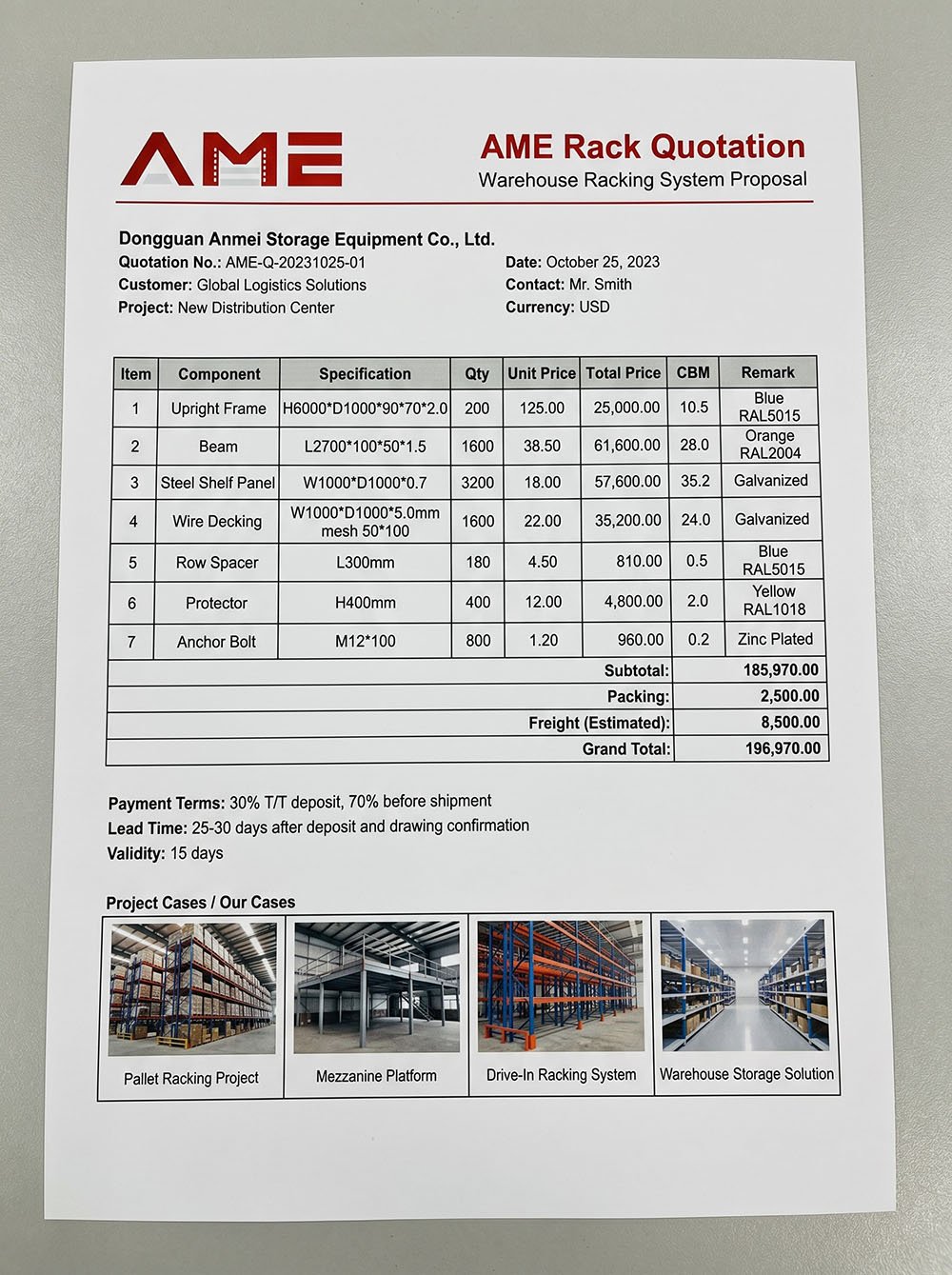
AME Rack quotation