ASRS Automated Storage & Retrieval — Lights-Out Warehouse Automation
Fully-automated unit-load or mini-load storage with stacker cranes operating in narrow high-bay aisles. 500–800 pallets/hour throughput per crane, 25 m tower height, lights-out 24/7 operation. The architecture used by Walmart, Amazon, Maersk and Sinopharm mega-DCs. AME Rack delivers FEM 9.831 + EN 528 + ISO 11393 compliant ASRS systems engineered with European-grade PLC and safety controls.
ASRS — The Robot Warehouse
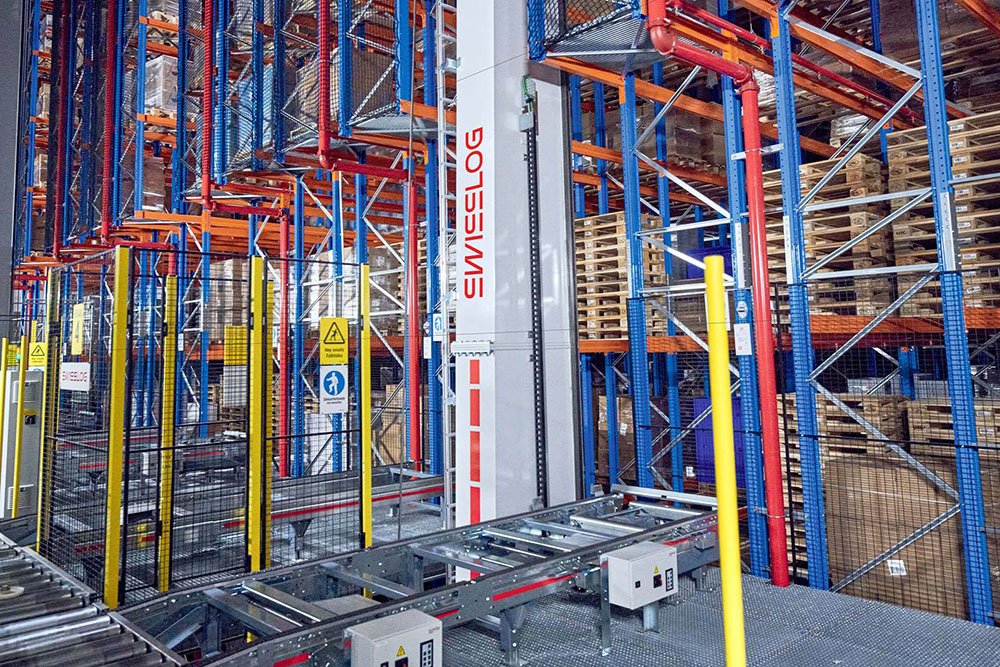
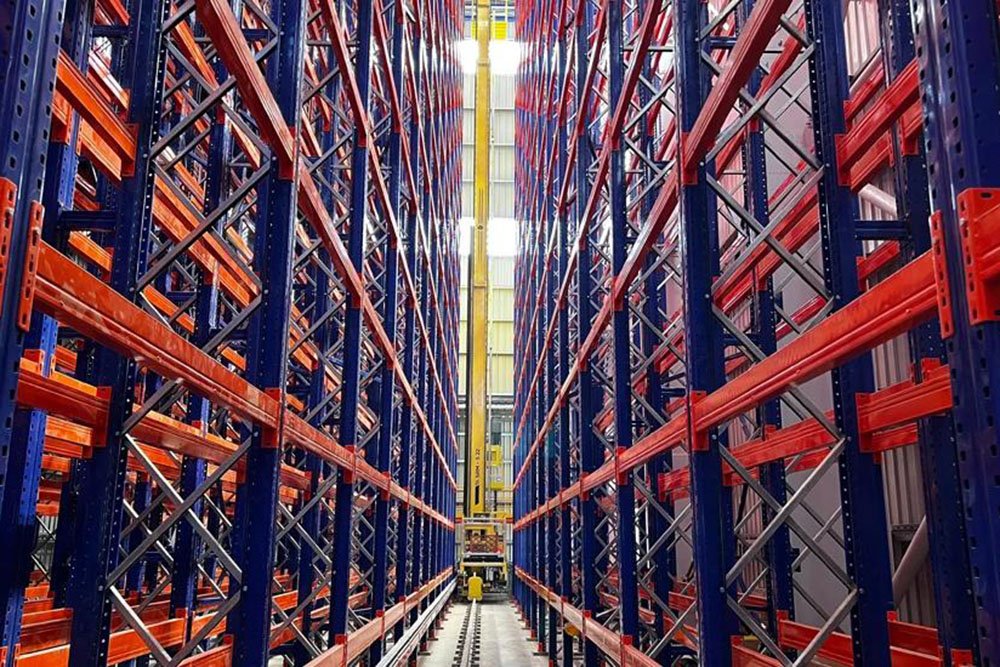
ASRS (also called AS/RS, automated storage and retrieval system, stacker crane system, automated warehouse system, high-bay automated rack or lights-out warehouse) is a fully-integrated rack-and-crane system in which computer-controlled stacker cranes (or shuttles + lifts in mini-load configurations) deposit and retrieve unit loads in narrow aisles up to 25 m high. WMS / WCS software directs every move; humans only enter for maintenance.
Standard architecture for highest-throughput, highest-density, highest-accuracy warehousing — Walmart, Amazon, Maersk, Sinopharm, Tesco, Coca-Cola and other Fortune 500 operators use ASRS for their flagship DCs. Capex is 4–10× selective rack but TCO breaks even within 36–60 months at high volume thanks to 40–60% labour reduction, 90% pick accuracy gain, lights-out 24/7 operation.
Why ASRS Wins for Mega-DCs and 24/7 Operations
Eight engineering and operational advantages that explain why ASRS is the architecture of choice for the world's largest distribution centres — and the only way to handle 100K+ cases per day with predictable cost and accuracy.
Lights-Out 24/7
Zero-person operation — cranes run continuously through night shift, weekends, holidays. Add 50–100% capacity vs single-shift human warehouse without extra labour.
+90% Density vs Selective
25 m tall + 1.55 m aisles + double-deep storage = roughly 5× pallet positions per ground m² vs standard selective rack. Drastic land cost reduction.
500–800 Pallets/Hr/Crane
10–15× the throughput of forklift-based storage. Combine 4–8 cranes in parallel for 3,000+ pallets/hour bay throughput.
99.99% Accuracy
Software-controlled location addressing — wrong-pick rate drops from typical 0.5% (forklift) to under 0.01%. Eliminates pick-error returns and customer disputes.
-40% to -60% Labour
Crane replaces 6–8 forklift drivers per shift. Remaining roles: WMS operator, maintenance tech, exception handler. Cuts wage + insurance + training cost.
Cold / Hazmat Friendly
Crane operates at -30°C frozen, in ATEX zones, in cleanrooms — no human exposure to harsh environments. Massive HSE benefit.
Zero Forklift Damage
No forklift = no rack collision = no goods damage. Insurance premium typically drops 30–50% vs equivalent forklift warehouse.
FEM 9.831 + EN 528
Rack frame to EN 15512 + AS 4084; crane to FEM 9.831 + EN 528; safety to ISO 11393 + CE Machinery Directive. Full integrated documentation.
Six ASRS Configurations for Every Mega-DC Profile
From unit-load pallet stacker crane to mini-load tote ASRS, multi-shuttle parallel architecture, cold-storage frozen variants and hybrid configurations — match crane type, payload and environment to your throughput goal.
Unit-Load ASRS (Pallet)
Stacker crane handles full pallets 500–1,500 kg. Single-deep, double-deep or multi-deep storage. 25 m height max. The standard for FMCG, beverage, raw materials.
Mini-Load ASRS (Tote / Carton)
Crane handles plastic totes or cartons 50–300 kg. 12 m height typical. For e-commerce small-parcel, electronics, spare parts pick-pack operations.
Shuttle ASRS
Multi-shuttle architecture — independent shuttles per level + central lift. Higher throughput than single-crane, lower capex than full crane ASRS.
Cold-Storage ASRS
-30°C frozen and 2–8°C chilled operation. HDG / stainless rack, cold-rated PLC and bearings. Standard for dairy, frozen-food mega-DC architecture.
Twin-Mast Heavy Crane
Two parallel masts for 2 T heavy pallets and double-pallet handling (1.4× standard throughput). For brick, ceramic, glass bottle, frozen-meat mega-DC.
Hybrid ASRS + Manual
ASRS for reserve + selective racking for forward pick. Combines automation efficiency with manual flexibility for mixed-SKU operations.
Engineered Technical Parameters — 4 Standard Configurations
Standard ASRS catalogue. Every project is custom-engineered — these specs are starting points for scoping. Send pallet / tote / case profile, throughput, environment and building drawings for full project FEA.
| Parameter | Unit-Load Standard | Mini-Load Tote | Cold-Storage Unit-Load | Twin-Mast Heavy 2T |
|---|---|---|---|---|
| Payload per Cycle | 1,000 – 1,500 kg pallet | 50 – 300 kg tote | 1,000 – 1,500 kg HDG | 2,000 kg (or 2 × 1T) |
| Throughput / Crane | 500 – 800 pal/hr | 800 – 1,500 tote/hr | 400 – 600 pal/hr | 700 – 1,100 pal/hr |
| Tower Height | 15 – 25 m | 8 – 14 m | 15 – 22 m | 15 – 25 m |
| Aisle Width | 1.55 – 1.65 m | 1.20 – 1.35 m | 1.65 m (insulated cell) | 1.75 – 1.85 m |
| Travel Speed (horizontal) | 240 m/min | 360 m/min | 180 m/min (cold-rated) | 200 m/min |
| Hoist Speed (vertical) | 60 m/min | 90 m/min | 50 m/min | 50 m/min (double mast) |
| Storage Depth | Single / double-deep | Single / double-deep | Single / double-deep | Single / double-deep |
| Pick Accuracy | 99.99% | 99.99% | 99.99% | 99.99% |
| Rack Upright Profile | 120 × 100 × 3.0 mm | 100 × 80 × 2.5 mm | 120 × 100 × 3.0 mm HDG | 150 × 120 × 3.5 mm |
| Crane PLC | Siemens S7-1500 | Siemens S7-1500 | Siemens S7 (cold spec) | Siemens S7-1500 redundant |
| WMS Integration | REST API / OPC-UA / SAP | REST API / OPC-UA | REST API / OPC-UA | REST API / OPC-UA / SAP |
| Safety System | ISO 11393 + CE MD | ISO 11393 + CE MD | ISO 11393 + CE MD | ISO 11393 + dual brake |
| Slab Flatness | FM1 superflat | FM1 superflat | FM1 superflat | FM1 superflat |
| Operating Temp | +5 to +45°C | +5 to +45°C | -30 to +20°C | +5 to +45°C |
| Compliance | FEM 9.831 + EN 528 + EN 15512 | FEM 9.831 + EN 528 | FEM 9.831 + EN 528 (cold) | FEM 9.831 + EN 528 heavy |
| Lead Time | 6 – 8 months | 5 – 7 months | 8 – 9 months | 7 – 9 months |
| FOB Price (USD/pal pos) | $ 380 – 580 | $ 220 – 380 / tote pos | $ 480 – 720 | $ 520 – 780 |
Every Crane, Rail and PLC — Engineered as One System
Ten core components integrated and tested under one roof at AME Rack's 15,500 m² Dongguan plant + dedicated automation engineering centre. Siemens S7-1500 PLC, SEW / Lenze drives, NSK / Schaeffler bearings — premium European / Japanese spec on every project.
Rack Upright Frame
Heavy double-leg upright 120×100 mm to 150×120 mm box section, Q345B / S355JR steel. Built to ±2 mm vertical tolerance to support guided crane operation per FEM 9.831.
Stacker Crane (Single-Mast)
Self-supporting crane runs in 1.55 m aisle on top + bottom guidance rails. Travel 240 m/min, hoist 60 m/min. Siemens S7-1500 PLC, encoder positioning ±5 mm.
Stacker Crane (Twin-Mast)
Two parallel masts for heavy loads up to 2T or double-pallet handling. Higher throughput, larger aisle (1.75–1.85 m). Standard for beverage / ceramic mega-DC.
Load-Handling Device (Telescopic Fork)
Pantograph telescopic fork extends single-deep, double-deep or push-back to deposit/retrieve pallets. 1,500–2,000 kg capacity.
Inbound / Outbound Conveyor
Pallet conveyor delivers loads from dock to ASRS lane entry + carries retrievals to dispatch. Roller, chain or belt design per pallet type.
WMS / WCS Software Stack
Warehouse Control System (WCS) drives crane move commands; integrates with customer WMS (SAP EWM, Manhattan, Korber, Blue Yonder, Oracle JDE) via REST API / OPC-UA.
Safety System (ISO 11393)
Aisle entry interlocks, light curtains, emergency stops every 10 m, two-channel safety PLC redundancy. CE Machinery Directive 2006/42/EC compliant.
Top + Bottom Guide Rail
Precision-ground steel rails — top rail mounts to upper bracing; bottom rail anchored to slab. ±2 mm alignment tolerance for crane wheel guidance.
Aisle Top Bracing
Horizontal + diagonal cross-bracing across top of rack — ties uprights together against lateral seismic and crane braking loads per EN 1998.
Crane Charging Station (Auto)
Inductive or contact-rail auto-charging at aisle end. Crane recharges between cycles — no battery swap, no operator intervention, true 24/7 operation.
Where ASRS Delivers Mega-DC Scale
Eight industries where automated storage and retrieval is the standard architecture for highest-throughput, lowest-cost operations. Tap any card for the full industry solution detail page.
Beverage Mega-DC
500K+ pallets/yr Coca-Cola / Pepsi / brewery scale operations.
View solution → ❄️Cold-Chain DC
-30°C frozen mega-DC, lights-out operation in unmanned cold cells.
View solution → 💊Pharmaceutical
GMP / FDA batch FIFO with full traceability at 100K+ lines/day.
View solution → 🛒E-commerce Mega-Fulfilment
Amazon-style same-day fulfilment with 200K+ orders/day.
View solution → 🚗Automotive Parts OEM
Just-in-sequence parts feed to assembly line, ±1-min accuracy.
View solution → 🏭Manufacturing WIP
Production-line buffer with WMS-orchestrated kanban replenish.
View solution → 📦3PL Mega-Warehouse
Multi-client 3PL with WMS-segmented client zones, billing automation.
View solution → 🔬Hazmat / Chemical
ATEX explosive-zone storage, no human exposure to hazardous goods.
View solution →How to Specify an ASRS in 3 Decisions
Throughput target, payload unit and integration scope drive 90% of ASRS project cost and feasibility. ASRS is a multi-million-dollar commitment — design discipline is non-negotiable.
Throughput — Peak Hour Pallets
The single biggest cost driver. Calculate peak-hour pallet moves (inbound + outbound + internal) at busiest forecast year, then size crane fleet.
- < 100 pal/hr — skip ASRS, use shuttle
- 200–800 pal/hr — 1–2 cranes
- 800–2,000 pal/hr — 3–6 cranes
- 2,000+ pal/hr — 6–12 cranes + WMS orchestration
Payload — Unit-Load or Mini-Load?
Pallet, tote, or carton — different ASRS architecture entirely. Choose payload first, then crane.
- Pallet (≥ 500 kg) — Unit-Load crane
- Tote / case (50–300 kg) — Mini-Load crane
- Mixed pallet + tote — separate ASRS zones
- Heavy pallet (≥ 1.5 T) — Twin-mast crane
Integration — Stand-Alone or End-to-End?
ASRS rarely runs in isolation — it integrates with conveyor, AGV, WMS, ERP, MES. Define integration scope upfront.
- Stand-alone ASRS — WMS interface only
- + Conveyor inbound / outbound
- + AGV dock-to-ASRS interface
- + Pick stations + outbound sorter
| Annual Pallet Movements | Recommended Crane Type | Crane Count | Building Clear Height | Approx Capex (USD M) |
|---|---|---|---|---|
| < 200K / yr | Skip — use shuttle rack | — | — | — |
| 200K – 500K | Unit-load single-mast | 1 – 2 cranes | 15 – 18 m | $ 2 – 5 M |
| 500K – 1.5M | Unit-load single-mast | 3 – 5 cranes | 18 – 22 m | $ 5 – 12 M |
| 1.5M – 3M | Unit-load single + twin-mast mix | 6 – 10 cranes | 22 – 25 m | $ 12 – 28 M |
| 3M+ | Multi-crane + AGV + sorter | 10 – 16 cranes | 22 – 25 m | $ 28 – 60 M+ |
ASRS vs Radio Shuttle / VNA / AGV / AMR / Selective + Forklift — Honest Pros & Cons
Which automation level is right for your DC? Compare on throughput, density, capex, lead time, integration complexity and TCO break-even point.
| Factor | ASRS (Stacker Crane) | Radio Shuttle | VNA (Manual Crane) | AGV / AMR | Selective + Forklift |
|---|---|---|---|---|---|
| Throughput / Aisle | 500–800 pal/hr | 30–60 pal/hr | 40–80 pal/hr | 30–60 pal/hr | 20–35 pal/hr |
| Density vs Selective | +90% | +80% | +72% | Baseline | Baseline |
| Capex per pal position | USD 380–780 | USD 200–280 | USD 120–250 | USD 80–150 | USD 60–120 |
| Lead Time | 6–9 months | 2 months | 2 months | 3–4 months | 1 month |
| 24/7 Lights-Out | ★★★★★ | ★★★★★ | ★★★★★ | ★★★★★ | ★★★★★ |
| Pick Accuracy | 99.99% | 99.95% | 99.5% | 99.9% | 99.5% |
| Labour Cut vs Forklift | -60% to -80% | -40% | -20% | -60% to -80% | Baseline |
| Break-even Volume / Yr | ≥ 300K pal | ≥ 80K pal | ≥ 50K pal | ≥ 100K pal | — |
| Best For | Mega-DC ≥ 100K cases/day | Mid-large DC, dense FIFO | Tall building, mid volume | Mixed flexible operations | Standard warehouse |
≥ 300K pallets/yr + 24/7 needed
You move 100K+ cases / day, run 24/7 operation, need 99.99% accuracy, and have capex flexibility for 6-9 month build. Standard for Fortune 500 mega-DCs.
Volume < 100K pal/yr or unstable SKU mix
Below 200K pallet/year, ASRS capex never breaks even. If your SKU/case profile changes every 6 months, ASRS rigid layout becomes a liability — choose flexible AGV/AMR instead.
Mid volume, dense FIFO, lower capex
Radio shuttle gives 50–70% of ASRS density + 70% of throughput at 30% of capex. Sweet spot for 80K–300K annual pallet operations with FIFO needs.
Modern e-commerce mega-DC
ASRS for reserve storage + AGV / AMR for last-mile order picking. Best of both: maximum density + flexible operations. Standard Amazon / Alibaba architecture.
Real ASRS Installations Around the World
Three flagship projects across three continents — beverage mega-DC, frozen 3PL, and pharma GMP. Each shows crane fleet, throughput, lead time and verified ROI metric.
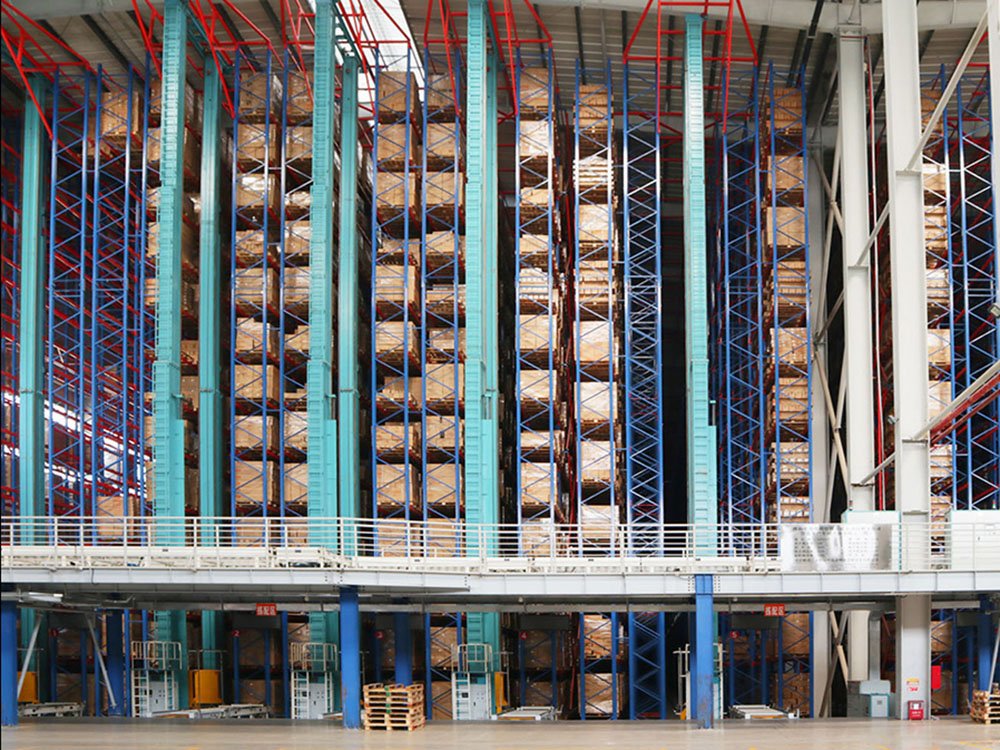
Monterrey Beverage Mega-DC — 6-Crane ASRS
Major Mexican beverage producer replaced 38-forklift selective warehouse with 6-crane unit-load ASRS. 24 m clear-height tower stores 86,000 pallet positions in same footprint as previous 26,000. Throughput 3,600 pal/hr peak. Labour cut from 78 to 18 people; payback in 38 months on labour + insurance + accuracy gains.
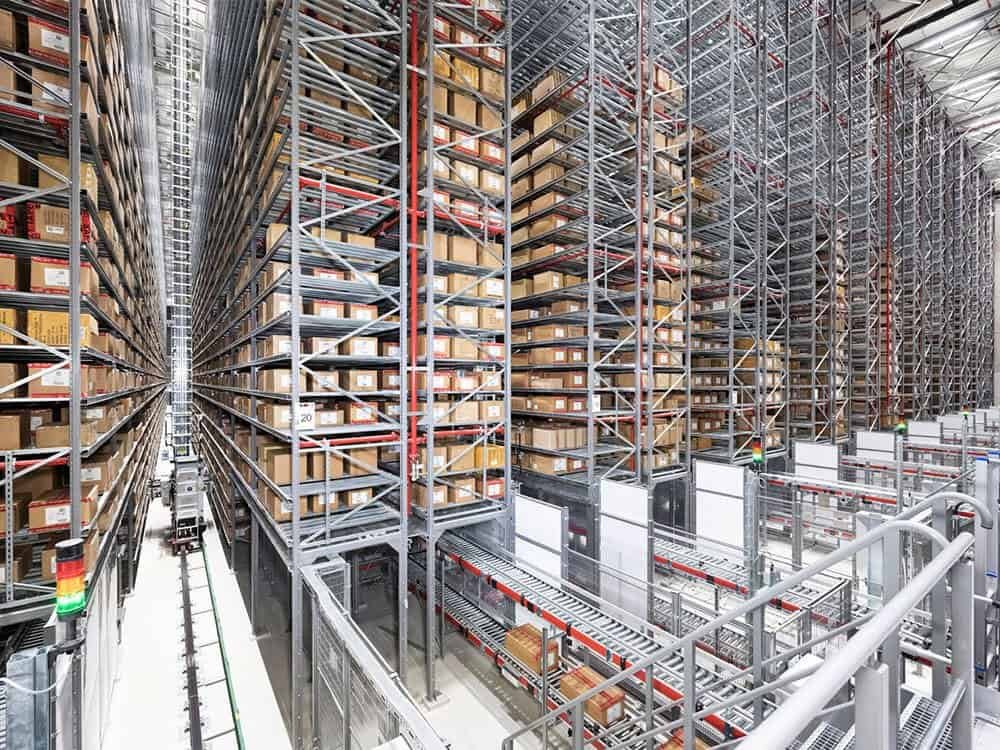
Oslo Frozen 3PL — -28°C Lights-Out ASRS
European frozen-food 3PL needed unmanned -28°C operation to eliminate cold-room worker fatigue and HSE risk. 4 cold-rated single-mast cranes, full HDG rack, sealed PLC enclosure with -30°C dry-air purge. Energy savings 42% vs incumbent forklift cold cell (no human zone heating needed). Payback in 42 months.
Mumbai Pharma DC — Mini-Load + Unit-Load ASRS
Multinational pharma DC built dual-zone ASRS: 4 unit-load cranes for pallet reserve, 8 mini-load cranes feeding pick-pack workstations. Full WMS integration with SAP EWM for batch-traceable FEFO. 99.998% pick accuracy verified at month-6 audit. Passed CDSCO + FDA + EMA audits within first year.
How AME Rack Builds ASRS — 6-Step Production Flow
Owned 15,500 m² Dongguan plant + dedicated automation engineering centre. Stacker cranes fabricated in-house with Siemens / SEW / Schaeffler premium components. Factory Acceptance Test (FAT) is non-negotiable on every project.
Rack High-Precision Fabrication
Tall uprights (15-25 m) cut on CNC lines to ±2 mm vertical tolerance — far stricter than standard rack ±5 mm. Slot pattern punched to ±0.1 mm to support crane guidance.
Stacker Crane Assembly
In-house crane fabrication: chassis welding, mast assembly, hoist motor + drive integration. Siemens S7-1500 PLC, SEW / Lenze drives, Schaeffler / NSK bearings. EN 528 + FEM 9.831 design.
Robotic Welding (Heavy Frame)
Heavy uprights and main beams welded on Panasonic / Yaskawa robotic cells. Full-penetration weld inspection per ISO 5817 Class B with 100% UT NDT on moment connections.
PLC & Software Programming
Crane motion control programmed on test bed in our automation lab. WMS interface (REST API / OPC-UA / SAP EWM) developed and customer-acceptance-tested before shipment.
Powder Coating / HDG
Standard: powder coat 80–100 μm DFT. Cold-storage: HDG 80–120 μm per ISO 1461 + cold-rated PLC enclosure with dry-air purge. Crane chassis powder-coated AME Rack orange.
Factory Acceptance Test (FAT)
Complete crane + sample rack assembled in factory for full Factory Acceptance Test before shipment. Customer engineers invited to witness — accelerates on-site SAT and reduces commissioning risk.
What to Send Us for a Same-Day Initial Sizing — B2B Procurement Checklist
Six inputs are all we need to produce an initial sizing + indicative budget within 24 hours. Detailed quotation requires Stage 1 Feasibility Study (USD 8,000, 4 weeks, credited back against PO).
Throughput Analysis
Peak-hour pallet movements (inbound + outbound + internal) at forecast peak year. ABC velocity split, daily / weekly / seasonal variation. Defines crane count.
Building Drawings & Slab
Floor plan + roof / structural drawings, clear height under steel, FM1 superflat slab survey, seismic zone, sprinkler design intent, MEP coordination.
Payload Profile
Pallet type (EUR / CHEP / US-GMA / custom), pallet weight range, footprint, height, condition. For mini-load: tote / carton dimensions, weight, accuracy required.
WMS / ERP Integration
Customer WMS / ERP platform (SAP EWM, Manhattan, Korber, Blue Yonder, Oracle JDE, custom). REST API / OPC-UA / SAP RFC interface. Real-time inventory sync needs.
Operational Schedule
24/7 vs 2/3 shift. Peak hours, dock door availability, planned maintenance windows. Drives crane redundancy and spare-parts strategy.
Compliance & Local Code
FEM 9.831 + EN 528 + EN 15512 + ISO 11393 + CE Machinery Directive. Local building code (IBC, NCh 2369, SBC, NSCP, NTC-DS, SNI 1726, TBDY 2018) + sprinkler NFPA 13.
15 Procurement Questions Buyers Ask Before Placing an ASRS Order
Answered for supply chain VPs, automation engineers, CFOs and procurement officers evaluating multi-million-dollar ASRS projects. If your question is not covered, WhatsApp Lily at +86 188 2453 7792.
01What is ASRS and how does it work?
02What throughput can a single ASRS crane achieve?
03How much does ASRS cost per pallet position?
04What is the minimum project size to justify ASRS?
05How long does an ASRS project take from PO to go-live?
06What PLC and control system do you use?
07What payment terms do you accept?
08Is your ASRS compliant with FEM 9.831 / EN 528 / EN 15512?
09What slab flatness is required?
10How do you handle cold-storage ASRS at -30°C?
11Do you integrate with SAP EWM?
12How much labour reduction do you guarantee?
13What maintenance does ASRS need?
14How much cheaper are you than European ASRS brands?
15What about after-sales support for international projects?
Ready to Spec Your ASRS Mega-DC?
Send throughput forecast, building drawings + slab survey, payload profile and WMS integration scope — receive initial sizing and indicative budget within 24 hours. For detailed engineering we run a 3-stage design package (USD 8K Feasibility + 15K Concept + 25K Detailed Engineering), all fees credited back against final PO. We engineer ASRS for Fortune 500 mega-DCs in 25+ countries.