AME Rack

🤖 Radio Shuttle Racking

Radio Shuttle Racking — Semi-Automated High-Density FIFO & LIFO Storage

The only deep-lane racking that combines 80%+ space density with true FIFO or LIFO flow. Battery-powered shuttle cart moves pallets autonomously inside lanes up to 40 pallets deep — forklift stays in cross aisle. AME Rack manufactures EN 15512 / FEM 9.831 / RMI MH16 compliant radio shuttle systems with WiFi / Bluetooth tablet control.

Pallet Shuttle RackingShuttle Rack SystemRadio Shuttle SystemSemi-Automated RackingDeep-Lane Shuttle StoragePallet Runner RackCart-Based RackingFIFO Shuttle Rack
Up to 80% density vs selective 8-hour battery / 350 cycles 10-year structural warranty
+80%DENSITY VS SELECTIVE
1.5 TPER PALLET
3–40PALLETS DEEP
45 daysSTANDARD LEAD TIME
📦 What Is This Product

Radio Shuttle — The Bridge Between Manual & Full ASRS

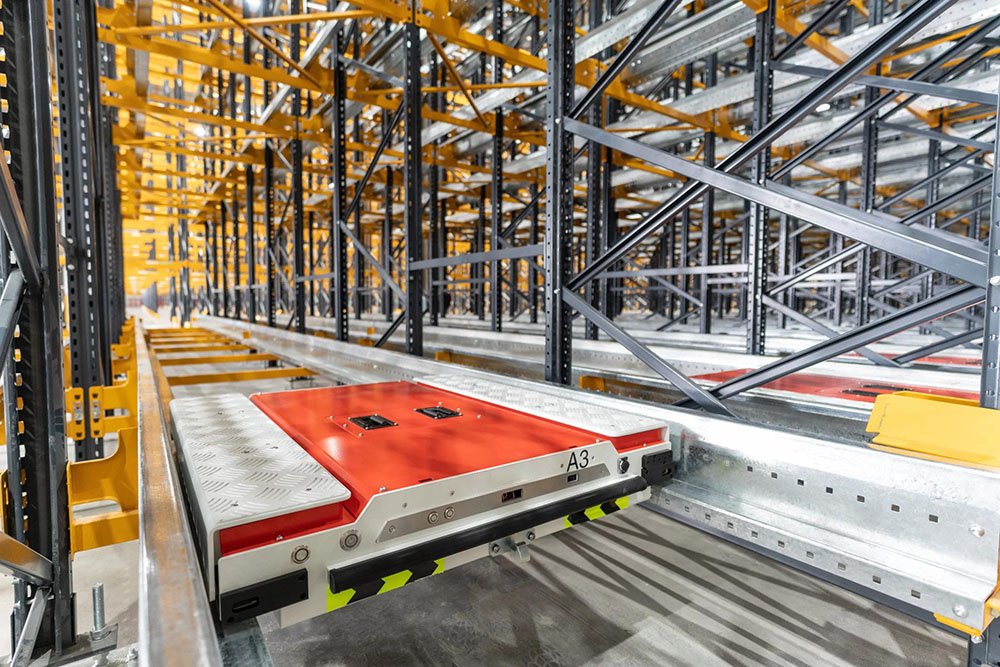
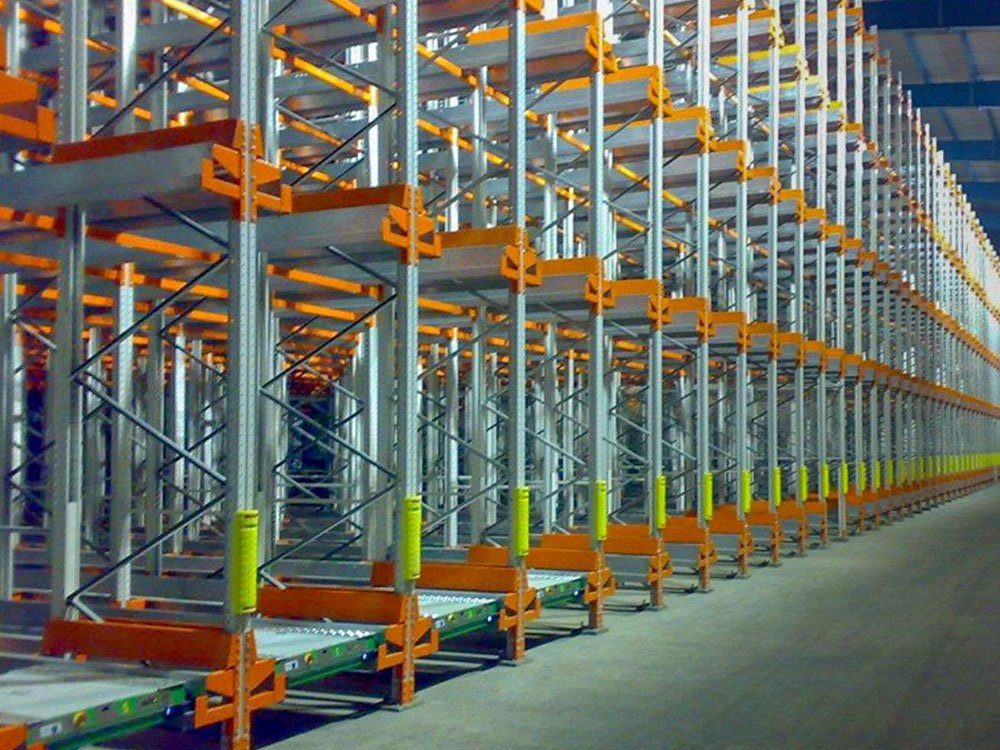
Radio shuttle racking (also called pallet shuttle racking, shuttle rack system or semi-automated racking) combines deep-lane rack frames with a battery-powered shuttle cart that moves pallets autonomously inside the lane. The forklift places a pallet at the lane entry — the shuttle carries it to the back position; reverses on retrieval. Lanes can run 3–40 pallets deep.

Operator controls the shuttle via WiFi or Bluetooth tablet from outside the rack — no forklift inside the lane, eliminating in-lane collision damage and forklift driver fatigue. Switchable FIFO (drive-through) or LIFO (drive-in) mode at the software level — one rack, two operating modes.
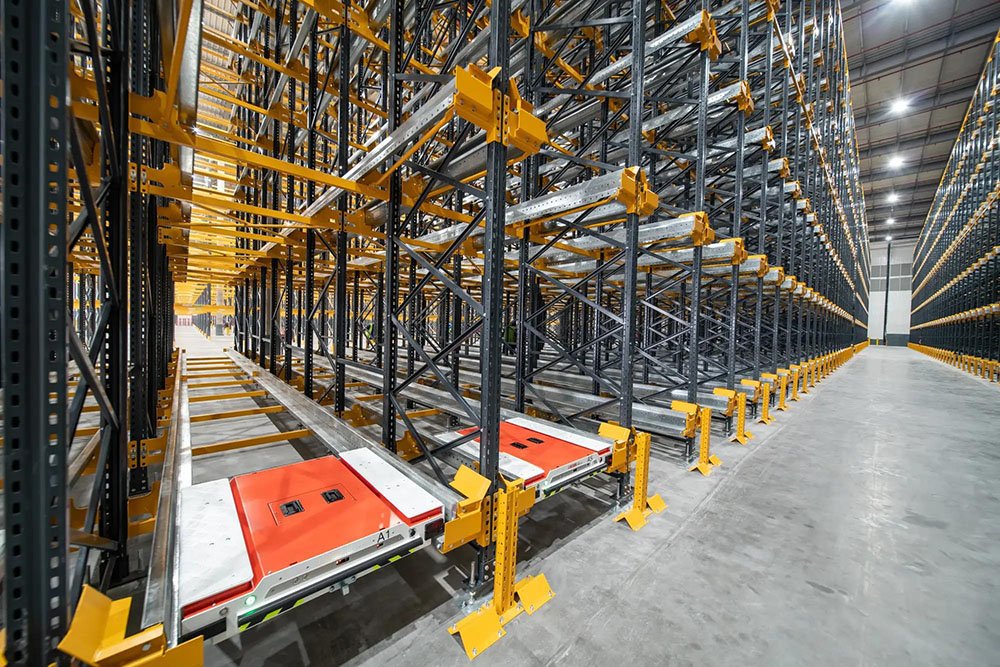
Lane Depth3 – 40 pallets per lane
FIFO or LIFOSwitchable at software level
Throughput30–60 pallets/hour per shuttle
Best For≤200 SKUs, >10 pallets/SKU
Radio shuttle cart moving pallet inside deep-lane racking
Battery shuttle moving 1.2 T pallet at 1.0 m/s inside 10-deep lane
⭐ Benefits

Why Radio Shuttle Wins for Dense + Active Storage

Eight engineering and operational advantages that explain why shuttle racking is the fastest-growing semi-automated storage category in cold-chain, beverage, FMCG and 3PL operations worldwide.

📦

Maximum Density

80%+ more pallet positions on the same floor area vs selective racking. Deeper than drive-in (40 vs 12 pallets) with no honeycomb loss penalty.

🔁

Switchable FIFO / LIFO

Same physical rack runs FIFO (drive-through) or LIFO (drive-in) — switch mode in the shuttle control software per lane or per SKU.

🚛

No Forklift In Lane

Forklift stays in cross aisle. Eliminates in-lane collision damage — typical drive-in racks lose 8–12% steel to forklift hits over 5 years; shuttle racks zero.

❄️

Cold-Storage Champion

Operator drives forklift outside the cold room cell — only the shuttle works at -30°C. Cold-rated shuttles deliver 80% energy savings vs manual deep-lane.

Fast Throughput

30–60 pallets/hour per shuttle. Multiple shuttles per system — large 3PL DCs run 8–12 shuttles in parallel for 250+ pallets/hour bay throughput.

🔋

Long Battery Life

48 V / 100 Ah LiFePO4 battery — 8-hour single-shift duty, 350 pallet cycles per charge. Swap battery in 60 seconds for 24/7 operation.

📱

WiFi / BT Tablet Control

Android tablet controls multiple shuttles. Real-time pallet count per lane, low-battery alert, fault diagnosis, ERP/WMS integration via REST API.

📐

EN 15512 / FEM 9.831

Rack frame engineered to EN 15512 + AS 4084 + RMI; shuttle conforms to FEM 9.831 plus CE Machinery Directive. Full stamped FEA on every order.

🏷️ Product Types

Three Radio Shuttle Configurations for Every Storage Profile

From standard two-way shuttle for FMCG and beverage warehouses to four-way shuttle for high-density mixed-SKU operations and cold-storage HDG shuttle for frozen DCs — match shuttle direction, drive system and finish to your operating environment.
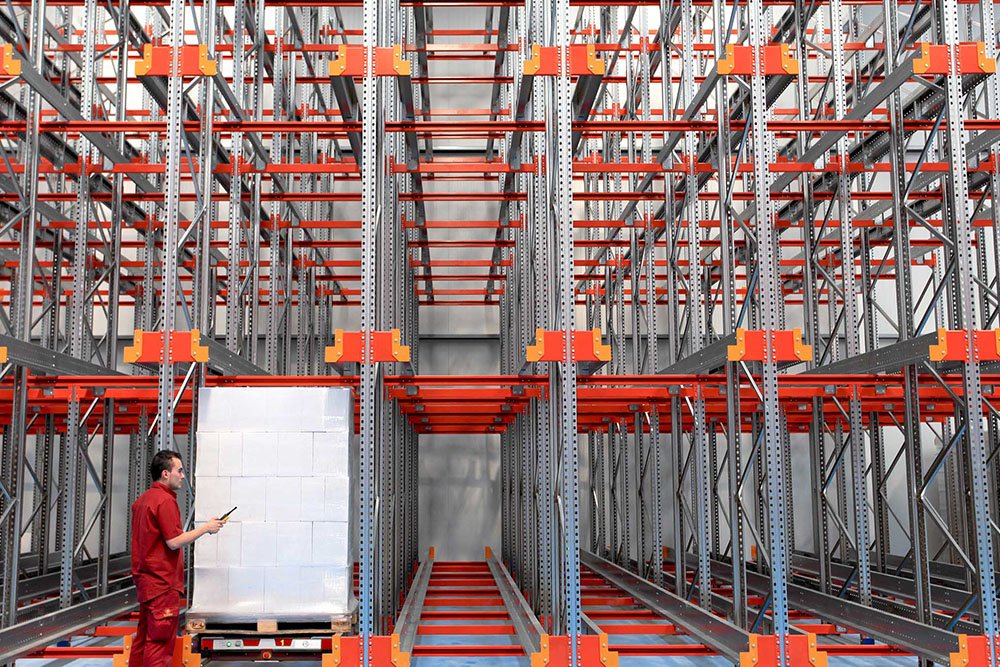
Standard two-way radio shuttle racking for FMCG and beverage warehouses

Standard Two-Way Shuttle

Battery-powered shuttle travels along a single lane axis — forklift shifts the shuttle between lanes at the cross aisle. 1,500 kg per pallet, 5–40 pallets deep, WiFi / Bluetooth tablet control. The volume seller for FMCG, beverage and general 3PL cold-chain operations.
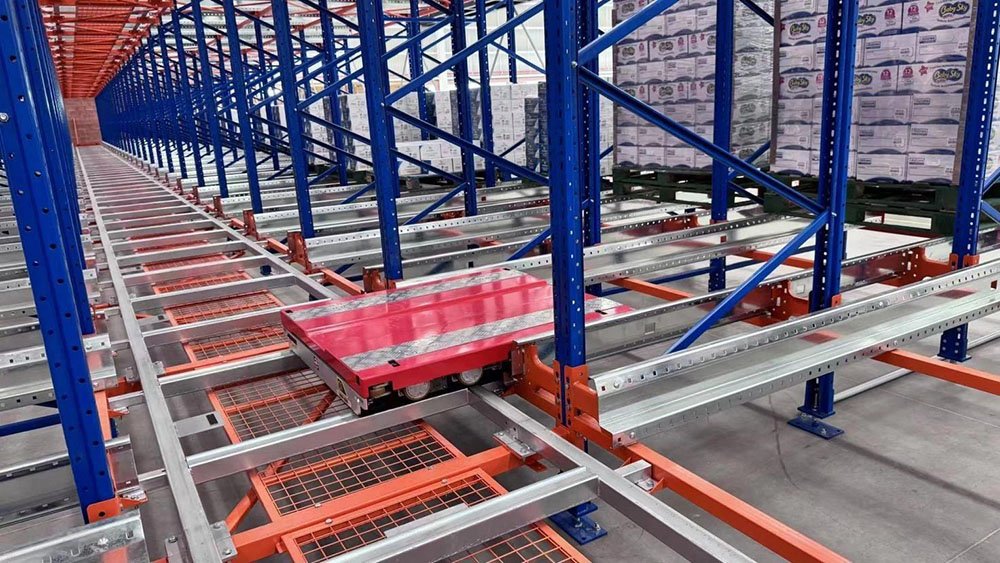
Four-way radio shuttle racking with omnidirectional drive for mixed-SKU high-density storage

Four-Way Shuttle

Omnidirectional shuttle with dual-axis drive system — moves both along and across lanes without forklift assistance. Ideal for mixed-SKU operations where every lane needs independent access. Integrates with lifts and conveyors for lights-out 3D storage grids.
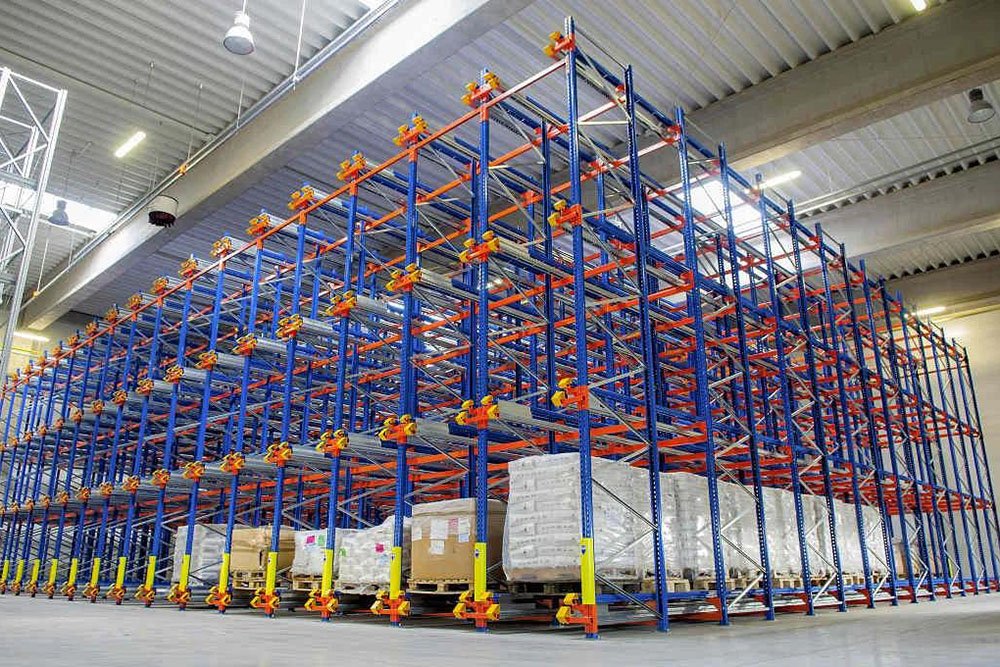
Cold-storage HDG radio shuttle racking for frozen warehouse -30°C operation

Cold-Storage HDG Shuttle

Cold-rated shuttle with -30°C low-temperature lubricant, sealed battery compartment and anti-condensation electronics. HDG 80–120 μm finish on rack structure per ISO 1461. Standard for frozen DCs, ice-cream storage, seafood 3PL and chilled pharma cold-chain operations.

📊 Specifications

Engineered Technical Parameters — 3 Standard Configurations

Standard catalogue specs across the three shuttle architectures. All parameters fully customisable — send pallet weight, temperature, lane depth target and throughput requirement for a project-specific quote.

ParameterTwo-Way ShuttleFour-Way ShuttleCold-Storage HDG
▎Application & Environment
Best ForFMCG, beverage, general 3PLMixed-SKU high-density, lights-out DCFrozen DC, cold-chain, chilled pharma
Drive DirectionSingle-axis (along lane)Dual-axis (along + across)Single-axis (along lane)
Operating Temp Range+5 to +45°C+5 to +45°C-30 to +20°C (deep-freeze to -40°C)
▎Load & Capacity
Pallet Load Capacity1,000 – 1,500 kg (2,000 kg heavy-duty option)1,000 – 1,500 kg1,000 – 1,500 kg
Lane Depth5 – 40 pallets deep5 – 40 pallets deep (any lane accessible)5 – 30 pallets deep
Rotation ModeFIFO or LIFOFIFO or LIFO (per lane)FIFO or LIFO
▎Shuttle Cart
Travel Speed (loaded)1.0 m/s1.0 m/s (both axes)0.8 m/s
Travel Speed (empty)1.2 m/s1.2 m/s (both axes)1.0 m/s
Lift Stroke40 mm hydraulic40 mm hydraulic40 mm hydraulic LT
Battery Type48 V / 100 – 150 Ah LiFePO448 V / 150 Ah LiFePO448 V / 100 Ah cold-rated LiFePO4
Battery Duty Cycle8 hr / 350 pallets7 hr / 300 pallets6 hr / 250 pallets
Throughput (single shuttle)30 – 60 pallets/hr40 – 80 pallets/hr25 – 45 pallets/hr
Shuttle Weight360 – 460 kg480 – 560 kg390 kg
▎Rack Structure
Upright Profile100 × 80 × 2.0 – 2.5 mm120 × 95 × 2.5 mm100 × 80 × 2.5 mm
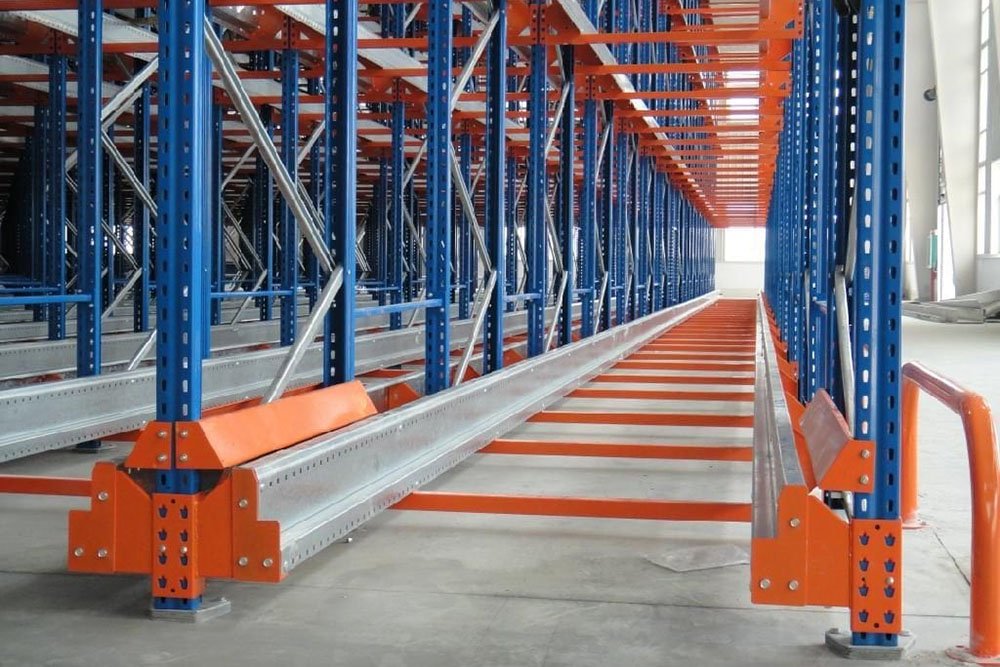
Rail ProfileC 100×60×5 mmC 120×60×6 mm (2-axis rail grid)C 120×60×6 mm HDG
Steel GradeQ235B / Q345BQ345B / S355JRQ345B (-40°C Charpy impact)
Surface FinishPowder coat 80 μmPowder coat 100 μmHDG 80 – 120 μm per ISO 1461
▎Control & Integration
Control MethodWiFi tabletWMS-driven + WiFi tablet backupWiFi + Bluetooth backup
WMS IntegrationREST APIREST API + OPC-UAREST API
Automation ReadyManual forklift shiftLifts & conveyors integrationManual forklift shift
▎Commercial
ComplianceEN 15512 · FEM 9.831 · RMI MH16EN 15512 · FEM 9.831 · CE MachineryEN 15512 · FEM 9.831 · ISO 1461
Corrosion Warranty3 years3 years15 years (HDG)
Lead Time40 – 45 days50 – 60 days50 – 55 days
FOB Price (USD/shuttle)$ 18,500 – 26,000$ 32,000 – 45,000$ 24,000 – 32,000
📌 Engineering Note: The shuttle is a separate purchase from the rack frame. Typical project ratio is 1 shuttle per 8–12 lanes for two-way and cold-storage; 1 shuttle per 15–25 lanes for four-way (higher throughput per unit). You can start with fewer shuttles and add as throughput grows. Rack frame quoted separately at USD 85–145 per pallet position.
🔩 Components

Every Shuttle, Rail and Sensor — Engineered as One System

Ten core components engineered, manufactured and tested under one roof at AME Rack's 15,500 m² Dongguan plant. Shuttle PLC and battery management software developed in-house — full source-code escrow option for enterprise customers.

01

Shuttle Cart Chassis

Welded steel chassis with 4-wheel drive, hydraulic lift table, on-board PLC, WiFi module, 360° proximity sensors, emergency stop button on top + side.

02

LiFePO4 Battery Pack

48 V × 100–150 Ah lithium iron phosphate battery — 350+ pallet cycles per charge, 3,000+ charge cycles service life, hot-swap in 60 seconds.

03

WiFi Tablet Controller

10-inch Android tablet pre-loaded with shuttle control app. Manages multiple shuttles, displays lane occupancy, battery status, error codes.

04

Rack Upright Frame

EN 15512 double-leg upright at 100 × 80 mm to 120 × 95 mm box section, Q345B steel for -40°C Charpy at -30°C below.

05

Shuttle Running Rail

C-channel 100 × 60 × 5 mm or 120 × 60 × 6 mm rail bolted to inside face of upright at every pallet level. Wheel-running surface precision-ground.

06

Pallet Support Rail

Standard cantilever rail above shuttle rail — pallet sits on cantilever rail when shuttle lifts and lowers underneath for transport.

07

End-of-Lane Stop

Mechanical stop at the rear of each lane prevents shuttle and pallet from over-travelling. Soft-rubber faced for impact absorption.

08

Lane Entry Sensor

Inductive proximity sensor reads shuttle position at lane entry — triggers lift table activation and forklift "OK to load" signal light.

09

Battery Charger Station

48 V intelligent fast charger — 80% charge in 90 min, full in 2.5 hr. Wall-mounted with 4 spare-battery slots for hot-swap operations.

10

Cross-Aisle Carriage

Optional transfer cart on rails — moves shuttle laterally between multiple lanes. Cuts shuttle fleet count by 60–70% for slow-mover zones.

🏢 Applications

Where Radio Shuttle Delivers Maximum ROI

Eight industries where shuttle racking outperforms drive-in, push-back and full ASRS.

❄️

Cold Storage / Frozen

-25°C and -40°C deep-freeze, operator outside the cold cell.

🥤

Beverage / FMCG

High-throughput bulk SKUs, FIFO batch rotation for dated stock.

🛒

3PL & E-commerce

Multi-client buffer with switchable FIFO/LIFO per lane.

💊

Pharmaceutical

GMP / FDA batch FIFO with full traceability via WMS integration.

🏭

Manufacturing Buffer

Production line WIP buffer between filling/packing and despatch.

🍔

Food Production

HACCP-compliant FIFO for ingredient and finished-product storage.

🛞

Tyre Storage

High-density tyre bulk storage, gentle pallet handling, no rolling.

📦

Building Materials

Brick, tile, plasterboard — heavy-duty 2 T shuttle for ceramics.

📐 Design Guide

How to Specify a Radio Shuttle System in 3 Decisions

Lane depth, shuttle fleet sizing and throughput per lane drive 85% of total radio shuttle project cost and ROI. Get these three right before signing PO.

1

Lane Depth — Density vs Throughput

Deeper lanes give more density but slower retrieval of the last pallet. Shuttle racks scale up to 40 deep — but most projects optimise at 10–20 deep.

  • 3–8 deep — moderate density, fast cycles
  • 10–15 deep — sweet spot for FMCG / cold
  • 16–25 deep — high density, slower retrieval
  • 26–40 deep — frozen seasonal stock only
2

Shuttle Fleet Sizing

Calculate per-hour pallet moves needed at peak then divide by single-shuttle capacity (allow 25% spare). Always start lean and add shuttles as throughput grows.

  • 30–60 pallets/hr per ambient shuttle
  • 25–45 pallets/hr per cold shuttle
  • Cross-aisle carriage = 60% fewer shuttles
  • Spare shuttle for every 4 active
3

FIFO or LIFO — Per Lane or Mixed

The shuttle handles either mode via software — physical rack is identical. But cross-aisle layout differs: FIFO needs entry + exit aisles, LIFO single aisle.

  • FIFO single mode — 2 cross aisles needed
  • LIFO single mode — 1 cross aisle, denser
  • Mixed per lane — 2 aisles, software toggle
  • Dated SKUs → always FIFO
📊 Lane Depth × Throughput Trade-Off (single 1.5T ambient shuttle)Picking deeper saves space but slows the worst-case retrieval cycle
Lane DepthDensity vs SelectiveAvg Cycle TimeWorst-Case RetrievalBest Use Case
5 deep+45%90 sec3 minMixed FMCG, fast SKU rotation
10 deep+62%120 sec5 minFMCG, beverage, dairy FIFO
15 deep+72%150 sec8 minCold storage, beer, dry FMCG
25 deep+78%240 sec14 minFrozen, slow-mover bulk
40 deep+82%360 sec22 minSeasonal frozen mega-SKU only
📌 Engineering Tip: Most successful shuttle projects optimise at 10–15 pallets deep — sweet spot between density gain and cycle time. AME Rack provides free 3D AutoCAD layout + throughput simulation (Excel + Arena models) with every quote — verify your peak-hour scenario before signing PO.
⚖️ Comparison

Radio Shuttle vs Drive-In / Push-Back / ASRS / Selective — Honest Pros & Cons

Which dense pallet storage solution is right for your warehouse? Compare on density, FIFO support, capex, throughput, forklift impact and reconfigurability.

FactorRadio ShuttleDrive-InPush-BackSelectiveMini-Load ASRS
Storage Density★★★★★★★★★★★★★★★★★★★★★★★
FIFO Capability★★★★★★★★★ LIFO★★★★ LIFO★★★★★★★★★★
Throughput per Lane30–60 pal/hr10–20 pal/hr15–30 pal/hr20–35 pal/hr120–180 pal/hr
Capex per Position$$$ Mid-high$$ Low$$$$ High$ Lowest$$$$$ Very high
Forklift Impact RiskNone (outside)High (in-lane)LowMediumNone
Cold-Storage Fit★★★★★★★★★★★★★★★★★★★★★★★★★
Reconfigurability★★★★★★★★★★★★★★★★★★★★★★★
Best ForFIFO + max density, coldLIFO bulk single-SKU4–6 pallet LIFO mixMixed SKU, <500/SKU≥200,000 cases/day
✅ Pick Shuttle When…

FIFO + density + cold storage

You need true FIFO, want 70%+ density gain, store in chilled or frozen environment, or want zero forklift impact damage. ROI 18–36 months vs drive-in.

↔️ Pick Drive-In When…

Pure LIFO bulk, capex constrained

If LIFO is fine and budget is tight, drive-in delivers 90% of the density at 40% of the cost — no shuttle technology. Best for non-dated bulk SKUs.

⚠️ Skip Shuttle When…

Throughput > 250 pallets/hr/bay

At extreme throughput, even 8 shuttles in parallel can't match a stacker crane. Move directly to mini-load or unit-load ASRS — higher capex, much faster.

🔁 Shuttle + Selective Combo

3PL and cold DCs do this

Shuttle for top-20% volume SKUs (dense bulk), selective for the long-tail (case-pick). 60% density gain across the building with full SKU coverage.

📍 Case Studies

Real Radio Shuttle Installations Around the World

Three recent projects across three continents — frozen 3PL, beverage producer, and pharma FIFO DC. Each shows rack mix, shuttle fleet, building geometry, lead time and verified ROI.
🇳🇱 NetherlandsRotterdam frozen 3PL radio shuttle racking

Rotterdam Frozen 3PL — -28°C Shuttle DC

5,200 m² · 6 cold shuttles · 11 m height · NEN-EN 15512 + seismic

European cold-chain operator converted legacy drive-in to radio shuttle for a global QSR client. 15-pallet-deep lanes, HDG rack frame, -30°C-rated shuttles with hot-swap battery system. Forklift drivers stay in 5°C cross aisle — full -28°C cold cell sealed except for shuttle entry. Energy savings 24% vs previous drive-in.
3,600Pallet pos.
52 daysFOB lead
-24%Cooling kWh
🇧🇷 BrazilSao Paulo beverage radio shuttle racking

São Paulo Beverage Producer — High-Throughput FIFO Buffer

3,800 m² · 4 standard shuttles + cross-aisle carriage · 8 m height · ABNT NBR 15512

Soft-drink bottler needed strict FIFO between filling line and despatch. 12-pallet-deep lanes, 4 ambient shuttles plus one cross-aisle transfer carriage. Throughput 220 pallets/hr at peak. Cuts pallet-loss-to-shelf-life by 92% — measurable inventory write-off saving USD 380K/year.
2,200Pallet pos.
45 daysFOB lead
-92%Shelf-life loss
🇮🇳 IndiaMumbai pharmaceutical radio shuttle racking

Mumbai Pharmaceutical DC — GMP FIFO Shuttle

6,400 m² · 3 standard shuttles · 7.5 m height · NDMA IS 1893 seismic + GMP

Generic pharma manufacturer needed batch-traceable FIFO for finished goods. 10-pallet-deep lanes, 3 ambient shuttles, REST API integration with SAP ECC for batch ID validation at lane entry. Audit-trail logs every pallet move with timestamp + operator ID. Passed first FDA audit 14 days post-commissioning.
5,000Pallet pos.
48 daysFOB lead
100%FDA audit pass
🏭 Manufacturing

How AME Rack Builds Radio Shuttle Systems — 6-Step Production Flow

Owned 15,500 m² Dongguan factory. Rack frame and shuttle cart engineered as one integrated system. PLC control software developed in-house — full source-code escrow available for enterprise customers.

Step 1 🛠️

Rack CNC Punching & Cutting

4 high-speed CNC lines cut uprights, rails and bracing from 2.0–2.5 mm Q345B coil. Tolerance ±0.15 mm. Shuttle running rail precision-ground after roll-form for wheel-track flatness within ±0.5 mm.

Step 2 🌀

Roll-Forming & Welding

Dedicated roll-forming lines for upright sections, cantilever pallet rails, and shuttle running rails. Robotic MIG welding for upright frame assembly. ISO 5817 Class B weld inspection 100%.

Step 3

Shuttle Chassis Welding

Shuttle steel chassis CNC-cut, robotically welded, machined for wheel-axle alignment within ±0.3 mm. Hydraulic lift table assembled and pressure-tested at 1.5× rated load.

Step 4 🔋

Electronics & Battery

PLC control board sourced from Siemens / Mitsubishi, WiFi module integrated and certified per CE EMC + FCC Part 15. LiFePO4 battery from CATL / EVE, BMS programmed and cycle-tested.

Step 5 🎨

Powder Coat / HDG Finish

Rack frame: powder coat 60–100 μm DFT or HDG 80–120 μm per ISO 1461 for cold-storage. Shuttle: powder coat AME Rack orange chassis, stainless wheel covers, anti-corrosion electronics enclosure IP65.

Step 6 📦

System Test, Burn-In & Loading

Every shuttle 48-hour burn-in test (1,000 pallet cycles) before crate-pack. Tablet pre-programmed with customer lane layout. Rack frame + shuttle ship in separate containers — rack 1,200–1,500 positions/40HQ, shuttle 6–8 units/40HQ.

15,500 m²Owned factory
48 hrShuttle burn-in
1.5×Lift load tested
45 daysStandard lead
📋 Buying Guide

What to Send Us for a Same-Day Quote — B2B Procurement Checklist

Six inputs are all we need to size a complete radio shuttle system (rack + shuttles + control). Send what you have — a hand-drawn floor sketch plus pallet inventory list is enough to start.

01

Building Drawings

Floor plan with column locations, clear height under steel/roof, slab thickness (≥200 mm reinforced concrete), seismic zone, ambient / chilled / frozen boundary.

02

Pallet & SKU Profile

Pallet dimensions, gross weight (kg), pallet type (EUR/US/CHEP), active SKU count, average pallets per SKU, daily inbound/outbound pallet count, peak hour multiplier.

03

Temperature Profile

Ambient, chilled 2–8°C, frozen -25°C, deep-freeze -40°C, ultra-low -70°C. Defines shuttle spec (standard / cold-rated / deep-freeze) and rack finish (powder vs HDG).

04

Access Mode & Throughput

FIFO (drive-through) or LIFO (drive-in) or both? Peak-hour pallet moves needed determines shuttle fleet size and whether cross-aisle carriage required.

05

WMS / ERP Integration

SAP, Oracle, Manhattan, Blue Yonder, custom WMS? REST API or OPC-UA needed? Batch ID validation at lane entry? Real-time inventory sync requirement.

06

Compliance Code

EN 15512 (EU rack) + FEM 9.831 (shuttle), AS 4084 (AU/NZ), RMI MH16 (US/Canada). Shuttle CE Machinery Directive 2006/42/EC. Local seismic & food-safety code.

❓ FAQ — B2B Procurement

15 Procurement Questions Buyers Ask Before Placing a Radio Shuttle Order

Answered for supply chain heads, facility managers, automation engineers and procurement officers comparing 3–5 shuttle racking suppliers. If your question is not covered, WhatsApp Lily at +86 188 2453 7792.

01What is a radio shuttle racking system and how does it work?
Radio shuttle racking (also called pallet shuttle racking, shuttle rack system or semi-automated racking) combines deep-lane rack frames with battery-powered shuttle carts that move pallets autonomously inside the lane. The forklift drops a pallet at the lane entry; the operator commands the shuttle via WiFi tablet to carry the pallet into the lane. Retrieval reverses the process. Forklift never enters the lane — eliminating in-lane collision damage.
02What is the difference between radio shuttle, drive-in, and ASRS?
Drive-in requires the forklift to drive inside the lane (LIFO only, no FIFO, high in-lane damage). Radio shuttle uses an autonomous battery cart (FIFO and LIFO supported, no forklift in lane, 80% density). Mini-load or unit-load ASRS uses fixed stacker cranes on rails (highest throughput, lights-out automation, 5–10× capex of shuttle). Shuttle is the sweet spot between drive-in capex and ASRS automation.
03Can the same shuttle racking run both FIFO and LIFO?
Yes — this is the killer feature. The physical rack is identical for both modes. You select FIFO (drive-through) or LIFO (drive-in) at the software level in the shuttle controller, per lane and per SKU. FIFO requires entry + exit cross aisles (2 aisles); LIFO needs only 1 cross aisle. Mixed-mode racks support both with 2 aisles and software toggle.
04What is the maximum lane depth?
Standard catalogue supports 3 to 40 pallets per lane. Most successful projects optimise at 10–15 pallets deep — the sweet spot between density gain and cycle time. Beyond 25 deep, retrieval cycle time exceeds 6 minutes, which only suits seasonal frozen mega-SKU storage. We will simulate your peak-hour scenario before signing PO.
05What is the throughput per shuttle?
Standard ambient shuttle: 30–60 pallets per hour depending on lane depth. Cold-storage shuttle (-30°C): 25–45 pallets/hr. Deep-freeze shuttle (-40°C): 20–35 pallets/hr. For higher per-lane throughput, add a second shuttle to the same lane group, or add a cross-aisle transfer carriage to share shuttles across lanes.
06How long does the battery last per charge?
48 V × 100 Ah LiFePO4 battery: 8 hours / 350 pallet cycles per charge in ambient operation, 6 hours / 250 cycles at -30°C, 5 hours / 200 cycles at -40°C. Battery hot-swap takes 60 seconds — enables true 24/7 operation with one spare battery per shuttle. Full charge time 2.5 hours via 48 V intelligent fast charger.
07Are the shuttles cold-storage rated?
Yes — three variants: standard ambient (+5 to +45°C), cold-storage (-30 to +20°C) with low-temperature lubricant and sealed battery compartment, and deep-freeze (-40 to +20°C) with -40°C-rated LiFePO4 cells and anti-condensation electronics enclosure (IP65). Frame finish HDG 80–120 μm for chilled or below.
08Can the shuttle integrate with our WMS / SAP?
Yes. Standard REST API for WMS communication (lane occupancy query, pallet move command, error code feedback, real-time inventory sync). Optional OPC-UA for industrial automation integration. We have integrated with SAP EWM, Manhattan, Blue Yonder, Manhattan SCALE, Korber, and dozens of custom WMS. Provide your WMS API documentation at quote stage.
09What is the MOQ for a radio shuttle project?
Minimum viable project is one 40HQ rack frame (1,200–1,500 pallet positions) + 1 shuttle. Total project floor USD 75,000–110,000 depending on temperature and lane depth. Smaller pilot projects accepted but unit pricing is 18–25% higher. We can also quote rack-only and shuttle-only separately if you already own one or the other.
10How long is the lead time from PO?
Standard ambient system: 45 days after deposit received (rack frame 25 days + shuttle 45 days, parallel production). Cold-storage variant: 50 days (HDG dip cycle adds 5 days). Deep-freeze -40°C: 55 days (cold-cell-rated battery has longer supplier lead time). Shipping by sea adds 28–45 days depending on destination.
11What payment terms do you accept?
Standard: 30% T/T deposit on PO confirmation, 70% balance against B/L copy before vessel sails. Alternative: 100% irrevocable L/C at sight from a top-50 bank. For enterprise customers with 3+ orders, OA 30/60 against credit insurance (Sinosure / Coface) available.
12Is your shuttle racking compliant with EN 15512 / FEM 9.831 / RMI MH16?
Yes. Rack frame engineered to EN 15512 + AS 4084 + RMI MH16; shuttle conforms to FEM 9.831 (shuttle-specific standard) plus CE Machinery Directive 2006/42/EC. Battery certified UN 38.3 for air freight, IEC 62133 for safety. Stamped FEA reports run in RFEM 5 / ETABS provided on request.
13Do you provide on-site commissioning?
Yes — optional. USD 350/day + travel/visa, typically 5–10 days for a 20-lane system. Includes shuttle setup, WMS REST API integration testing, operator training (2 days), and a 1,000-pallet acceptance test. For multi-site rollouts we offer a fixed-price commissioning package — quote on request.
14What spare parts should I keep on hand?
Recommended ex-stock inventory for every 4 active shuttles: 1 spare battery pack, 1 set of drive wheels (4 units), 1 PLC controller board, 1 WiFi module, 2 proximity sensors. Total spare-pack USD 4,800. We carry these ex-stock in our Shenzhen depot — air freight delivery within 5 days globally.
15How much cheaper are you than European brands?
For equivalent EN 15512 + FEM 9.831 spec, AME Rack direct factory pricing is typically 35–50% below European brand-name suppliers (Stow-Atlas Copco, AR Racking, Mecalux, SSI Schäfer Orbiter) for a comparable rack + shuttle bundle. We own the 15,500 m² plant outright, develop shuttle firmware in-house, and procure CATL/EVE batteries via direct contracts.

Ready to Spec Your Radio Shuttle Project?

Send building dimensions, pallet spec, temperature profile, peak-hour throughput and WMS integration needs — receive a 3D AutoCAD layout, stamped FEA report, throughput simulation, full BOM (rack + shuttles + control) and FOB quotation within 4 working hours. Zero commitment, English / Spanish / French / Arabic available.

🤖 48 hr shuttle burn-in📐 Free throughput simulation🛡️ 10/2/5-yr rack/shuttle/battery🌍 Shipped to 65+ countries

Get a free quote quickly

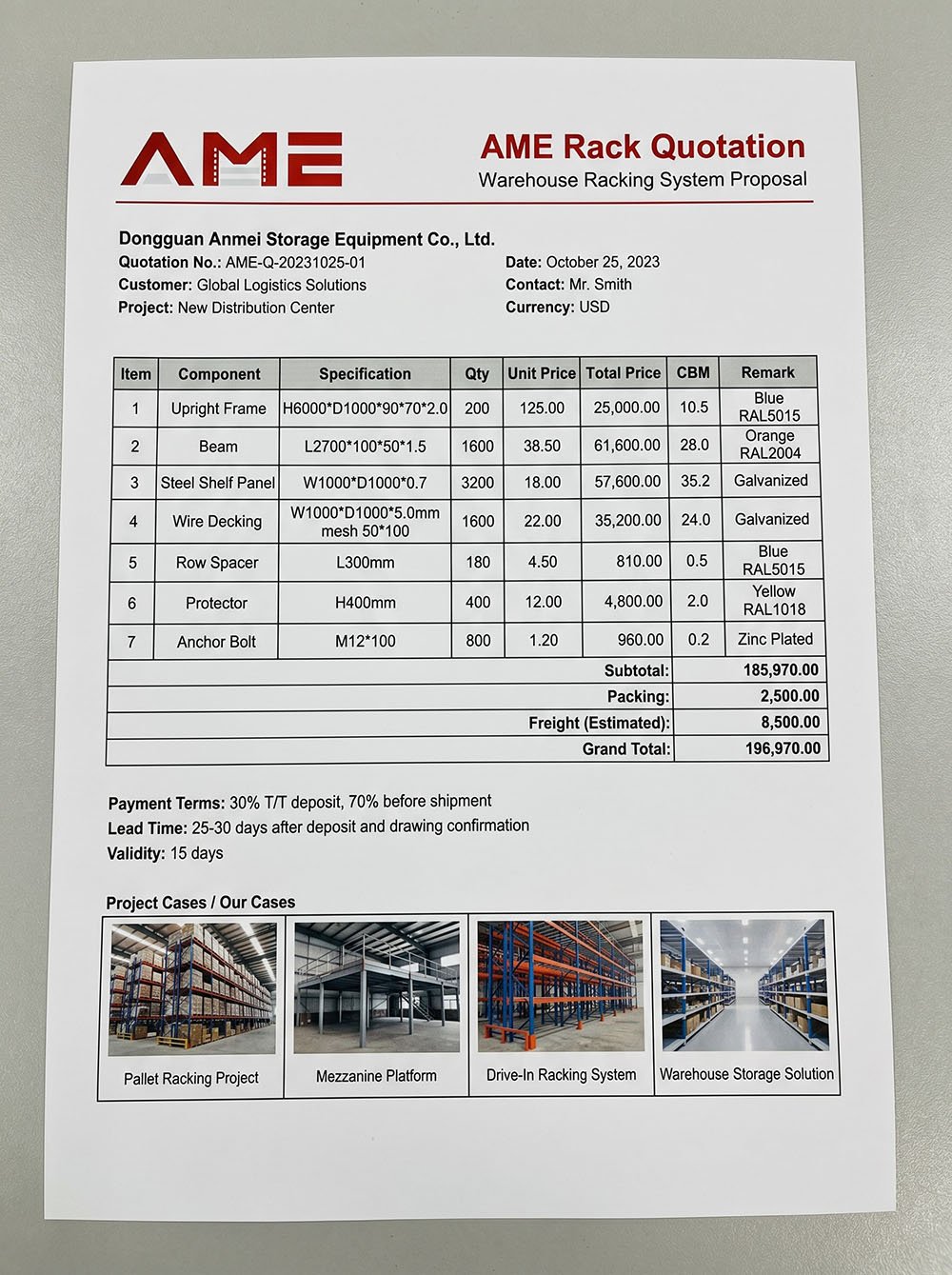
AME Rack quotation