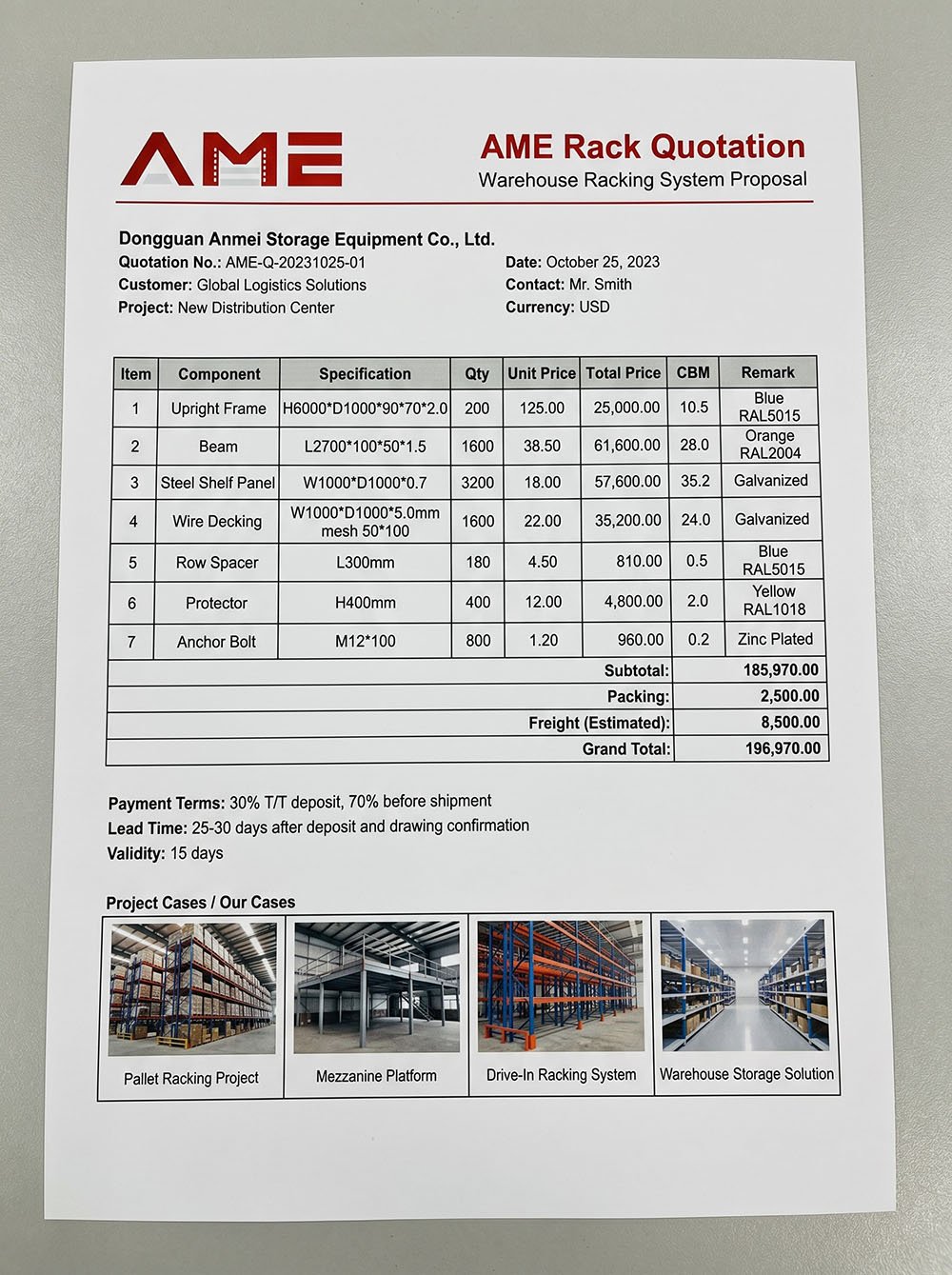
Drive-In & Drive-Through Pallet Racking — Maximum Density for Bulk Single-SKU Storage
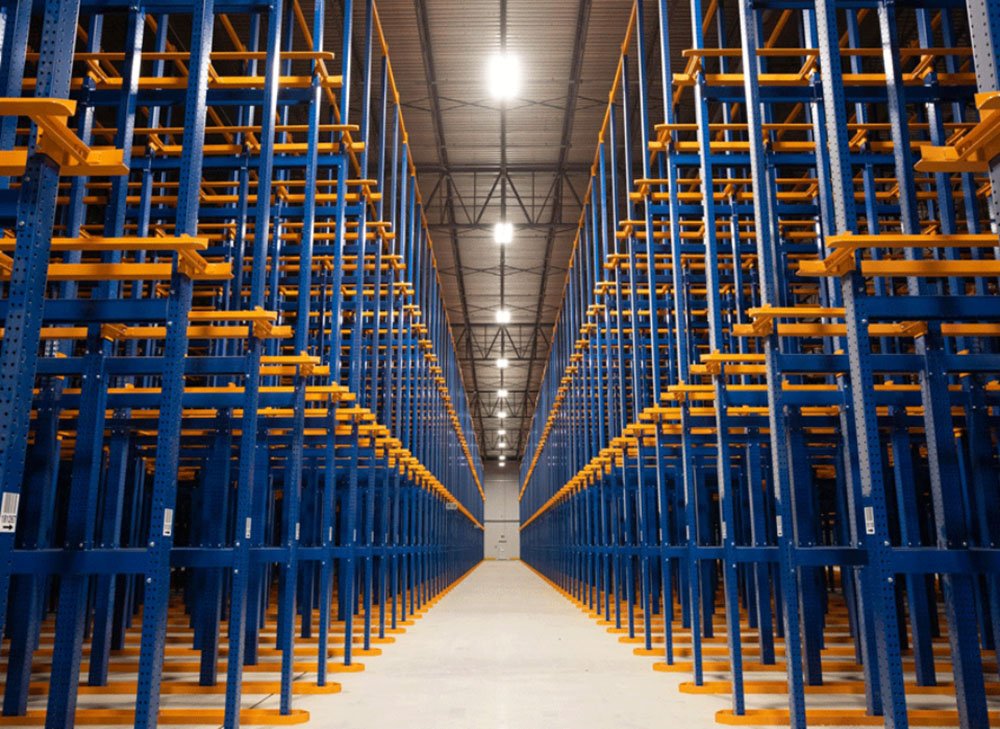
Up to 75% denser than selective pallet rack. Forklifts drive directly into the lane to deposit or retrieve pallets — perfect for cold storage, beverage, dairy, frozen food and FMCG buffer stock. AME Rack manufactures EN 15512 / FEM 10.2.07 / RMI MH16.3 compliant systems exported to 65+ countries.
Drive-In Racking — The Densest Forklift-Accessible Pallet Storage
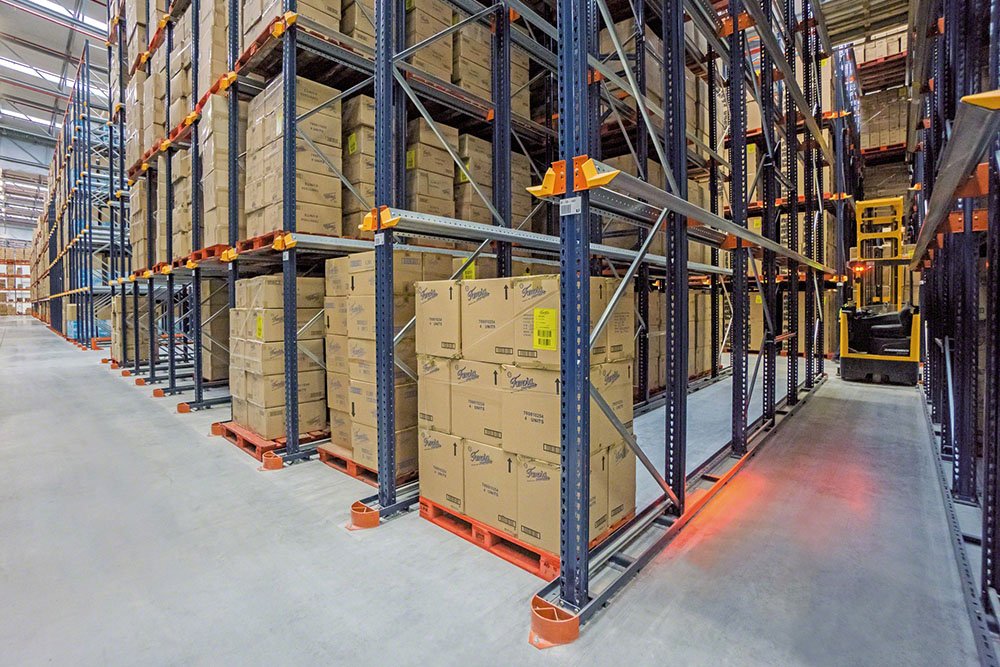
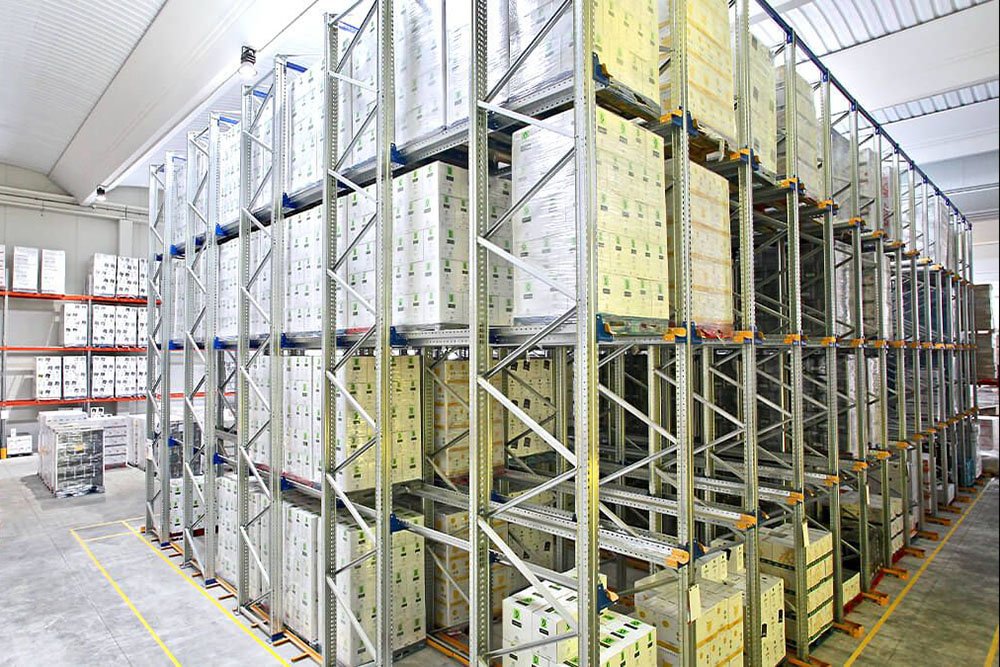
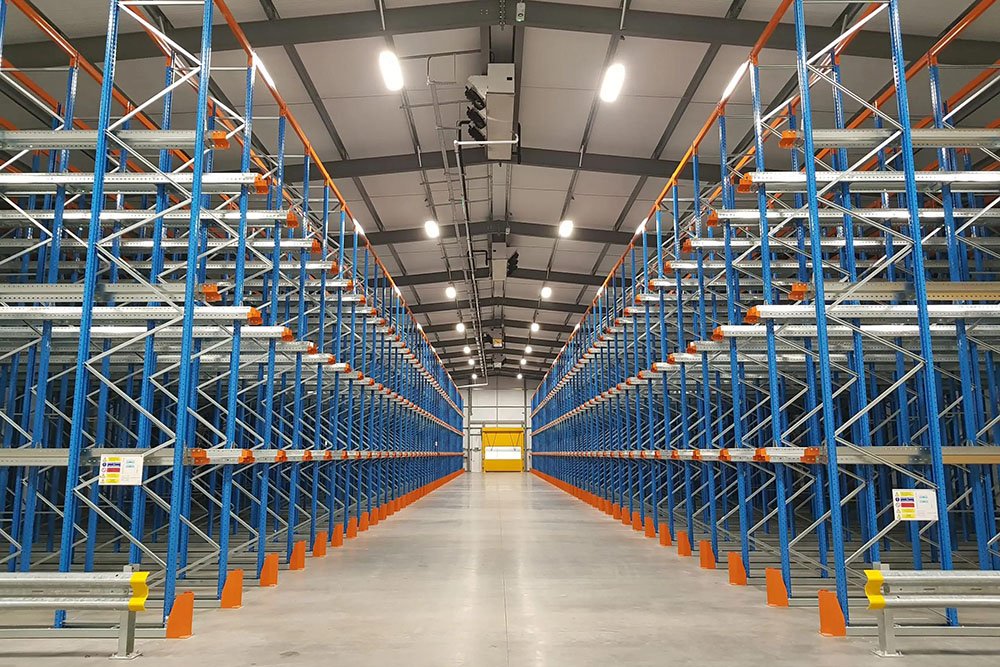
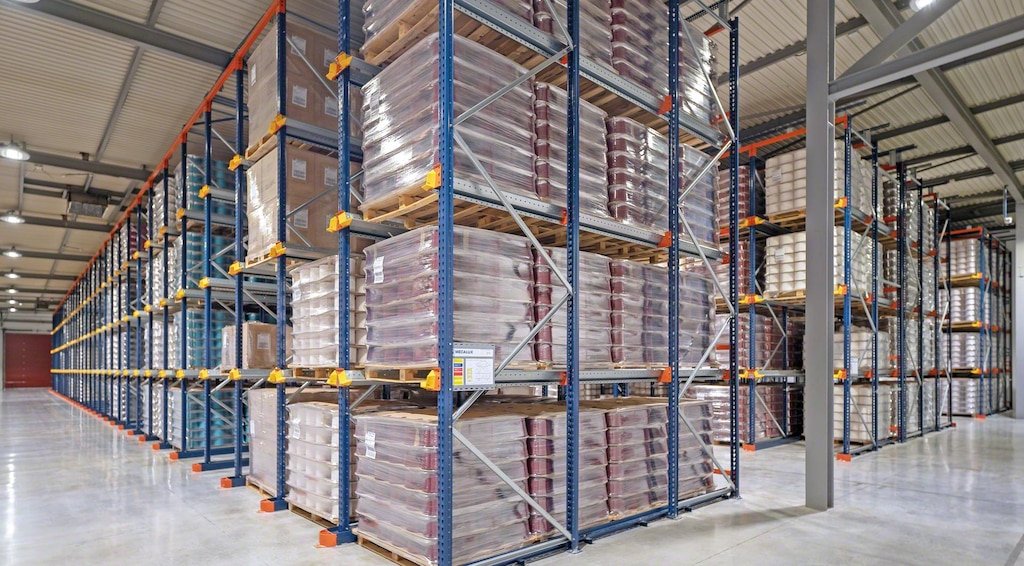
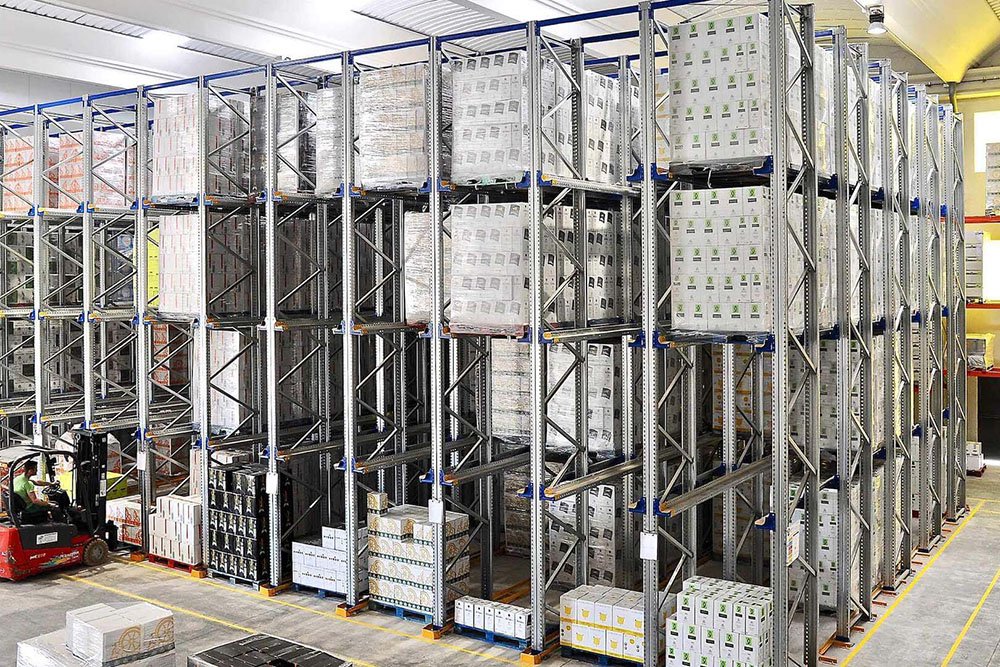
Drive-in pallet racking eliminates picking aisles. Forklifts drive directly inside the rack lane on continuous support rails to deposit pallets onto cantilever arms — LIFO (last-in, first-out) operation. Drive-through racking opens both ends of the lane, allowing FIFO operation when paired with separate load and unload aisles.
Best deployed when one SKU fills an entire lane and pick-face selectivity is not required: typically frozen food, dairy, beverage, paint, tyre and dry-bulk FMCG with high inventory turnover but low SKU count (under 50 SKUs in the racking zone).
Why Drive-In Racking Wins for Bulk Single-SKU Storage
Eight engineering and operational advantages that explain why drive-in / drive-through racking is the standard solution in cold-chain, beverage and FMCG distribution centres worldwide.
Maximum Density
Up to 75% more pallet positions on the same floor area vs selective racking. Best $/pallet position economy.
Cold-Storage Optimised
Smaller chilled / frozen volume to refrigerate — typical 30–45% energy saving vs selective layout in -25°C rooms.
Standard Forklifts
Works with any counterbalance or reach truck — no specialised VNA or shuttle equipment needed.
LIFO Buffer Storage
Perfect for raw-material buffers, seasonal stock, and beverage / FMCG bulk SKUs where rotation order is not critical.
FIFO Drive-Through
Open both ends of the lane to convert LIFO into FIFO — required for dairy, fresh produce and pharma batch traceability.
Heavy Frame Design
Reinforced uprights, double-leg upright frames, full-length guide rails and column protectors withstand daily forklift impact.
EN 15512 / MH16.3
Engineered to EN 15512, FEM 10.2.07, AS 4084 and RMI MH16.3 — stamped FEA calculation provided on every order.
Global Shipping
Compact disassembled bundling — average 1,500–1,800 pallet positions per 40HQ container.
Three Drive-In Racking Configurations for Every Application
From standard LIFO drive-in for beverage warehouses to drive-through FIFO for dairy and HDG cold-storage rooms — all three variants share the same engineered upright/rail system, differing in access mode and finish to match your operation.

Standard Drive-In (LIFO)
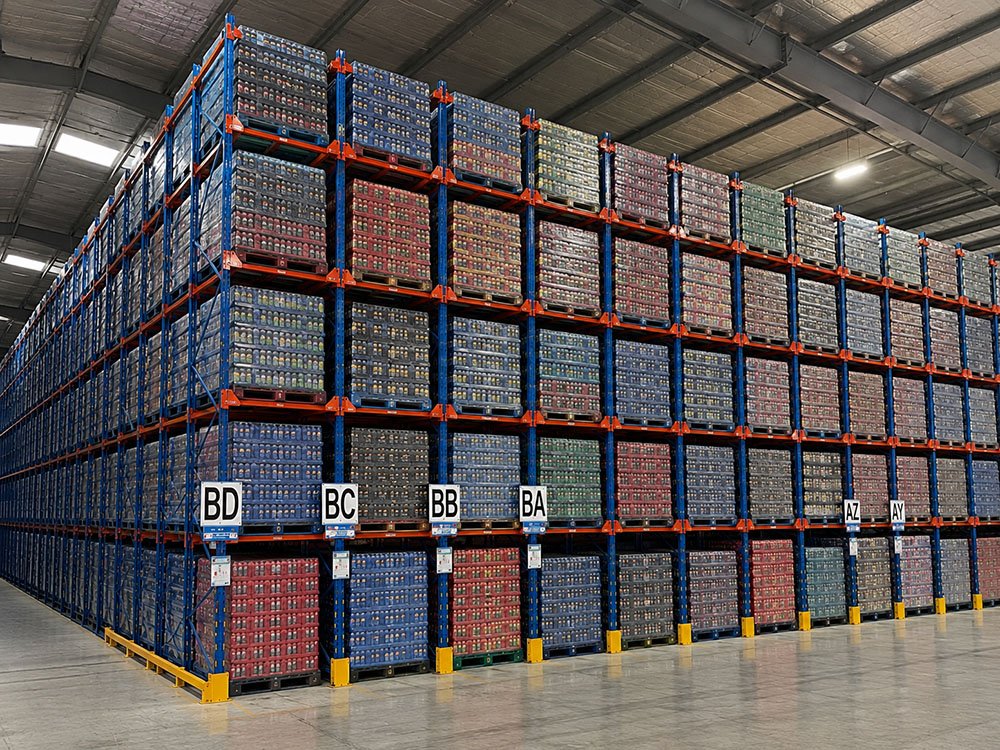
Single entry/exit per lane. Forklift loads and retrieves from the same aisle. 4–10 pallets deep, 3–8 m height. Lowest cost per position — ideal for single-SKU bulk storage in beverage, FMCG and dry-goods warehouses.

Drive-Through (FIFO)
Both lane ends open. Load on one aisle, retrieve from the opposite aisle. Used for dairy, fresh produce, dated pharma — true FIFO batch rotation with first-in-first-out date control.

Cold-Storage HDG
Hot-dip galvanised 80–120 μm finish — full corrosion protection in 2–8°C chilled, -25°C frozen and -70°C ultra-low-temperature rooms. Q345B seismic steel withstands freeze-thaw cycles and forklift impact.
Engineered Technical Parameters — 4 Standard Configurations
Standard catalogue spec range. All parameters are fully customisable — send pallet weight, building dimensions and forklift class for project-specific engineering.
| Parameter | Light-Duty DI | Standard DI | Heavy-Duty DI | Cold-Storage HDG |
|---|---|---|---|---|
| Pallet Load | ≤ 800 kg | 800 – 1,200 kg | 1,200 – 2,000 kg | 800 – 1,500 kg |
| Lane Depth (pallets) | 3 – 5 | 4 – 8 | 5 – 10 | 4 – 8 |
| Max Height | 5.5 m | 8.0 m | 10.5 m | 12.0 m |
| Upright Profile | 75 × 75 × 2.0 mm | 100 × 80 × 2.0 mm | 120 × 95 × 2.5 mm | 100 × 80 × 2.5 mm |
| Steel Grade | Q235B | Q235B / Q345B | Q345B | Q345B (-40°C Charpy) |
| Rail Profile | C 80×40×4 | C 100×50×5 | C 120×60×6 | C 100×50×5 (HDG) |
| Finish | Powder coat 60 μm | Powder coat 80 μm | Powder coat 80–100 μm | Hot-dip galv 80–120 μm |
| Backstop Bar | Optional | Standard | Standard (heavy) | Standard |
| Guide Rail | Optional | Standard | Standard (full-length) | Standard |
| Column Protector | Optional | Standard | Standard (HDPE + steel) | Standard (HDG) |
| Anchor Spec | M12 × 95 mm | M16 × 110 mm | M20 × 150 mm | M16 × 110 mm HDG |
| Compliance | EN 15512 | EN 15512 / RMI MH16.3 | EN 15512 / AS 4084 / RMI | EN 15512 / FEM 10.2.07 |
| Seismic Zone | Zone 1–2 | Zone 1–3 | Zone 1–4 | Zone 1–4 + IBC |
| Service Life | 10 years | 15 years | 20 years | 20 years |
| Lead Time | 20 days | 25 days | 30 days | 35 days |
| FOB Price (USD/pos) | $ 65 – 95 | $ 85 – 135 | $ 145 – 220 | $ 175 – 280 |
Every Bolt, Beam and Bracing — In-House Manufactured
Ten core components engineered, rolled, welded and coated under one roof at AME Rack's 15,500 m² Dongguan plant. Full bill of materials and replacement-part price list shipped with every order.
Upright Frame
Double-leg reinforced frame — 100×80 mm to 120×95 mm box section, 2.0–2.5 mm Q345B steel, EN 15512 slot pattern at 50 mm pitch.
Cantilever Arm
L-shaped arm bolted to upright, supports continuous pallet rail. 6 mm thick plate, powder-coated red for visibility.
Pallet Support Rail
C-channel rail running the full length of the lane on which pallet skids slide forward. Standard C100×50×5 mm Q235B steel.
Top Bracing
Horizontal & diagonal bracing across the top of the rack, ties uprights together for lateral seismic stability per EN 15512 §9.
Back Stop
Rear-end barrier bar prevents pallets from over-pushing in LIFO drive-in. Removable for drive-through FIFO configuration.
Guide Rail
Floor-mounted U-channel rail along both sides of the lane — protects upright legs from forklift wheel impact, full lane length.
Column Protector
Yellow HDPE + steel hybrid guard at every lane entrance upright. 400 mm tall, replaceable. Mandatory in EU forklift safety codes.
Baseplate
200×150×8 mm hot-rolled plate, 4-hole pattern, fully welded to upright base. Anchored with M16/M20 × 110/150 mm chemical bolts.
Safety Pin / Lock
Drop-in safety pin secures cantilever arm to upright slot — prevents lift-out under forklift impact. ISO 5817 Class B weld.
Identification Sign
Aluminium load notice sign — lane number, max pallet weight, max pallet count per level, contact for damage report.
Where Drive-In Pallet Racking Delivers Maximum ROI
Eight industries where drive-in / drive-through racking is the standard storage architecture.
Cold Storage
-25°C frozen rooms, 2–8°C chilled, dense pallet storage with HDG finish.
Beverage & FMCG
Bulk SKU buffer for soft drinks, beer, water, dairy — high turnover.
Pharmaceutical
Drive-through FIFO for batch traceability — 304SS variant for cleanroom.
Tyre Storage
Bulk tyre stacks per SKU, drive-in lanes with reinforced rails.
Oil Drum & Chemical
IBC and 200 L drums, hazmat-zone spill containment available.
3PL Logistics
Buffer storage for client overflow — fast reconfigurable lane setup.
Raw Material
Coil, sheet, ingot, granular feedstock buffer pre-production line.
E-commerce Reserve
Slow-mover replenishment buffer feeding selective pick faces upstream.
How to Specify a Drive-In Rack Layout in 3 Decisions
Lane depth, access mode (LIFO vs FIFO) and forklift class drive 80% of total drive-in racking project cost. Get these three right before sizing uprights — your warehouse planner can complete this in 30 minutes.
Access Mode — LIFO vs FIFO?
How critical is pallet rotation order to your operation? Match access mode to inventory rules.
- LIFO drive-in — non-dated bulk SKUs (paint, lube, tyres)
- LIFO drive-in — frozen storage with deep stock
- FIFO drive-through — dairy, fresh produce, dated pharma
- FIFO drive-through — beverage with batch traceability
Lane Depth — Pallets per Lane
Deeper = more density, but slower retrieval and more "honeycomb" empty positions when SKU partially picked.
- 3–5 pallets — moderate SKU rotation
- 6–8 pallets — high-volume single SKU (most common)
- 9–12 pallets — frozen / seasonal stock only
- Rule: pallets-per-SKU ≥ lane depth × 1.5
Forklift & Aisle Clearance
Forklift drives inside the lane on rails — mast height and lift capacity matter, but turning radius does not (only used in cross aisle).
- Cross aisle — 3.6–4.2 m for counterbalance
- Cross aisle — 2.9–3.2 m for reach truck
- Lane inside clearance — pallet width + 150 mm each side
- Vertical clearance — pallet height + 200 mm minimum
| Lane Depth | Total Positions | Avg Fill Rate | Effective Density | Best Use Case |
|---|---|---|---|---|
| 3 deep | 3 / lane | 85% | +45% vs selective | Mixed SKU bulk |
| 5 deep | 5 / lane | 80% | +58% vs selective | Standard FMCG |
| 7 deep | 7 / lane | 74% | +65% vs selective | Cold storage / beverage |
| 10 deep | 10 / lane | 68% | +72% vs selective | Frozen seasonal stock |
| 12 deep | 12 / lane | 62% | +75% vs selective | Single mega-SKU only |
Drive-In vs Selective / Double-Deep / Pushback / Shuttle — Honest Pros & Cons
Which dense pallet racking solution is right for your warehouse? Compare on density, selectivity, throughput, FIFO compatibility, capex, forklift requirement and reconfigurability.
| Factor | Drive-In (LIFO) | Drive-Through (FIFO) | Selective | Double-Deep | Pushback | Radio Shuttle |
|---|---|---|---|---|---|---|
| Storage Density | ★★★★★ | ★★★★★ | ★★★★★ | ★★★★★ | ★★★★★ | ★★★★★ |
| SKU Selectivity | ★★★★★ | ★★★★★ | ★★★★★ | ★★★★★ | ★★★★★ | ★★★★★ |
| FIFO Compatible | ★★★★★ LIFO | ★★★★★ | ★★★★★ | ★★★★★ | ★★★★★ | ★★★★★ |
| Capex (per pos.) | $$ Low | $$$ | $ Lowest | $$ | $$$$ | $$$$$ |
| Forklift Type | Standard CB / Reach | Standard CB / Reach | Standard CB / Reach | Reach + extending fork | Standard | Standard + shuttle |
| Cold-Storage Fit | ★★★★★ | ★★★★★ | ★★★★★ | ★★★★★ | ★★★★★ | ★★★★★ |
| Reconfigurability | ★★★★★ | ★★★★★ | ★★★★★ | ★★★★★ | ★★★★★ | ★★★★★ |
| Best For | ≤50 SKUs, bulk LIFO | Batch FIFO, fresh produce | Mixed SKUs, <500/SKU | Medium SKU count | 4–6 pallet LIFO mix | FIFO + max density |
Cold storage, bulk single SKU
You have ≤50 SKUs and ≥10 pallets per SKU. Refrigeration cost matters. You want maximum density without buying shuttle technology.
Dairy, dated pharma, fresh
You need FIFO batch rotation but still want 60–70% density gain. Building has space for separate load/unload aisles at both ends.
500+ SKUs, low pallets per SKU
Honeycomb loss kills your effective density — single-SKU lanes sit half-empty most of the time. Choose selective or pushback instead.
Most cold-chain DCs do this
Drive-in for top 20% volume SKUs (bulk), selective for the long tail (case-pick). 50% density gain with full SKU coverage.
Real Drive-In / Drive-Through Installations Around the World
Three recent projects across three continents — frozen DC, dairy FIFO and beverage buffer. Each shows the rack mix, building geometry, pallet positions delivered and on-site lead time.

Hamburg Frozen DC — -25°C HDG Drive-In
Frozen-food 3PL replaced legacy block-stack with HDG drive-in racking. 3-pallets-deep lanes, full hot-dip galvanised finish 100 μm. Reduced refrigerated volume by 38% — annual energy savings exceeded the full capex within 26 months. Installation completed in 10 working days.

Monterrey Dairy DC — Drive-Through FIFO
Major dairy producer required strict FIFO rotation for ESL yoghurt and chilled milk. We engineered full drive-through configuration — load from production aisle, retrieve from despatch aisle. 7-pallet-deep lanes balanced density with batch traceability per Mexican NOM-251.

Lagos Beverage Plant — High-Density LIFO Buffer
Beverage bottler needed dense pallet buffer between filling line and outbound despatch. Standard LIFO drive-in at 10 pallets deep, traffic-yellow column protectors at every lane entrance, double-leg upright frames spec'd for tropical humidity. Project handover ahead of schedule.
How AME Rack Builds Drive-In Racks — 6-Step Production Flow
Owned 15,500 m² Dongguan factory. Steel coil enters one end, container-loaded racking exits the other. Every step in-house — no outsourcing, no hidden margins.
CNC Punching & Cutting
4 high-speed CNC lines (Amada / Yawei) cut and perforate drive-in uprights from 2.0–2.5 mm Q345B steel coil. EN 15512 slot pattern punched to ±0.15 mm tolerance.
Roll-Forming
Dedicated roll-forming lines for double-leg upright sections, cantilever arms, pallet support rails (C-channel) and bracing members. Continuous run minimises setup changeover.
Robotic Welding
Panasonic / Yaskawa robotic MIG welding builds upright frames with horizontal and diagonal bracing — critical for drive-in racks because they lack longitudinal beam bracing.
Acid Pickling & Phosphating
7-stage pre-treatment line: degrease → rinse → acid pickle → rinse → zinc-phosphate → rinse → DI rinse. Adhesion ≥6N/cm cross-cut test, mandatory for cold-storage HDG variant.
Powder Coating / HDG
Powder coat 60–100 μm DFT for ambient, hot-dip galvanise 80–120 μm for cold-storage / outdoor. Standard colour AME Rack orange — full RAL custom available.
QC, Bundling & Container Loading
Final dimensional QC (10% random sample), pallet rail deflection test per EN 15512, bundled with steel strapping + corner protectors. Average 1,500–1,800 pallet positions per 40HQ container.
What to Send Us for a Same-Day Quote — B2B Procurement Checklist
Six inputs are all we need to produce a fully-engineered drive-in / drive-through racking quotation. Send what you have — we can work from a hand-drawn floor sketch if AutoCAD is not available.
Building Drawings
Floor plan with column locations, clear height under steel/roof, slab thickness (recommended ≥180 mm reinforced concrete for drive-in), seismic zone, ambient/cold-room boundary.
Pallet & SKU Profile
Pallet dimensions (L×W×H), gross weight, pallet type (EUR / US GMA / CHEP), active SKU count, average pallets per SKU, daily inbound/outbound pallet count.
Forklift Profile
Forklift make / model, mast type (single / triplex / quad), max lift height, fork carriage width. Drive-in needs free-lift mast to enter the lane without raising mast first.
Access Mode & Rotation
LIFO (drive-in) or FIFO (drive-through)? Batch traceability required (dairy, pharma, dated stock)? Mixed-SKU lanes acceptable or strict one-SKU-per-lane?
Environment & Finish
Indoor ambient / chilled 2–8°C / frozen -25°C / ultra-low -70°C / outdoor canopy. Coastal salt-air? Food contact? HACCP/BRC required?
Compliance Code
EN 15512 + FEM 10.2.07 (EU), AS 4084 (AU/NZ), RMI MH16.3 (US/Canada), local seismic code (IBC, NCh 2369, SBC, NSCP, NTC-DS, SNI 1726).
15 Procurement Questions Buyers Ask Before Placing a Drive-In Rack Order
Answered for facility managers, supply chain heads, and procurement officers comparing 3–5 racking suppliers. If your question is not covered, WhatsApp Lily at +86 188 2453 7792.
01What is the difference between drive-in and drive-through pallet racking?
02How dense is drive-in racking compared to selective pallet rack?
03What is honeycomb loss and how do I avoid it in drive-in design?
04What is the MOQ for drive-in racking — can I order less than a full container?
05How long is the lead time from PO to ready-for-shipment?
06Which forklift type is required for drive-in racking?
07What payment terms do you accept for B2B buyers?
08Is your drive-in rack compliant with EN 15512 / FEM 10.2.07 / RMI MH16.3?
09What steel grade do you use for drive-in racks?
10Do you supply cold-storage hot-dip galvanised drive-in racks?
11Can you provide drawings, FEA reports, and installation supervision?
12What about damage from forklift impact inside the lane?
13How much cheaper are you than European / North American drive-in brands?
14Can you handle seismic-zone engineering for drive-in racks?
15What after-sales support do you provide for international buyers?
Ready to Spec Your Drive-In / Drive-Through Racking Project?
Send building dimensions, pallet spec, SKU count and forklift class — receive a 3D AutoCAD layout, stamped FEA report, full BOM and FOB quotation within 4 working hours. Zero commitment, no template recycling, English / Spanish / French / Arabic communication available.